

What is skin fasting — definition and origins
Skin fasting means consciously and temporarily giving up most or all skincare products to "reset" the skin. The term became popular through the Japanese brand Mirai Clinical, which proposed it as a response to the sheer number of products, layers and active ingredients in daily routines.
The philosophy is simple: skin is a self-sufficient organ. It produces its own sebum and NMF (Natural Moisturizing Factor), and it maintains its own lipid barrier. Layering multiple products onto it every day supposedly "dulls" these natural mechanisms. A break is meant to let the skin remember how to function on its own.
The trend fits neatly into several cultural currents at once:
- Overconsumption backlash — a reaction against multi-step routines and the "more is better" culture
- Minimalism — fewer products, fewer steps, less effort
- Clean beauty and naturalism — "your skin knows what it needs"
- Detox and fasting culture generally — intermittent fasting, juice detoxes, digital detox — skin fasting is just another version of the same impulse
On TikTok, the hashtag #skinfasting has hundreds of millions of views. Creators show transformations: "a week with nothing on my face and my skin has never looked better." But once you put the phone down and check the dermatological literature, the picture becomes far less clear-cut.
What does science say — the lipid barrier doesn't need "a rest"
A review published in the Journal of Clinical and Aesthetic Dermatology (2021) confirms that regular moisturiser use improves epidermal barrier function, reduces transepidermal water loss (TEWL) and prevents inflammation. Suddenly stopping moisturisation — especially in low-humidity conditions — leads to a decline in barrier parameters within 48–72 hours.
When skin fasting makes sense — product junkie syndrome
There is, however, one situation where the idea behind skin fasting has genuine merit. And it applies to a fair share of skincare enthusiasts.
Signs of a damaged barrier include: persistent irritation, stinging after applying a cream you once tolerated well, redness, paradoxical dryness (skin feels dry despite layers of hydration), small breakouts, uneven texture, and heightened sensitivity to temperature and wind.
When skin fasting causes harm
For some people, giving up skincare completely can be not just ineffective, but genuinely harmful.
- Atopic dermatitis — atopic skin has a genetically impaired lipid barrier. Regular moisturising with emollients isn't a cosmetic step — it's part of treatment. Stopping moisturisation can trigger a flare-up within days.
- Rosacea — a break in your routine means no protection from irritants like wind, temperature and UV. The result: worsening inflammation and increased redness.
- Acne — stopping ingredients that regulate sebum production and inflammation leads to breakouts returning. Acne-prone skin without proper care often gets worse.
- Mature skin (45+) — as you age, natural production of hyaluronic acid, sebum and ceramides declines. A break from cream isn't a reset — it accelerates the ageing process.
A middle ground — skincare minimalism, not zero skincare
If the skin fasting trend has taught us anything, it's that a lot of people put far too much on their face. That's a fair point. But the answer isn't an extreme fast from all skincare — it's skincare minimalism: consciously trimming your routine down to what actually works.
These three steps protect the barrier, prevent photoageing and keep your skin in good condition. Everything beyond that — vitamin C serum, retinol, acids, niacinamide — is an extra. Valuable, but not fundamental.
If you want a "reset" — how to do it wisely
Instead of skin fasting, try a week-long simplified routine based on elimination and reintroduction — an approach borrowed from allergy testing and dietetics and adapted for skincare.
- Week 1–2: put away all active ingredients (retinol, acids, vitamin C). Keep ONLY cleansing, moisturising and SPF.
- Watch for this: does your skin settle down? Do irritation, stinging and redness fade? That's a sign one or more active ingredients was the problem — either on its own or in combination with others.
- Week 3–4: reintroduce active ingredients one at a time, one per week. Start with vitamin C (morning). Then niacinamide (evening). Then retinol (twice a week, in the evening). Watch how your skin reacts after each addition.
An in-salon treatment as a genuine "reset"
If you feel your skin needs a reset — an intensive, deep, noticeable one — the answer isn't "nothing on your face." The answer is an in-salon treatment.
- Professional cleansing — manual cleansing, extraction, a soothing mask. Skin comes out of this treatment clean in a way home routines simply can't match.
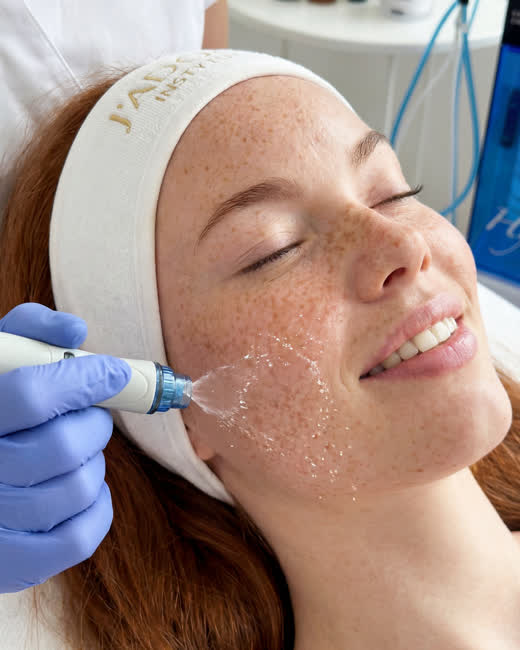
- HydraFacial — exfoliation, extraction and hydration in one. It resets skin at the epidermal level — no irritation, zero downtime, with an immediate effect visible for many clients.
- Facial massage with professional masks — drainage, improved microcirculation, deep hydration. This resets not just the skin, but facial muscle tension too.
In summary — fewer products, more strategy
Skin fasting as a trend has exposed a real problem: too many products, layers, steps and active ingredients, which can ironically make skin worse. That's a fair observation.
But the solution isn't giving everything up. It's choosing a smart minimum that actually works. Three products. A professional treatment once a month. And nothing more — unless your skin specifically needs it.
If you're not sure where to start — a cosmetology consultation is an hour devoted entirely to your skin. We assess its condition, identify problems (including those caused by product overload), and put together a routine that makes sense. Sometimes the outcome of a consultation is cutting a few steps from your routine. That's often the best recommendation we can give.