Skin is a fortress — and that's its greatest strength
To understand why a serum "doesn't work", you first need to understand what the skin barrier actually is. It isn't a metaphor. It's a physical, biochemical structure shaped by millions of years of evolution, making skin one of the most impermeable organs in the body. Its main protective layer — the epidermis, specifically its outermost part called the stratum corneum — has a structure dermatologists describe as "bricks and mortar".
- "Bricks" — corneocytes. Dead, flattened epidermal cells packed tightly into multiple layers. A single "brick" is dehydrated, hard and has no nucleus — a deliberate strategy: a dead cell needs no resources, yet it forms an excellent physical barrier.
- "Mortar" — intercellular lipids. Ceramides, cholesterol and free fatty acids form a tightly packed matrix filling the spaces between cells. This isn't random fat — it's a precisely organised mixture, and its exact proportions are critical to how well the whole structure holds together.
- The hydrolipidic film — the surface "varnish". A thin layer of sweat, sebum and shed lipids sits on the very outside of the skin. It buffers pH and forms the first line of mechanical defence. Overly aggressive cleansing strips it away entirely, leaving the skin temporarily "exposed".
- The skin microbiome — "guards on the outside". Billions of bacteria, fungi and viruses live on the skin's surface, forming an ecosystem that actively blocks pathogens and supports immunity. Antibacterial soaps and alcohol-based toners don't distinguish "good" from "bad" — they wipe out everything.
Three routes in — and why they're all narrow
To do anything at all, an active ingredient in a serum has to physically get past the barrier and reach the living cells of the dermis or the deeper layers of the epidermis. In theory, it has three routes available — but none of them is a motorway.
Transepidermal route
through the lipid "mortar"
- The most important route for cosmetics
- Only possible for small, lipophilic molecules
- Blocked by ceramides and cholesterol
- High lipid density alone is enough to bounce an ingredient off the barrier
Appendageal route
via hair follicles and glands
- Follicle and sebaceous gland openings
- Bypasses the stratum corneum — entry through a "side door"
- Limited to skin areas with a dense follicle network
- Accounts for only ~0.1% of the skin's surface
Transcellular route
straight through corneocytes
- Directly through the "bricks" — the horny cells
- Requires crossing cell membranes and cytoplasm
- Energy-costly and slow
- In practice, marginal for cosmetic active ingredients
What does this mean in practice? An active ingredient's molecule has to be small enough and "fat-loving" enough to fit between the barrier's lipids and flow through them. Classic hyaluronic acid — the same ingredient sold as a "super-hydrator" — has a molecule so large it doesn't cross the stratum corneum at all. It stays on the surface. That's not necessarily useless — surface hydration has real value — but it's a completely different mechanism from "penetrates deep and hydrates from within".
Why the ingredients list isn't enough
The cosmetics industry has known about the penetration problem for decades — and, to be fair, has worked hard on solutions. The race continues: liposomes, nanosomes, microemulsions, cyclodextrin carriers, transfersomes, ethosomes. Every technology aims at the same goal — carrying the active ingredient across the barrier intact to the right target site. Results vary, and verification is difficult, since most studies come from manufacturers and aren't independently replicated.
But there's a deeper problem: even a good delivery-vehicle technology needs skin capable of receiving the ingredient. And this is a point rarely discussed. The skin barrier isn't fixed — its permeability changes depending on the skin's condition. A healthy barrier — well hydrated, correct pH, intact microbiome — is tight. A compromised barrier — dehydrated, irritated, with damaged lipids — loses its selectivity. This cuts both ways: a weakened barrier lets more active ingredients through, but also more irritants. And it reacts to inflammation faster.
And finally, a point the cosmetics industry rarely addresses directly: most active ingredients act at the level of the epidermis, not the dermis. Collagen-producing fibroblasts sit in the dermis. Epidermal stem cells sit deeper still. Melanocytes, responsible for hyperpigmentation, sit at the epidermal-dermal junction. For a cosmetic product to genuinely affect these structures, it needs to do more than cross the barrier — it needs to reach much deeper. Pharmaceutical law in most countries effectively bans cosmetics from operating at this level: a product that penetrates to living cell layers and exerts a lasting effect on them is, by definition, a medicine or a medical device — not a cosmetic.
How the barrier changes over a lifetime — and over a single day
The skin barrier isn't the same throughout life. In childhood it's thin and permeable — which is why infant skin absorbs substances much faster, and why only ingredients with proven safety are used on it. It reaches optimal integrity in youth. After forty, it starts to lose efficiency — ceramide levels drop, lipid renewal slows, and TEWL rises. This is one of the reasons behind "dry" mature skin.
But the barrier also changes over the course of a single day. In the morning, skin is set up differently than in the evening — at night, lipid regeneration, shedding and stratum corneum renewal work harder. pH is lower. Enzymatic activity is higher. This is why, for example, exfoliating acids applied in the evening have a different effectiveness than in the morning. This isn't a myth — the barrier's circadian rhythm is real and matters when planning a skincare routine.
What to do about it — and when a cosmetic simply isn't enough
Understanding the barrier and penetration isn't a reason to give up — it's a starting point for smarter choices. A sensible skincare routine should focus first on caring for the barrier itself, because a healthy barrier is a prerequisite for anything else to work.
- Don't overdo acids and peels. Exfoliation has its place — it removes dead cells and temporarily boosts ingredient penetration. But exfoliating too often or too aggressively damages the barrier's lipids and triggers chronic subclinical inflammation. A month later: reactive skin, "sensitive to everything", absorbing more irritants than active ingredients.
- Ceramides and cholesterol aren't marketing — they're building material. Products containing ceramides, cholesterol and fatty acids, in proportions close to the skin's own, genuinely replenish the "mortar" between corneocytes. This is one of the better-documented categories of ingredients in dermatology — and one of the few the skin literally builds into its own structure.
- pH matters. Gentle syndets with a pH of 4.5–5.5, or micellar water as a daily cleanser, protect the barrier far better than a classic soap bar. It's a small technical detail, but it makes a real difference.
- Product order matters. Lighter, water-based products (low pH, hydrophilic) go on before heavier, occlusive ones (lipophilic). An occlusive layer applied over a water-based one blocks evaporation and boosts penetration of the ingredients underneath — this is the "wrap effect", and you can use it deliberately.
But there's a limit where home skincare — even the best, most expensive kind — runs into a physical barrier. If the goal is to work deeper than the epidermis — stimulating fibroblasts to produce collagen, reducing pigmentation at the melanocyte level, remodelling the vascular network — these are tasks that need completely different tools. Tools that bypass the barrier, or briefly and deliberately open it.
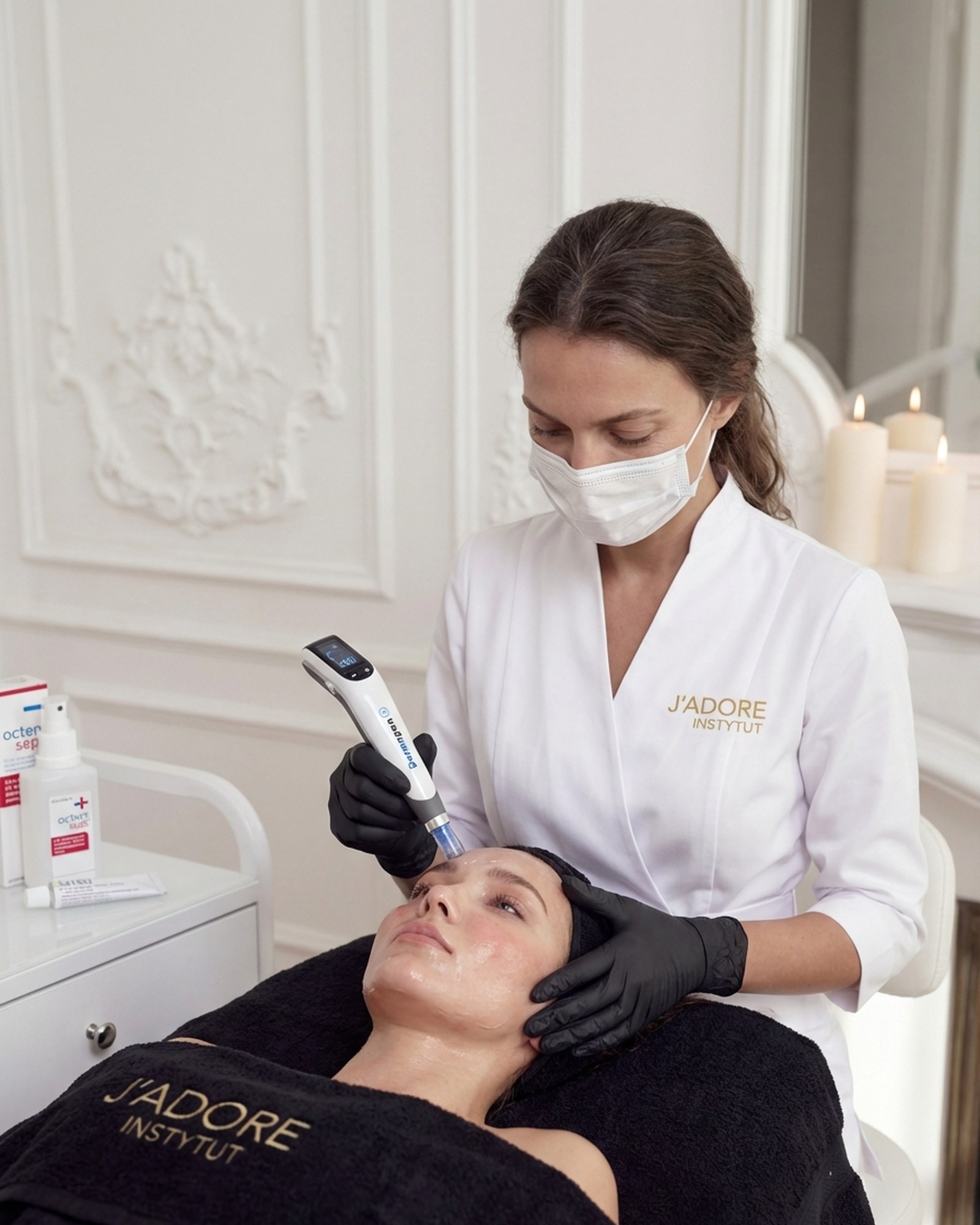
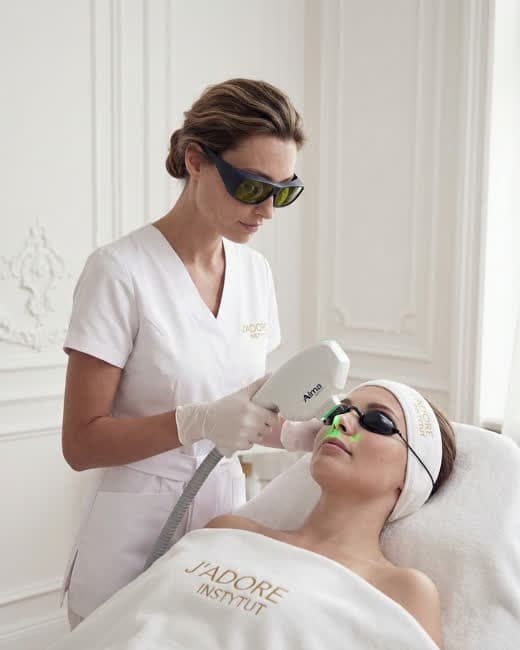
Clinic-based treatments aren't a "stronger version of a cream" — they're a fundamentally different mechanism for delivering active ingredients or stimulating the skin to work. A needle reaches places a cream never will. A laser triggers a biological response at a level no cosmetic can achieve from the outside. That doesn't devalue skincare — a cream has real value on its own level — but it's a different level. Different tools in the same toolbox: one for a nail, another for a screw.
Barrier regeneration and repair
The foundation before any next step — for skin that's reactive, dry or "tired" from over-treatment.
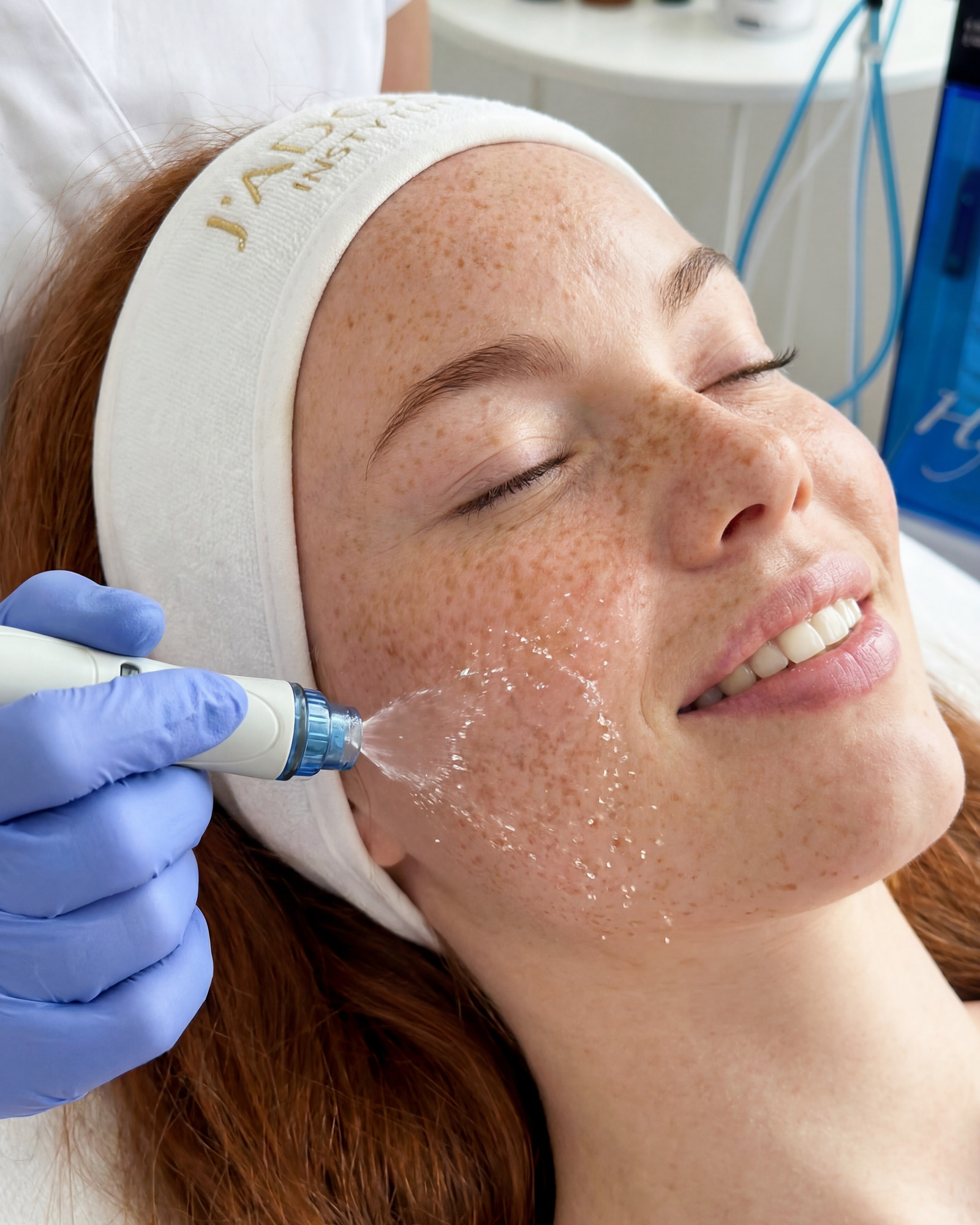
Deep hydration and skin quality
For when home skincare can't keep up with a hydration deficit in the deeper layers of the skin.
Working at a level a cream can't reach
Stimulating the skin to produce its own collagen, elastin and growth factors — from within.