
Cuticles and nails — what actually goes wrong, and why
The cuticle is a thin layer of skin that sits against the base of the nail. Its job is to seal the area — it protects new nail cells from bacteria and mechanical damage. When it's dry or neglected, it starts to lift, crack and peel. That's when the reflex kicks in: you tear it, you bite it — and you create a wound. The wound hurts, becomes inflamed, and the cycle closes in on itself.
The nail plate is also built in layers. If it's dehydrated, lacking key nutrients (zinc, biotin, iron), or exposed to detergents without gloves, it starts to split and break. Add manual work or sport into the mix, and you have a recipe for chronic problems. This isn't about "weak nails" — it's about specific deficiencies and a lack of regular care.
How a men's manicure differs from a women's manicure
In short: the goal and the approach. A women's manicure very often ends with polish, styling, or gel. A men's manicure focuses on care for the nail and the surrounding skin — no colour, nothing artificial, nothing anyone would notice. You leave with hands that simply look good and cause no trouble.
Women's manicure
common elements
- nail styling and polish
- extensions (gel, acrylic)
- nail art and patterns
- longer nails as a result
Men's manicure
what's done for men
- cuticle work and removal of excess skin
- shaping and evening out the nail
- nail buffing (matte or light sheen)
- hydration of the hands and nails
There's no polish, no visual effect that would give away where you've been. The only thing a professional men's manicure leaves behind is hands that simply look well cared for — like tidy clothes or a neat haircut. No one will know where it came from.
What exactly happens during the treatment
No magic, no unnecessary rituals. It's a task-focused process:
- 01
Soaking and softening
Your hands go into warm water with a cuticle-softening solution. It's the only part that might feel relaxing — and that's about as far as the relaxation goes. The rest is work.
- 02
Cuticle work
A manicure tool or a fine drill gently removes excess cuticle. There's no cutting into live skin — only dead, flaking tissue comes off, never living skin. The result: cuticles stop lifting and tearing.
- 03
Shaping and evening the nail
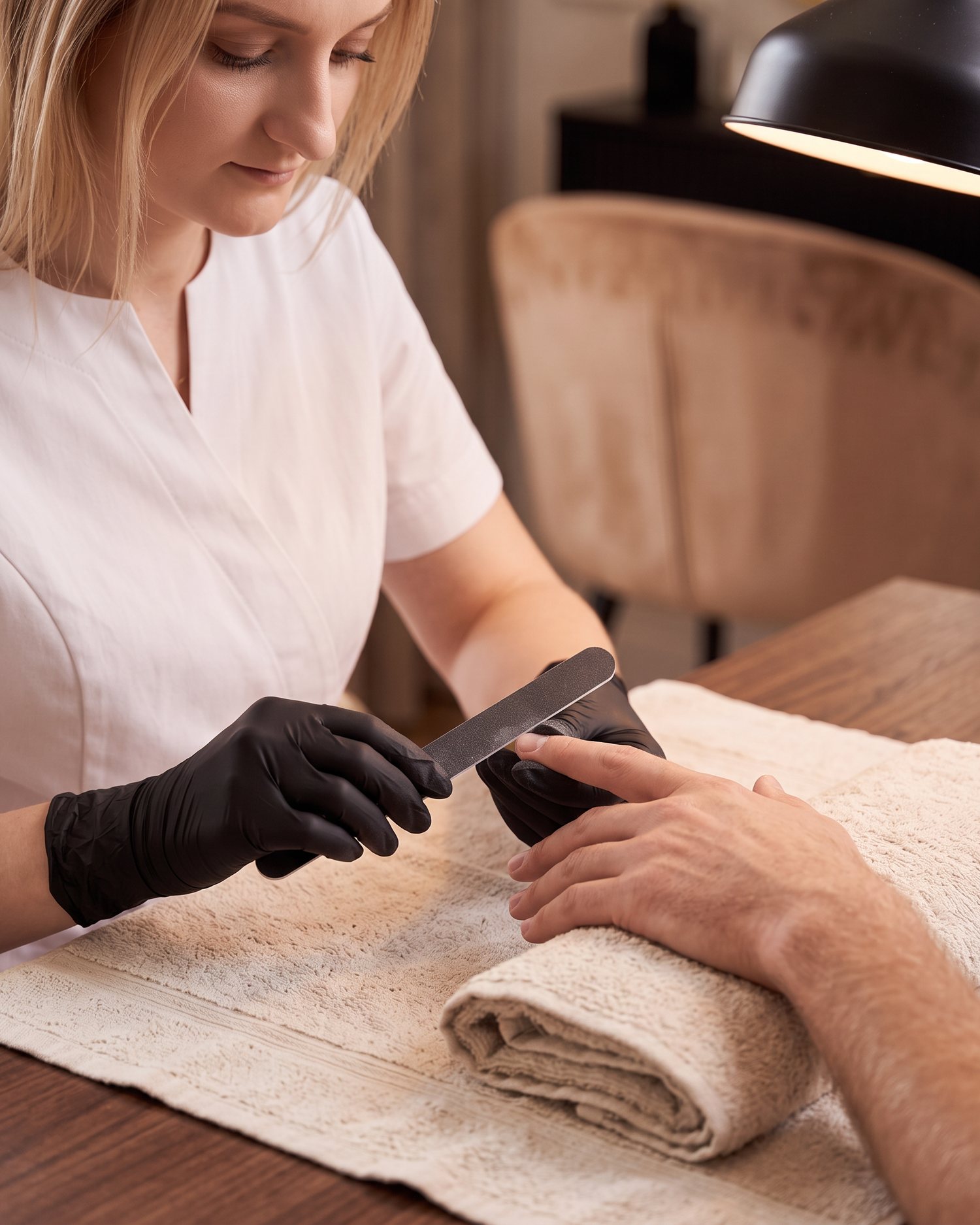
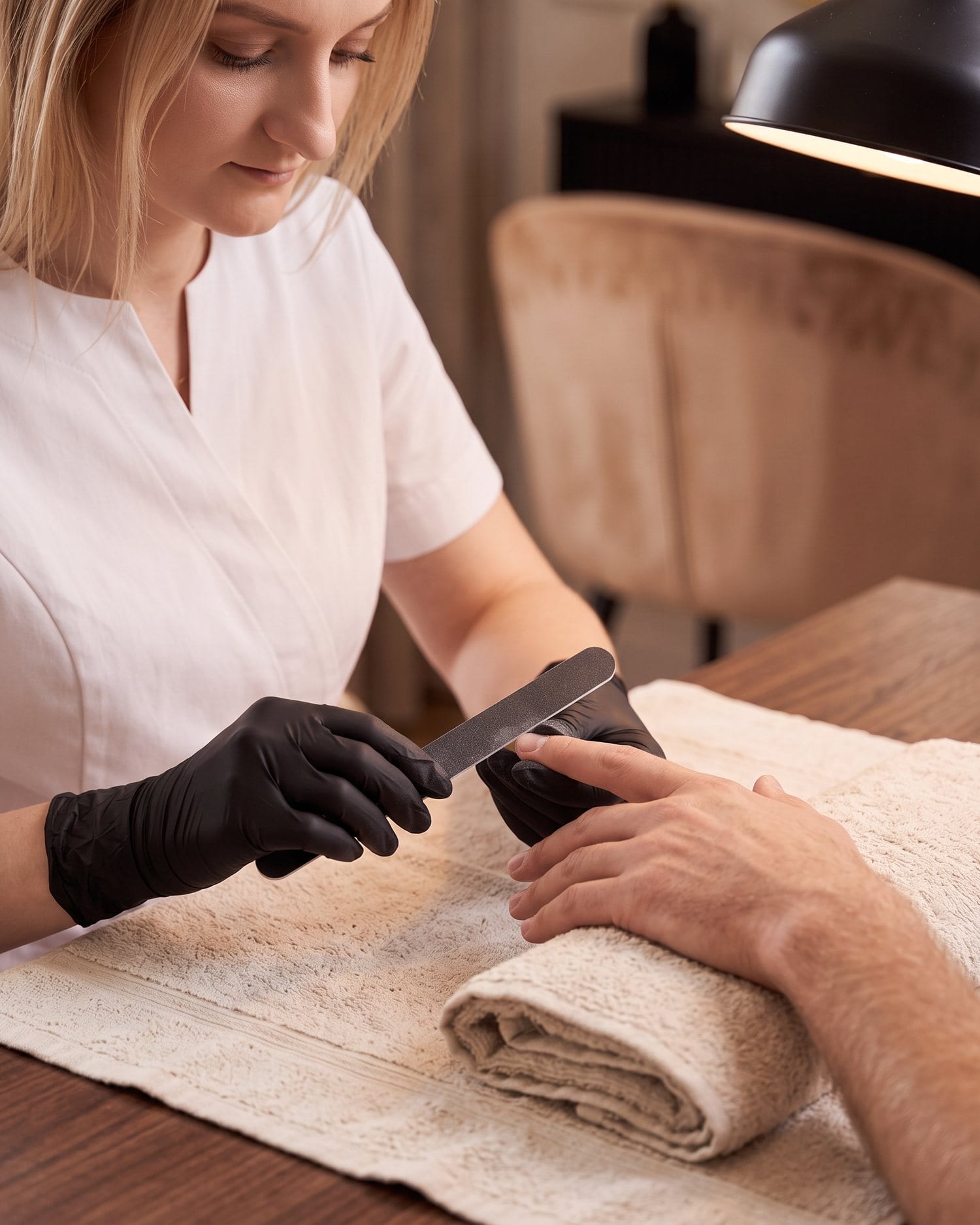
A file corrects the edges — smoothing sharp corners and evening out uneven breaks. The shape stays natural: short, straight or slightly rounded, with no styling involved.
- 04
Buffing
A multi-sided buffer smooths the nail surface. The result is a natural, matte or slightly silky sheen — no polish, no gel, nothing applied. The nail is simply even and clean.
- 05
Hydration
Hand cream or cuticle oil is massaged into the skin around the nails. This closes the process: hydrated skin doesn't dry out, doesn't lift, and doesn't tempt you to bite.
Is buffing alone enough, or do you need a combined manicure?
It depends where your hands are starting from. If your cuticles are only slightly dry and the nail plate is in reasonably good condition, buffing with hydration alone can make a noticeable difference. If your cuticles are badly bitten, if there's inflammation around the nails, or if breaking is chronic, full treatment is needed.
With regular visits, a lighter version is usually enough, because the problem never has time to return to square one. It's like teeth: a check-up every six months takes less work than repairing three years of neglect. Regularity keeps the scope of each visit smaller.
What to do between visits — the minimum that works
You don't need a ten-step care routine. A few things genuinely reduce the problem and take almost no effort:
- Cuticle oil. Rub a single drop into your cuticles in the evening — or whenever you notice them lifting. Softened skin doesn't invite tearing and doesn't hurt. This one habit is the single most useful thing you can do.
- A file in your pocket. If you break a nail, smooth it out straight away instead of biting or tearing it off. A torn nail with a jagged edge keeps breaking further and often pulls the cuticle with it. A file is a tool, not a cosmetic.
- Gloves around detergents. Washing dishes, cleaning products, contact with petrol or oils — all of it damages the skin's lipid barrier and weakens the nail plate. Rubber gloves stop most of the problem at the source.
- Don't bite — interrupt the habit consciously. Every bite is a micro-wound that hardens into rougher skin. If it's a stress habit, replace it with something else (a pen, an elastic band on your wrist) — or at least trim the nail before you're tempted to bite it.
Who comes in — and why, really
The men who come for a manicure at J'ADORE aren't usually "metrosexuals" chasing an aesthetic experience. They're surgeons, musicians, IT specialists, managers, athletes — people who either need well-kept hands for their profession, or who are simply tired of a specific problem that isn't going away on its own.
Manicure + hand care
For very dry hands — cuticle work combined with intensive hand hydration. Often chosen after winter or physical work, when the skin is hard and cracked.
Regular manicure — every 3–4 weeks
Maintaining results with almost no effort on your part. Between visits, cuticle oil and a file are enough — the specialist handles the rest. Most men settle into this exact cycle after their first visit.
There's no ideology here, no "getting used to" grooming. This is a specific service solving a specific problem — just like fixing a shoe or servicing a car. You do it because the result is worth the time and money. That's it.