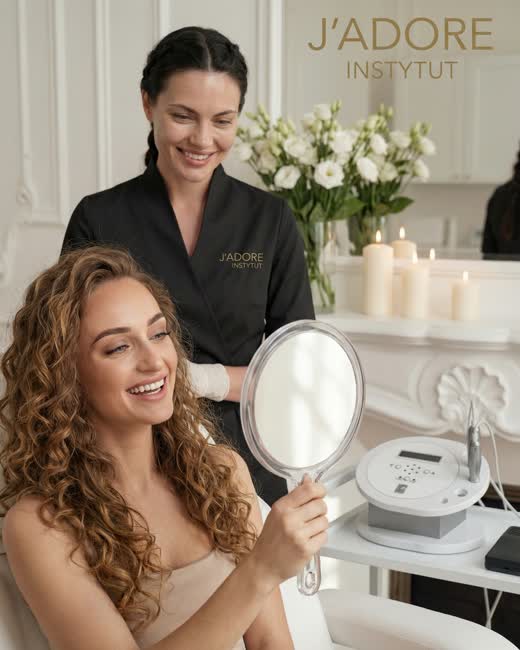
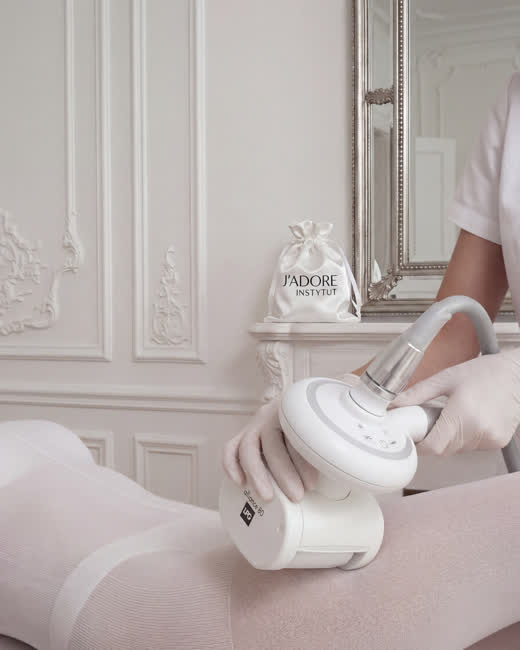
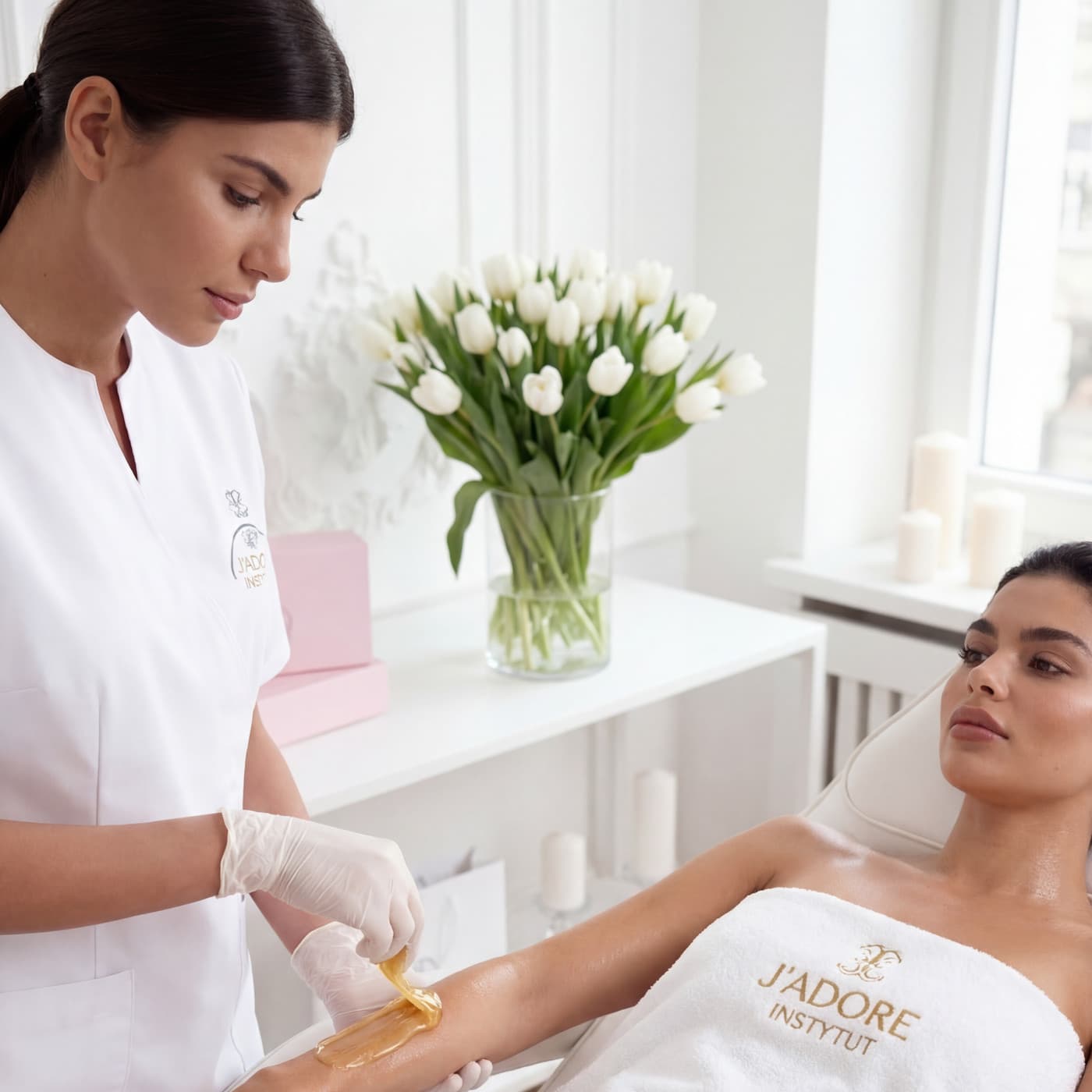
A treatment room at J'adore
HAIR REMOVAL
Daily shaving, waxing every few weeks, ingrown hairs and irritation — classic hair removal is a battle that never ends, because it removes the hair, not what creates it. Laser hair removal works differently: a beam of light targets the hair's pigment and calms the hair follicle responsible for its growth.
This is not temporary smoothness, but permanent hair reduction built session by session. At J'adore Instytut we work with the Soprano ICE Platinum (Alma) diode laser using 3-beam technology — combining three wavelengths with head cooling, thanks to which the treatment is almost painless. The treatment is performed by an experienced cosmetologist. Below you will find everything worth knowing before your first session.
series of 6–8 sessions at intervals (depending on the area)
How it works
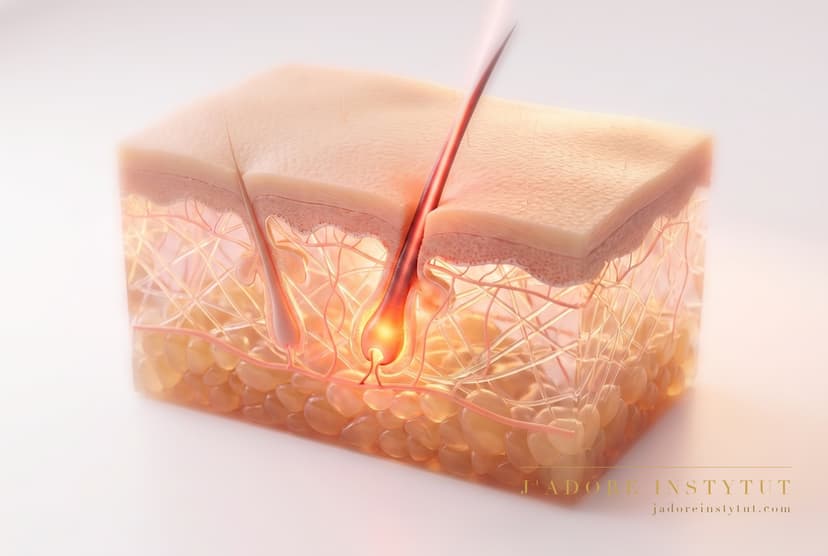
Laser hair removal is based on a simple principle: laser light is absorbed by melanin — the pigment that gives hair its colour. The energy converts into heat and travels down the hair to the hair follicle, the "factory" the hair grows from. Once heated, the follicle stops producing hair. The surrounding skin, which contains far less melanin, remains unaffected.
We use the Soprano ICE Platinum diode laser with 3-beam technology — it emits three wavelengths simultaneously (755 + 810 + 1064 nm). Each wavelength works at a different depth and on a different hair type, which is why this laser performs well on every skin phototype (I–VI), including dark and tanned skin — a limitation of older alexandrite lasers.
The second pillar is SHR mode (Super Hair Removal): instead of a single strong pulse, the laser gradually warms the follicle with a series of gentle pulses, moving the tip continuously (in-motion). This heats the target effectively without overheating the epidermis — hence the treatment's comfort and safety.
Important, and honest: the laser delivers permanent hair reduction, realistically around 80–90% after a full series — not "100% forever after one treatment." A few finer, lighter hairs may still appear; we maintain results with maintenance sessions once or twice a year.
Ideal for
The laser works best on dark hair on lighter skin, because the hair's pigment is the target. Hair that is grey, white or very light (blond, red) contains too little melanin for the laser to "see" — in these cases, electrolysis tends to be more effective. We always confirm the right method during your consultation.
Female and male areas
Laser hair removal for women most often means smooth legs, a clean bikini line, irritation-free underarms and a gentle approach to the face. Hair can be finer than men's, but the areas vary widely — from large surfaces (legs) to precise spots (upper lip). For some women, facial or neck hair has a hormonal basis — in these cases, laser helps aesthetically, while the underlying cause is worth discussing with a dermatologist or endocrinologist.
What we work with
Laser hair removal for men is primarily about large, densely haired areas and shaping. Male hair is usually thicker and darker — which means more melanin and often a better response to laser than fine downy hair. The most common area is the back, which is difficult to care for on your own, as well as ingrown hairs after shaving the beard.
What we work with
Fun fact: the laser "sees" hair by its pigment, not its thickness. That's why it doesn't work on grey, white or very light hair — these contain almost no melanin, so there's nothing to heat. This isn't a flaw of any particular device — it's simply the physics of how light works, and the reason why, after the age of 35–40, when hair starts turning grey, we turn to electrolysis for stubborn individual hairs.
Why Soprano ICE Platinum specifically
Laser hair removal has a reputation for feeling like "an elastic band snapping against your skin." That's a memory from older lasers (IPL, alexandrite), which worked with a short, powerful pulse. Soprano ICE Platinum works completely differently.
A fresh tan (from sun, sunbeds or self-tanner) means extra melanin in the skin — not just in the hair. Using a laser on such skin without assessing skin phototype or adjusting parameters risks burns or discolouration. A salon that doesn't ask about tanning, doesn't do a patch test, and promises "100% smoothness after one treatment" is a warning sign. You have every right to ask what device they use and how they adjust parameters to your skin.
Contraindications
Some contraindications are permanent, others temporary — in the latter case, we simply postpone the treatment until the situation passes. We'll go through the full list individually at your consultation.
This isn't an exhaustive list — we'll discuss your medications, skin conditions and previous treatments during your consultation, and carry out a patch test before starting the series.
The visit
The key thing to understand: laser hair removal is a series, not a single treatment. Hair grows in cycles, and the laser can only effectively destroy a follicle during the growth phase (anagen) — and at any given moment, only some of your hair is in that phase. That's why sessions are repeated at intervals, "catching" another portion of hair each time.

Consultation + patch test
skin phototype and hair colour assessment, ruling out contraindications, patch test and parameter selection

Session 1–2
the biggest, most visible hair loss; hair starts shedding within 1–3 weeks

Session 3–5
growing permanent density reduction; regrowth becomes finer and sparser

Session 6–8
final result of around 80–90% reduction; only a few fine hairs remain

Maintenance
1–2 sessions a year to maintain smoothness and "catch" any regrowing hairs
Intervals between sessions depend on the area — faster-growing regions (underarms, bikini, face) usually every few weeks, slower ones (legs, arms) less often. The exact schedule is set by the cosmetologist; a single visit — from a few minutes (upper lip) to several dozen (legs, back) — takes place without any interruption to daily life, that is, with no downtime.
From the cosmetologist's chair
The most common disappointment we hear: "I went once and the hair grew back — laser doesn't work." True — it grew back, because a single session only "caught" the hair that happened to be in the growth phase. The rest will enter that phase later, which is why we book a series. The second pitfall: someone waxes a week before a session. In that case, there's no hair in the follicle for the laser to conduct heat through — the session goes to waste. Between sessions, shaving only.
Portfolio
A record of the work in our salons — the place where we publish treatment frames and, after photo sessions, results.


A record of results — in preparation. We publish photographs of our clients only with their consent.
Laser hair removal and your lifestyle
The treatment doesn't take you out of daily life — you return to your routine straight away. But for the first few days, the area is slightly "warmed" and more sensitive, so it's worth pausing a few things briefly to avoid irritation and protect your results.
This is the most important rule. Fresh tanning means more melanin in the skin, and a risk of burns or discolouration. We protect the treated area with SPF 50+, and hold off on sunbeds and self-tanner.
High temperatures worsen redness in freshly treated skin. It's best to wait 1–2 days before sauna, hammam or a very hot bath.
Chlorinated water can irritate warmed skin. Wait 1–2 days before using a pool or jacuzzi, until any redness has faded.
After underarm hair removal, skip antiperspirant and alcohol-based products for 24 hours — they cause irritation. You can return to your usual routine the next day.
Intense sweating and clothing rubbing against freshly treated skin can encourage irritation. Skip strenuous exercise for 24 hours; walking and light activity are fine.
Shaving is allowed between sessions (the follicle stays intact). Waxing, plucking or using an epilator is not allowed — this removes the hair from the follicle and weakens the next session. On the day of treatment, the area should be shaved.
Laser hair removal
Every method has its place — for a different purpose and at a different stage. The fairest way to compare them is directly, without claiming any single one "wins" every time:
permanent reduction at the source
doesn't work on grey/light hair; doesn't work "instantly" — needs a series and patience
temporary smoothness, immediate
a temporary effect — hair always grows back; repeated every few weeks; can promote ingrown hairs
fastest, at home
effect lasts 1–3 days; irritation, "goosebumps", ingrown hairs, an endless daily ritual

Combine with
Laser works well alongside other methods and skincare. The logic stays constant; the details are set by your cosmetologist during your consultation:
A simple rule: if you want to significantly reduce hair once and for all and have dark hair — choose laser. If you want smoothness for a specific occasion, or have light/grey hair — choose wax or sugaring. And shaving? Perfect between laser sessions — it's the only method that doesn't pull the hair from the follicle.
Technology and supporting products
Results are determined by the laser technology and how the series is managed — while comfort and outcome are completed by home care between sessions. Here's what really works in your favour:
A diode laser emitting three wavelengths simultaneously (755/810/1064 nm) in SHR mode. Three wavelengths mean effectiveness across different hair types and every skin phototype.
Dla kogoAll areas, phototypes I–VI, including dark skin and (after assessment) lightly tanned skin.
A tip cooled to −4°C protects the epidermis and removes most of the pain sensation — hence the description "warm and cool" rather than an "elastic band snap".
Dla kogoSensitive areas (bikini, face, underarms) and people with low pain tolerance.
A barrier against UV radiation — essential, since freshly treated skin is more sensitive to sun, and tanning interrupts the series.
Dla kogoAny area exposed to sun: face, arms, legs, neck.
Gentle exfoliation (AHA/BHA, enzymes) clears the follicles, helps hair shed after laser treatment, and prevents ingrown hairs.
Dla kogoBikini, neck, beard area (men) and anywhere hair has tended to become ingrown.
Soothes and hydrates the skin right after a session, reducing any redness.
Dla kogoThe first 24 hours after treatment, especially larger areas (legs, back).
Fact: Where do the differences between devices on the market come from? Older lasers (IPL, alexandrite) work with a single wavelength and a short, strong pulse — hence the pain and the limitations on dark or tanned skin. Soprano ICE Platinum combines three wavelengths + SHR mode + cooling, making it comfortable and versatile for all skin types. This is technology, not magic — the result still depends on a well-managed series and the cosmetologist's skill, not the device name alone.
Price list
Checking free hours…
From the magazine
Editorial pieces on how this treatment works in practice — what happens during the session, how to prepare, where the limits are and what the first days after look like.
See also
The result lastspermanent reduction after the series + maintenance sessions 1–2× a yearJ’adore Instytut
Information. Laser hair removal is a beauty and personal-care treatment (hair removal); it is not a medical treatment and does not replace a dermatological consultation for skin conditions or hormonal disorders. The text above is for informational purposes only and does not constitute medical advice. Indications, method selection and contraindications are determined by an experienced cosmetologist during an individual consultation.
Home care
Cosmetics matched to what your skin needs after a treatment — so the clinic effect lasts longer.
 soothing body skinDiego Dalla PalmaSENSITIVE Lipid-Balancing Body Cream 350 mlView in the shop(opens in a new tab)
 body sun protectionSkeyndorBody protective b-phase SPF 50 – Age Photo DefenseView in the shop(opens in a new tab)
 soothing body skinestGenLive Balancing BalmView in the shop(opens in a new tab)
 body sun protectionCell Fusion CAquatica Sun Spray SPF50+ PA++++View in the shop(opens in a new tab)
 soothing body skinPeel MissionAsiatic Face and Body Mist 150 mlView in the shop(opens in a new tab)
 soothing body skinDiego Dalla PalmaSENSITIVE Delicate Cleansing Oil for Body 350 mlView in the shop(opens in a new tab)
 soothing body skinestGenLipid ReconstructionView in the shop(opens in a new tab)
 body sun protectionSelvert ThermalSUN CARE SPORT MIST SPF50 SPRAY 200MLView in the shop(opens in a new tab)