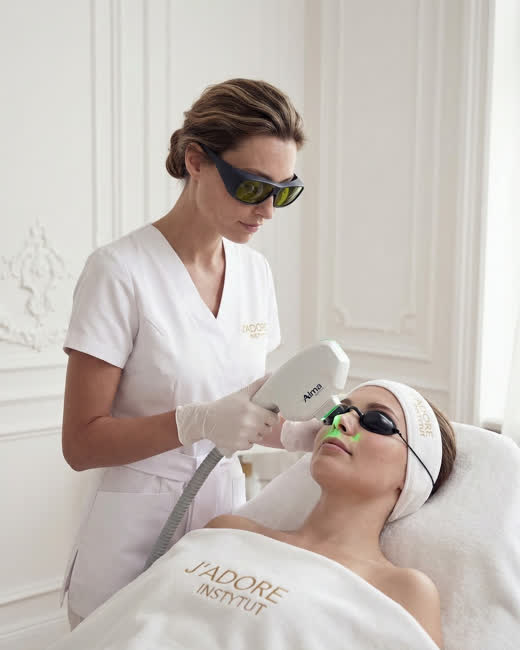
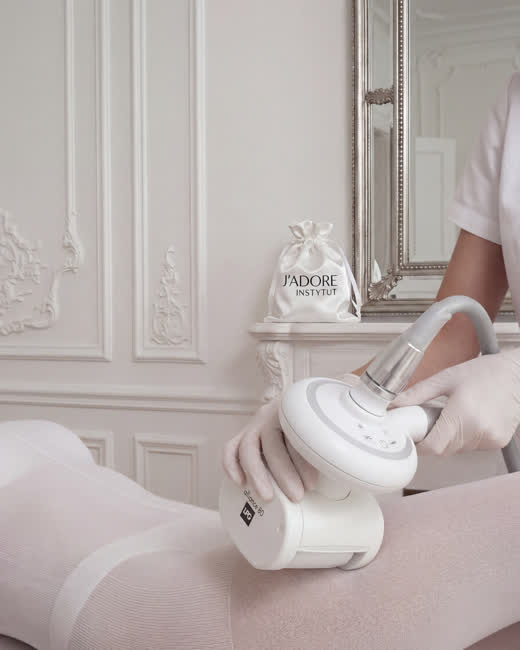
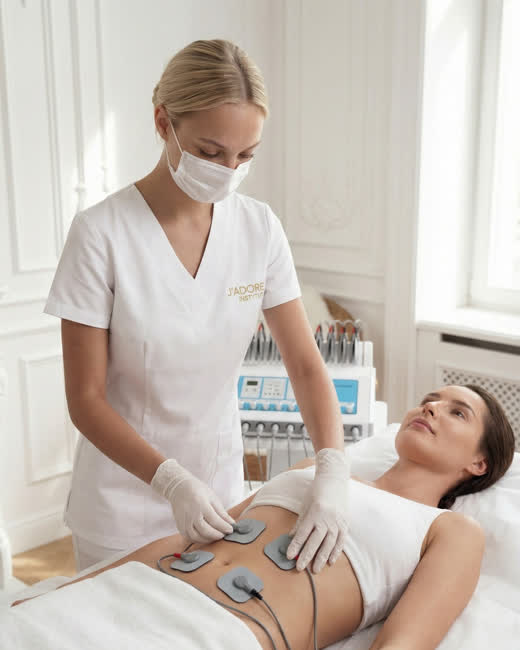
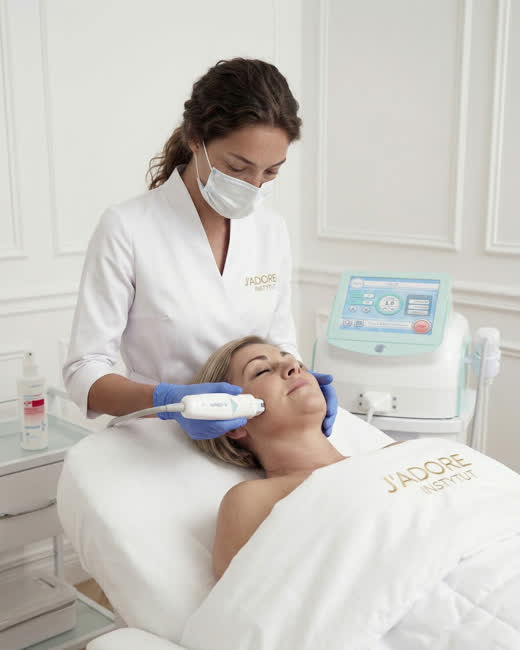
A treatment room at J'adore
LASER THERAPY / HIGH-TECH / REMOVAL
Sun spots on the cheeks and temples, freckles, and "scattered" hyperpigmentation on the hands and décolletage are the marks left by summer and years without SPF. Melanin pigment deposits unevenly, and the skin loses its uniform, rested appearance.
Removing hyperpigmentation with light does not bleach the entire face — it works selectively: the energy is absorbed by melanin clusters and breaks them down, sparing the surrounding skin. The discolouration first darkens, then flakes off and fades. At J'adore Instytut, the treatment is performed by a doctor or an experienced cosmetologist. Below you will find everything worth knowing before your first visit — including the most important caveat: not every "spot" is the same, and melasma follows different rules.
a series of several sessions every few weeks
How it works
The colour of hyperpigmentation is caused by melanin — a pigment that the skin produces, among other things, in response to the sun. In healthy, uniform skin, it is distributed evenly. In hyperpigmentation, it gathers into clusters that the eye perceives as a spot.
Light-based treatments work on the principle of selective energy absorption by melanin. The beam is selected to "target" the pigment, not the surrounding skin — the energy heats and breaks down the melanin clusters, sparing healthy tissue. This is why, after a well-performed treatment, the spot fades while the rest of the complexion remains untouched.
Something surprising happens after the treatment: the hyperpigmentation first darkens. The broken-down pigment "rises" to the surface and flakes off with the epidermis over several days. This is an expected stage, not a worsening — it is crucial not to scratch the scabs and not to expose the skin to the sun during this time.
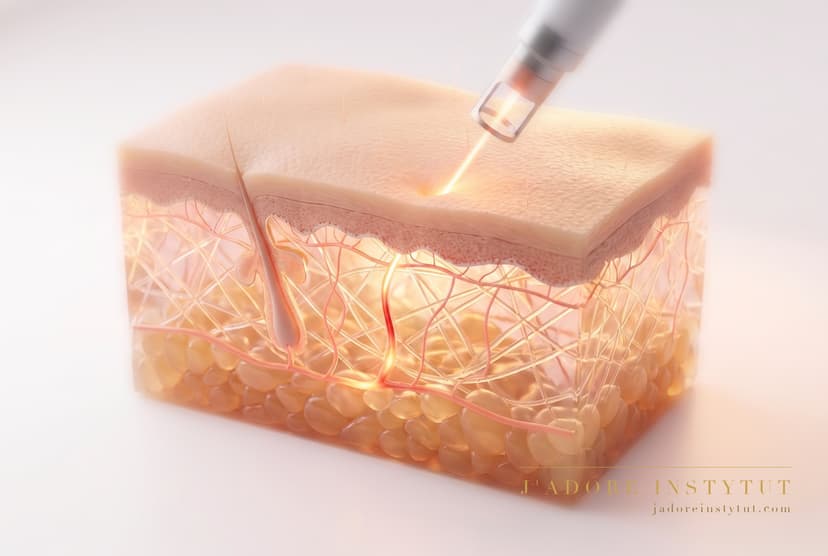
An important distinction: some hyperpigmentation lies shallowly (sun spots, freckles, lentigo) and responds well to light, while some is deeper or hormonal (melasma) — here, light alone may be ineffective and sometimes even makes things worse. This is why there is no single "machine for everything" and a consultation is mandatory.
Ideal for
…have light or medium skin tone, non-tanned skin, realistic expectations ("lightening and evening out", not "bleaching to white") and are ready for a series of treatments and daily SPF 50+ filter. Without sun protection, the hyperpigmentation will simply return — this is not a flaw of the treatment, but biology.
Women's zone and men's zone
For women, hyperpigmentation is one of the most common reasons for visits and at the same time the most nuanced topic, because a hormonal factor is involved. This is classic hyperpigmentation removal for women.
What we work with
For men, hyperpigmentation is most often the result of years without a filter — working in the sun, outdoor sports, lack of a skin protection habit. The skin is thicker, and spots can be extensive. This is hyperpigmentation removal for men.
What we work with
Interesting fact: the same light that breaks down a pigment spot, in a different configuration, "closes" small capillaries and brightens redness because it acts on a specific pigment (melanin or haemoglobin). That is why treatments for hyperpigmentation and capillaries are often performed with the same device, just with different settings.
Contraindications
Some contraindications are permanent, while others are temporary — in such cases, we simply reschedule the treatment until the situation passes. With light treatments, we are particularly careful about sun exposure and medication.
We do not remove moles or lesions of unclear character "for beauty". If someone suggests "lasing a mole" without prior dermatological assessment — this is a serious warning sign. Suspicious changes are assessed and qualified by a doctor, sometimes with a histopathological examination. Safety is more important than a quick result.
This is not a full list — we will go through your medications, illnesses, skin tone and previous treatments individually during the consultation, including a patch test before the series.
What to expect
Most importantly: the hyperpigmentation will first darken, it will not disappear overnight. This is not a mistake — this is exactly what a working treatment looks like. The broken-down pigment migrates to the surface and exfoliates along with the epidermis over several to a dozen days.
The most common message after two days: "the spot is DARKER, did something go wrong?". No — this is exactly what was supposed to happen. The pigment has "come to the surface" and will come off in a few days with the exfoliating epidermis. Please do not scratch it and keep up with your SPF — that is when the result is most beautiful.
The result is permanent for a specific, removed spot — but only as long as you protect your skin. Sun exposure without a filter will create new hyperpigmentation. This is why daily SPF 50+ all year round is not an extra, but a condition for maintaining the result.
Portfolio
A record of the work in our salons — the place where we publish treatment frames and, after photo sessions, results.
A record of results — in preparation. We publish photographs of our clients only with their consent.
The treatment and your lifestyle
Regarding hyperpigmentation, most questions concern the sun, holidays and when to actually have the treatment. There is one rule: your skin must be untanned before the treatment and protected after it — a tan means "too much pigment everywhere" for the light, and a real risk of burns and new spots.
Do not tan before the series and for a few weeks after it. The best season is autumn and winter. A fresh tan or self-tanner = we postpone the treatment.
This is a condition for maintaining the result, not an option. SPF 50+ every single day — even in winter and on cloudy days. Without this, hyperpigmentation returns.
Going to the seaside or the mountains in summer? Plan your treatments so they do not clash with tanning — mention your dates during the consultation.
High temperatures intensify redness and swelling immediately after the treatment. Sauna, hammam, hot baths — only after 1–2 days.
When the hyperpigmentation darkens and begins to come off — do not pick at the exfoliating epidermis. Scratching risks post-inflammatory hyperpigmentation or scarring.
After gentle treatments, mineral make-up is usually fine from the next day, and you can return to work the same day. After a fractional laser — wait according to the instructions.
Melasma is a different story
The most important thing regarding hyperpigmentation: melasma is not the same as a sun spot. It is a chronic, often hormonal, discolouration — it appears during pregnancy ("pregnancy mask"), while using contraception, and intensifies with sun and heat. It behaves in a completely different way.
With melasma, aggressive IPL or a strong laser can worsen the situation — it can stimulate pigment cells and trigger even darker spots. If a salon promises that "one treatment will make melasma disappear" — this is a warning sign. Melasma requires a cautious, multi-month approach (cosmetic depigmentation, gentle technologies, strict sun protection), and often a dermatological consultation. It is better to start with a qualification than with a "machine".
This is why we first identify the type of hyperpigmentation during the consultation. If they are classic sun spots — we work with light. If there is a suspicion of melasma — we propose a different, safer plan rather than forcing a treatment. This is not an excuse; it is the difference between brightening the skin and making it worse.
From the cosmetologist's office
The most common misunderstanding: a client says "I want to laser these spots on my cheeks", but after an examination, it turns out to be melasma from pregnancy. If I were to simply "go over" it with strong light, the risk is that the spots will be larger and darker in a month. It is better to tell the truth and create a longer, cautious plan — it is simply better for your skin.
LASER THERAPY / HIGH-TECH / REMOVAL
Hyperpigmentation removal (DYE-VL)
These three approaches do different things and often complement each other. Which one we choose depends on the depth of the spot, your skin tone and how much time you have for regeneration:
breaks down pigment using light
less effective for deep hyperpigmentation; proceed with caution or avoid in cases of melasma and dark skin tones
targets deeper layers or renews the epidermis
fractional laser requires real downtime; it is a stronger intervention than light alone
controlled exfoliation
will not "extract" deep pigment in one step; works gradually, in a series
What to combine
Hyperpigmentation rarely appears alone — it is usually accompanied by broken capillaries, a tired complexion or poorer skin quality. This is why removing hyperpigmentation fits well into a broader plan. The specialist decides on the order and intervals during the consultation, but the logic remains consistent:
A simple rule I repeat to clients: a shallow sun spot → light or a peel; stubborn hyperpigmentation with uneven skin texture → fractional laser; suspected melasma → cautious depigmentation and SPF first, not an aggressive "machine". The best results usually come from a combination of methods spread over time, not a single "all-in-one" treatment.
How we do it
There is no single "laser for hyperpigmentation". What we use depends on the type and depth of the spot and on your skin tone. That is why we work with several technologies and choose them during the consultation — sometimes we combine them in a series.
Filtered light absorbed by melanin (and haemoglobin). It brightens sun spots and evens out skin tone, while refreshing the skin texture. Usually no downtime (redness for 1–2 days).
Dla kogoSun spots, lentigo, freckles, photorejuvenation. Light and medium skin tones; for darker ones — proceed with caution or use a different technology.
A laser that works deeper without damaging the epidermis — hence zero downtime. It works gently on delicate hyperpigmentation and simultaneously stimulates collagen.
Dla kogoMore delicate hyperpigmentation, people without time for recovery; a safer choice for darker skin tones.
A fractional laser that renews the epidermis with micro-columns. It targets stubborn hyperpigmentation while rebuilding skin texture. It requires downtime — a few days of redness and peeling.
Dla kogoStubborn hyperpigmentation combined with uneven texture, scarring or photoageing; when milder methods are insufficient.
Controlled exfoliation that brightens superficial hyperpigmentation and prepares the skin. Often part of a series or used to maintain results between light-based treatments.
Dla kogoSuperficial hyperpigmentation, maintenance of results, melasma (using a cautious, appropriate protocol).
Fact: Why the difference in price? It depends on the surface area (a single spot vs the entire face, hands and décolletage), the number of sessions in the series and the type of technology (gentle light with no downtime is a different treatment to a fractional laser with recovery time). This is why there is no single "price for hyperpigmentation" — we determine the quote and the series plan after assessing your skin during a consultation.
Price list
Checking free hours…
From the magazine
Editorial pieces on how this treatment works in practice — what happens during the session, how to prepare, where the limits are and what the first days after look like.
See also
The result lastslong-lasting, provided you protect your skin from the sunJ’adore Instytut
Health information. The text above is for information purposes only and does not constitute medical advice or a diagnosis. Hyperpigmentation can have various origins — from harmless sun spots to changes that require dermatological assessment. Any mole or spot that changes shape or colour, itches or bleeds must first be consulted with a dermatologist — we do not remove such lesions "for aesthetic reasons". A specialist will decide on the qualification for the treatment, the choice of technology and contraindications during an individual consultation.
Home care
Cosmetics matched to what your skin needs after a treatment — so the clinic effect lasts longer.
 hyperpigmentationSesdermaMANDELAC Liposomal SerumView in the shop(opens in a new tab)
 sun protectionCell Fusion CAquatica Sunscreen 100 SPF 50+/PA++++View in the shop(opens in a new tab)
 post-treatment regenerationMedMelanoSkinbiotic Elixir Probiotic Repair Serum 50 mlView in the shop(opens in a new tab)
 hyperpigmentationPeel MissionMelasma & PIH Cream 50 mlView in the shop(opens in a new tab)
 sun protectionDermaQuestSunArmor SPF50 30 mlView in the shop(opens in a new tab)
 post-treatment regenerationVagheggiEmozioni Plus — Anti-Stress Face Mask 75mlView in the shop(opens in a new tab)
 hyperpigmentationDermoMedicaTRX C Foam Cleanser 150 mlView in the shop(opens in a new tab)
 hyperpigmentationMediderma1+1 Set — FR-Antiox MD Concentrate + Mela 360 Bellis TRX Brighter SPF 50View in the shop(opens in a new tab)