 A treatment room at J'adore
LASER THERAPY / HIGH-TECH / REMOVAL
Spider veins on the cheeks and the sides of the nose, redness that cannot be concealed with foundation, small red "ruby spots" on the body or networks of dilated vessels on the legs — these are vascular changes that usually become permanent over time. Make-up only covers them, whereas the laser selectively closes the vessel itself, which the body then gradually absorbs.
The surrounding skin remains intact, and the skin tone becomes more even. The choice of technology — DYE-VL, IPL or Nd:YAG — depends on the type and location of the lesion. Below you will find everything worth knowing before your first visit.
a series of several sessions — the specialist determines the number based on the type of vessels
How it works
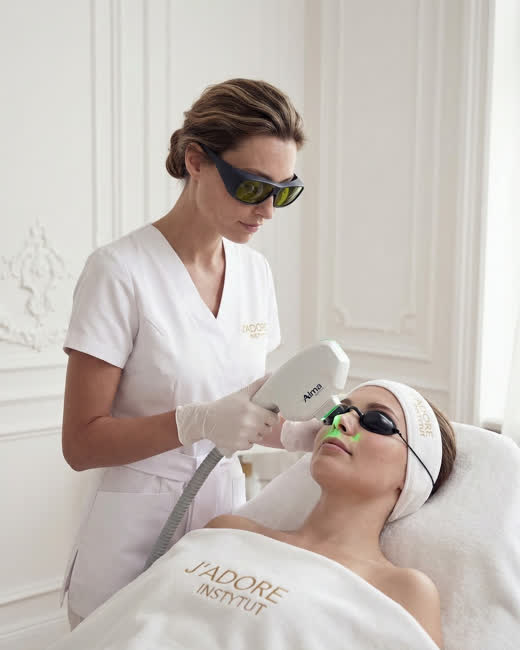
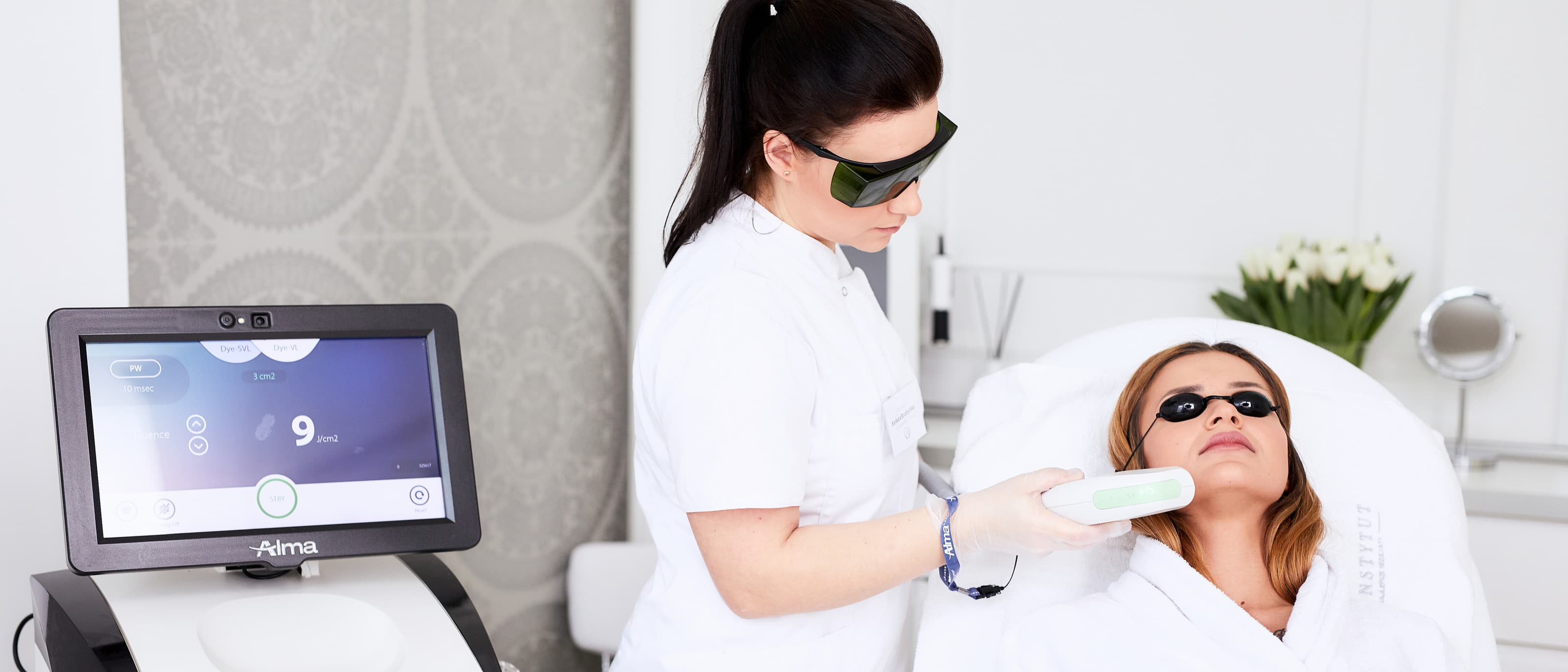
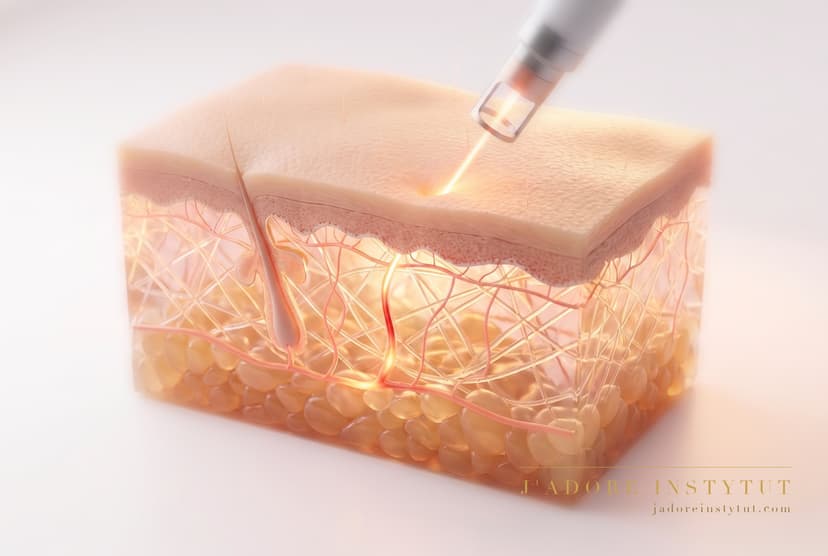
Thread veins are widened, visible small blood vessels beneath the skin. Laser and pulsed light work through selective photothermolysis: the energy is absorbed by haemoglobin inside the vessel, converts to heat, and "closes" (coagulates) it from within. The surrounding skin, which contains no haemoglobin, stays untouched — hence the precision of this treatment.
Once closed, the vessel doesn't disappear instantly — your body absorbs it gradually over several weeks. A vessel that's been successfully closed doesn't "reopen". This doesn't mean the problem is gone forever, though: with a genetic predisposition, sun exposure, temperature changes or rosacea, new thread veins can appear over time — and we treat these as needed.
It is very important to match the technology to the type and depth of the lesion. We work differently with a delicate redness on the face, differently with individual spider veins, and differently again with deeper networks on the legs. At J'adore we do not use a single handpiece "for everything" — we match it to the problem.
Ideal for
We assess every lesion individually. If the appearance, colour or behaviour of a lesion raises any doubt, we refer you for medical/dermatological assessment first — we only treat lesions of clearly vascular character with the laser.
Women's and men's zones
For women, the most common goal is evening out the skin tone of the face and décolletage and reducing spider veins that "show through" makeup. The skin can be thinner and more reactive, so parameters are selected carefully, and the décolletage area and the eye area are treated with particular gentleness. This is classic spider vein removal for women.
What we work with
Male skin is thicker, and the typical causes of broken capillaries are compounded by daily shaving and frequent UV exposure without SPF. Capillaries on the nose and cheeks appear in many men after the age of 30, and with rosacea the redness can be permanent. This is capillary removal for men — the goal: even skin tone without a "red" face and without changing your character.
What we work with
Good to know: the laser doesn't "erase" a thread vein — it just closes it. Your own body does the rest, absorbing the closed vessel over the following weeks. That's why the result keeps developing long after you leave the salon, not just during the treatment itself.
LASER THERAPY / HIGH-TECH / REMOVAL
Contraindications
Some contraindications are permanent, others are temporary — in that case, we simply postpone the treatment until the situation passes. With lasers and pulsed light, we're especially careful about sun exposure and phototype.
This is the most common warning sign. On freshly tanned skin, laser/IPL carries a real risk of burns and pigmentation — and you'll still need to avoid the sun and wear SPF 50+ afterwards. If someone offers a series "right away" despite your tan, or without asking about photosensitising medications and phototype — that's a reason to be cautious. A good salon will assess your skin first, and schedule the series outside sun season.
This isn't a complete list — we'll go through your medications, health conditions, phototype and previous treatments individually at consultation.
What to expect
Most importantly: the effect builds over time and with successive sessions. The vessel reacts during the treatment itself (it darkens and closes), but it only fades once the body absorbs it — this is a matter of weeks, not hours. That is why we usually close vessels in a series of several treatments, with the number chosen by the specialist according to the type and severity of the changes.
The most common thing I hear after the first session is: "but I can still see the vessel." That's normal — full absorption takes weeks, and some lesions need another session. We assess thread veins after the full series, not after the first visit. And to be honest: the laser is excellent at reducing redness and thread veins, but it doesn't "cure" rosacea — it improves how your skin looks, while the underlying condition still needs to be managed with skincare and by avoiding trigger factors.
After the complete series, the result is lasting — a closed vessel doesn't come back. However, because the predisposition to thread veins can be rooted in genetics and lifestyle, some people book a single top-up session once a year.
Portfolio
A record of the work in our salons — the place where we publish treatment frames and, after photo sessions, results.
A record of results — in preparation. We publish photographs of our clients only with their consent.
Thread vein removal and your lifestyle
The most common questions aren't about the treatment itself, but about what comes after: sun, sauna, exercise, alcohol, shaving. The rule is simple — for the first few days, we don't want to heat up or widen the vessels or irritate freshly treated skin, and for longer after that, we want to protect it from UV, which "creates" new thread veins.
A fresh tan rules out the treatment (risk of pigmentation and burns). SPF 50+ is mandatory afterwards — UV encourages new thread veins to form. We schedule series outside the intense sun season.
High temperatures widen the vessels and increase swelling. Skip the sauna, hammam and hot showers for the first 1–2 days.
Intense exercise significantly speeds up circulation and heats the skin. Skip training for 1–2 days after the treatment, especially for facial lesions.
Alcohol widens the vessels and increases redness — best avoided the day before and for the first 48 hours after the treatment.
Skin is sensitive, and shaving is a mechanical irritant — wait a few days in the treated area, so as not to heighten the post-treatment reaction.
Light make-up is usually fine from the next day. You're back to work the same day. Don't rub or force cover-up over areas with purpura — let them fade naturally.
Thread vein removal — Nd:YAG / DYE-VL
These methods work at different depths and don't replace each other — in fact, they often complement each other on the same face:
precise for superficial thread veins and redness
doesn't reach deep — thicker, deeply positioned vessels on the legs aren't its job
reaches deeper — to thicker vessels
can be "too much" for delicate, diffuse redness across the whole face — light-based treatment works better there
different methods for different lesions
a vascular laser doesn't remove pigmented lesions or raised growths — these are different indications
Combine with
Capillaries are often "one of several" concerns of vascular and mature skin. The order and intervals are decided by a specialist during the consultation, but the general logic is fixed: first we calm the capillaries and redness, then we work on the quality and structure of the skin.
The most common misunderstanding: someone comes in "for thread veins" and shows us a brown spot or a raised cherry angioma. That's not a job for the vascular laser. Simple rule: red, flat, "translucent" vessel → vascular laser/IPL. Brown spot → pigmentation. Raised growth → electrocoagulation. And if a lesion looks unusual — see a dermatologist first, then consider treatment.
Technologies
Behind the term "thread vein removal" lie several different technologies available at J'adore. You don't choose them "off the shelf" — the specialist selects them based on the colour, depth and location of the lesion, as well as your skin phototype. We most often use the Alma Harmony XL Pro platform (with interchangeable handpieces) and the Nd:YAG laser.
Filtered, precise light absorbed mainly by haemoglobin — targeting vascular lesions and diffuse redness selectively. Mild purpura is possible after the treatment (a desired reaction).
Dla kogoRedness, rosacea and thread veins on the face; evening skin tone.
Broader light spectrum; good for widespread, superficial telangiectasia and general improvement in skin tone. Requires careful selection for darker phototypes and tanned skin.
Dla kogoSuperficial telangiectasia, general redness, texture.
The longer wavelength reaches deeper than pulsed light — it treats thicker, deeper-lying vessels. It works on the vessel itself, without contact.
Dla kogoThread veins and webs on the legs, deeper vessels, single thicker lesions.
A non-ablative laser with zero downtime — not a primary tool for thread veins, but sometimes included in a plan to improve skin tone and quality alongside pronounced redness.
Dla kogoComplement: skin quality and even skin tone, with no downtime.
Fact: Where do the price differences come from? From the surface area and number of zones treated (a small thread vein isn't the same as diffuse redness across both cheeks, or an entire leg), from the number of sessions in the series needed for results, and from the type of technology matched to the lesion. That's why we quote prices "per zone / see price list", and we set the price of a series at consultation — with no figures given in advance.
Price list
Checking free hours…
From the magazine
Editorial pieces on how this treatment works in practice — what happens during the session, how to prepare, where the limits are and what the first days after look like.
See also
The result lastspermanent closure of the vessel (new changes can be treated separately)J’adore Instytut
Medical information. Laser removal of vascular lesions is a treatment performed using medical devices (lasers, pulsed light sources). The text above is for information purposes only and does not constitute medical advice or a diagnosis. Qualification, choice of technology and parameters, and contraindications are determined by a specialist during an individual consultation; skin changes of unclear nature require prior medical/dermatological assessment.
Home care
Cosmetics matched to what your skin needs after a treatment — so the clinic effect lasts longer.
 capillaries and rednessMedidermaRedness Control A&A Sensitive Cream 50mlView in the shop(opens in a new tab)
 sensitive skinCell Fusion CLow pH CleanserView in the shop(opens in a new tab)
 sun protectionDermaQuestSunArmor SPF50 30 mlView in the shop(opens in a new tab)
 capillaries and rednessPeel MissionAza Gel 30 gView in the shop(opens in a new tab)
 sensitive skinSesdermaSERENITY mask 50 mlView in the shop(opens in a new tab)
 sun protectionSkeyndorProtective cream SPF 50+ – Age Photo DefenseView in the shop(opens in a new tab)
 capillaries and rednessMedik8Calmwise™ SerumView in the shop(opens in a new tab)
 capillaries and rednessVagheggiEmozioni Plus Soothing Mist 100ml — Soothing concentrated mist/tonerView in the shop(opens in a new tab)