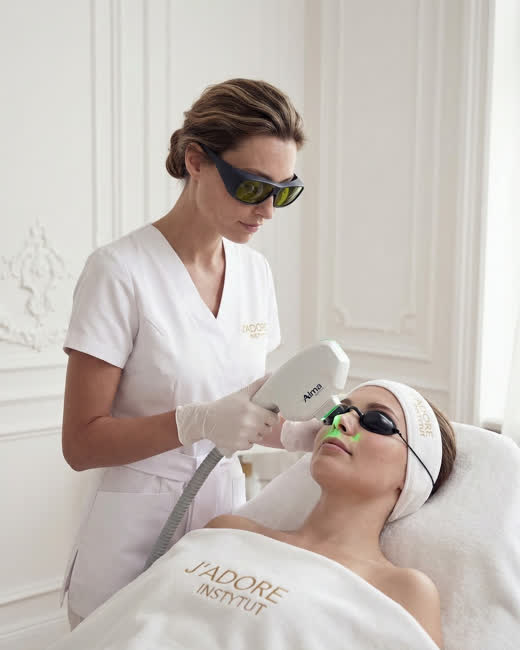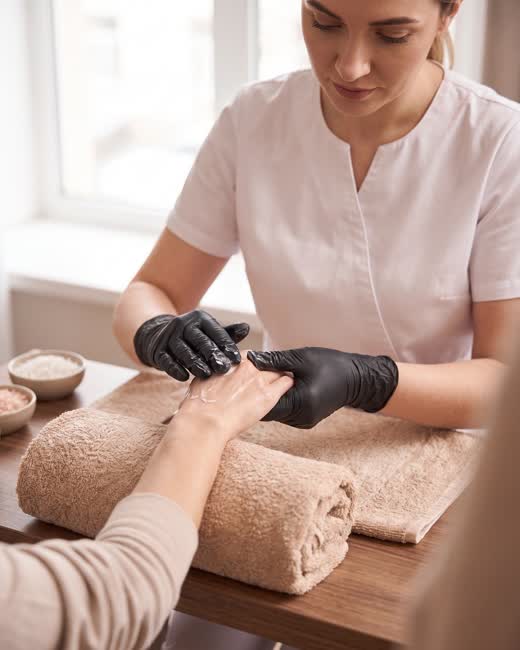
 A treatment room at J'adore
HANDS & FEET
Your feet work hard every day — shoes, walking, summer in sandals — yet they're usually last on the care list. Pedicure changes that: nail trimming and shaping, removal of hardened skin and light thickening, cuticle care, hydration and optional colour — feet come away smooth, groomed and pleasant to touch.
This is a beauty and styling service: it looks after appearance and comfort, not a medical treatment. If the problem goes beyond aesthetics — an ingrown nail, deep calluses, cracked heels — that's a job for podology, not a cosmetic pedicure. Below you'll find everything worth knowing before your visit — including when a medical variant is the better choice.
single visit; repeat every few weeks to maintain results
HANDS & FEET
Pedicure is comprehensive care for the whole foot, not just polished nails. We trim and shape the nail plate, remove hardened skin and light thickening, care for the cuticles, hydrate intensively and — if you like — apply colour. Feet come away smooth, soft and well-groomed.
This is a beauty and styling service: it improves appearance and comfort, and looks after how your feet look. It's not a medical treatment and doesn't involve any needles on the skin — we work on the surface of the skin and nail plate. When a foot needs more than cosmetic care, we refer you to podology.
How it works
The skin on the sole is the thickest epidermis on the whole body, and one of the few areas without sebaceous glands. No natural oil film forms here to slow down water loss — yet your feet work every day inside shoes, on hard ground, under constant friction. There's a mechanical factor too: in areas of repeated pressure, the stratum corneum thickens on purpose, because that's how skin defends itself against damage. Hardened skin on the heel and under the toes isn't a sign of neglect. It's a protective response — one that only gets out of hand when hydration and flexibility run low.
That's why pedicure starts with softening, not scraping. A soak or a urea-based product loosens the bonds between hardened cells, so the compacted layer can be removed evenly, without disturbing the living skin underneath. Then comes occlusion — a rich cream applied to smoothed skin traps water that would otherwise evaporate within hours. That's what determines how long the heel stays soft — not the exfoliation itself. Toenails, meanwhile, are trimmed straight across, because the plate here is thicker and grows back more slowly, and rounding the corners can push them towards the nail fold.
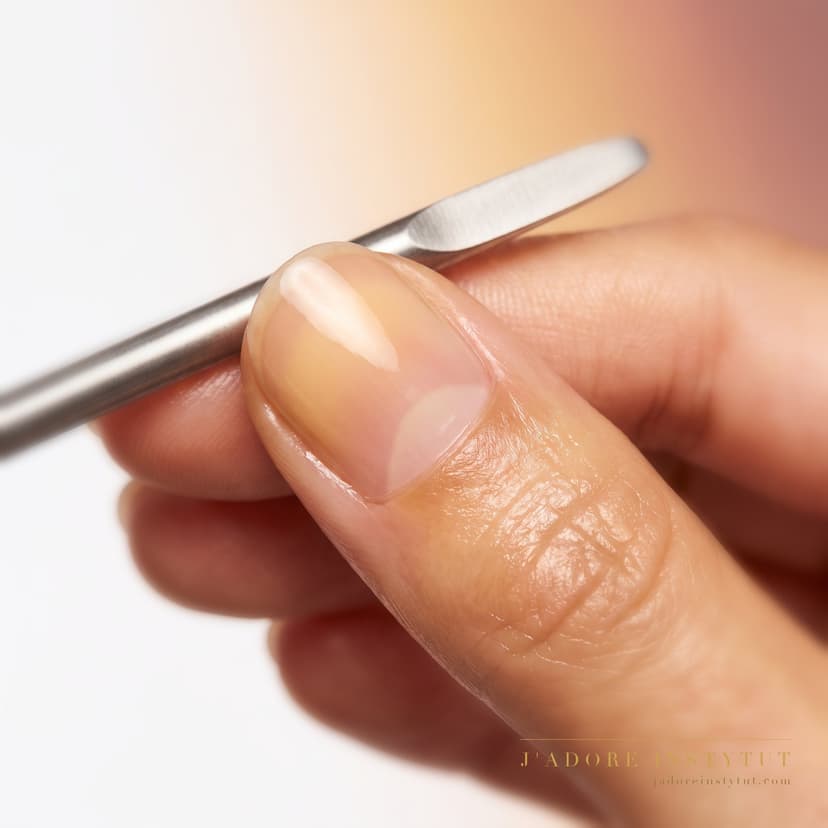
Did you know: the skin on the heel can be many times thicker than the skin on the eyelid, even though both are built from exactly the same keratin — the only difference is the number of layers. Thickness isn't down to genetics; it's down to load. Skin adds layers precisely where it takes the most daily pressure.
Ideal for
If you recognise an ingrown nail, deep calluses, painful corns or cracked heels — this is not a job for a cosmetic pedicure. Check podology.
Women's and men's needs
Pedicure for women is most often a mix of care and styling: smooth feet plus lasting, polished colour or natural shine. A popular choice before holidays, for sandal season, and as a regular ritual every few weeks.
What we work with
Pedicure for men is mainly about hygiene, comfort and a groomed look — with no colour, or with a discreet matte finish. An increasingly common choice among men who look after their feet, especially those who are active or wear closed footwear. See the men's pedicure variant for details.
What we work with
Did you know: toenails grow more slowly than fingernails — which is why hybrid polish "lasts" longer on feet before growing out and revealing the line. It's not the polish that's magic, just how fast the nail plate grows.
Safety
Cosmetic pedicure is safe and pleasant, but there are a few situations where we postpone your visit or refer you to the right specialist. Some of it is simply common sense.
on the foot — we wait until it heals.
this is a job for podology, not a cosmetic pedicure.
(discolouration, thickening, crumbling) — these need diagnosis first, not covering up with polish.
we choose a classic or Japanese variant instead.
A red flag: diabetic feet and fungal infection · Diabetes — let your stylist know before your visit. Skin on the feet heals more slowly and is more sensitive with diabetes, so we recommend a medical / podology pedicure (podology) instead of a classic cosmetic one. Nail fungus (colour change, thickening, crumbling of the plate) needs a dermatologist's consultation — we won't cover it with polish or hybrid colour, as that masks the problem and helps it spread.
This isn't an exhaustive list — your stylist will assess the condition of your feet and any concerns at the start of your visit and recommend the right variant.
The visit

A short chat and foot assessment
your stylist checks the condition of your nails, cuticles and skin and chooses the right variant. This is also where we pick up on signs that a podology pedicure would be a better fit.

Softening and preparation
a soak or a product that softens skin and cuticles.

Nail and skin treatment
trimming, shaping, removal of hardened skin and light thickening, cuticle care.

Smoothing and hydration
care for the heels and the whole foot, nourishing the skin.

Styling (optional)
classic, hybrid or gel colour, or Japanese care with no polish.
Finishing
you leave with feet ready to go; with hybrid and gel, colour is dry straight away.
Portfolio
A record of the work in our salons — the place where we publish treatment frames and, after photo sessions, results.
A record of results — in preparation. We publish photographs of our clients only with their consent.
After your pedicure
Pedicure needs no recovery time — you're back to your day straight away. A few simple rules help the result last longer, especially with fresh classic polish.
With fresh classic polish, wear sandals or slides — closed shoes can smudge the colour before it dries. With hybrid or gel, colour is dry straight away, so there are no restrictions.
Regularly moisturising heels and feet with cream (ideally one with urea) keeps skin smoother for longer and delays hardened skin returning. It's the simplest way to extend the results.
With classic polish, avoid soaking your feet for the first few hours. Hybrid and gel are water-resistant straight away.
Don't trim cuticles or hardened skin at home — it's easy to cut yourself or cause irritation. Leave more intensive care for your next visit.
Light smoothing of the heels with a home file between visits is fine — gently and without overdoing it, so as not to stimulate the skin to keratinise faster.
If pain, an ingrown nail or a worrying change in the nail plate appears after your visit, don't mask it with polish. Book podology.
Pedicure
The most common mix-up: "I have an ingrown nail, I'll book a pedicure." These are two different services with different goals. A cosmetic pedicure looks after appearance and smoothness. Podology treats a foot problem. Here's the short version.
aesthetics and grooming
does not treat ingrown nails, deep calluses or cracked heels
treatment of foot problems
this is a separate treatment — see podology
regeneration and relaxation
does not replace nail care — see Hand & Foot SPA

Pedicure works well as a pair — most often with a hand styling treatment for a matching look, or with a regenerating treatment for the skin. When a health issue arises, we "pair" it with the right specialist.
If I notice something during treatment that goes beyond aesthetics — deep ingrowth, a suspicious change on the nail plate, a heel cracked right to the living skin — I say so and refer you to a podologist. It's better to treat it properly than to "paint over" a problem that will come back in a week.
Pedicure variants
The word "pedicure" covers several variants that differ in how long the colour lasts, the finish, and how much attention goes into the nail plate itself. Your stylist chooses the variant based on the condition of your feet and how long you want the result to last.
Full foot and nail treatment, with optional traditional polish.
Dla kogoWhen you want groomed feet straight away and don't need the colour to last for weeks.
Colour cured under a lamp — dries instantly, doesn't smudge, lasts exceptionally long on feet.
Dla kogoHolidays, sandal season, when you want long-lasting, hard-wearing colour.
Nourishing, smoothing care for the nail plate with no polish — a healthy, natural shine.
Dla kogoWhen you prefer a "bare" nail in good condition instead of colour.
Strengthens and rebuilds thin or brittle nail plates, with a smooth, long-lasting finish.
Dla kogoThin, brittle toenails that need protection.
Intensive hydration, smoothing and relaxation — as an add-on to pedicure or as a standalone treatment.
Dla kogoDry, tired feet and a moment to relax — see Hand & Foot SPA.
Fact: Why the difference in how long it lasts? Classic polish looks great straight away but wears off faster; hybrid and gel, cured under a lamp, last much longer. Every variant lasts longer on feet than on hands, because toenails grow more slowly.
Price list
Checking free hours…
Gift voucher
Buy a voucher for this treatment in the J'ADORE online boutique — an elegant gift, redeemable at the salon of your choice.
Voucher pricePLN 165
Buy the voucher (opens in a new tab)Purchase and payment take place in the J'ADORE online store. The voucher is valid for 12 months from purchase and covers the selected treatment variant.
From the magazine
Editorial pieces on how this treatment works in practice — what happens during the session, how to prepare, where the limits are and what the first days after look like.
See also
The result lastsgrooming effect lasts a few weeks; hybrid polish on feet lasts longer than on handsJ’adore Instytut
Note. Pedicure is a cosmetic and grooming service; results depend on home care and individual factors. This text is for information purposes. Your specialist will confirm details and select the right variant during your visit.
Home care
Cosmetics matched to what your skin needs after a treatment — so the clinic effect lasts longer.
 foot carePodopharmExtra Dry Skin Serum 30mlView in the shop(opens in a new tab)
 foot carePedibaehrWellness Green Asia cream foam with lotus and bamboo extract 125 mlView in the shop(opens in a new tab)
 foot carePodopharmPODOFLEX® Foot Cream with ColostrumView in the shop(opens in a new tab)
 foot carePedibaehrintensively moisturizing cream for cracked skin with ceramides 125 mlView in the shop(opens in a new tab)