

Combination skin — it's not you, it's statistics
If you think your skin is "strange" because it behaves differently across different zones of your face — you simply have combination skin. And you're in good (and large) company.
Dermatological estimates suggest that around 60% of women have combination skin. It's by far the most common skin type — more common than dry, oily or normal skin. The problem is that most products are designed as if the whole face were one skin type. But your face is a mosaic.
The map of your face
Dermatology divides the face into two key zones:
- T-zone (forehead, nose, chin) — more sebaceous glands, a tendency towards oiliness, blackheads and larger pores.
- U-zone (cheeks, temples, jawline) — fewer sebaceous glands, a tendency towards dryness, sensitivity and irritation.
Under normal conditions these zones get along reasonably well. But in winter? In winter everything falls apart.
The winter paradox — why skin goes haywire from November to March
To understand what happens to your skin in winter, you need to know one key player: the hydrolipidic barrier. This is a thin layer made of lipids (fats) and water that protects the skin from moisture loss and external factors. Think of it as an invisible raincoat.
In winter, this coat comes under attack from two sides:
From the outside:
- Frost and wind — physically damage the barrier and dry out the stratum corneum.
- Low air humidity — in winter, outdoor humidity drops to as low as 20–30% (in summer it's 50–70%).
- Sudden temperature changes — you step from -5°C outside into +23°C in the office, and your capillaries go wild.
From the inside:
- Central heating — radiators, office air conditioning, underfloor heating at home. All these systems drastically lower indoor humidity, often down to 15–25%.
- Hot baths and showers — in winter we instinctively turn the water hotter, which further strips the lipid barrier.
What does this mean for combination skin?
Your T-zone reacts to this in two phases — and that's exactly why the result is so paradoxical:
Phase 1: Dehydration. The barrier on your nose and forehead gets damaged. Skin loses water. Dryness, flaking and a tight feeling appear. Your nose starts to look like sandpaper.
Phase 2: Compensation. Sebaceous glands in the T-zone (where there are plenty of them) detect the moisture loss and respond in the only way they know how — they produce more sebum. But sebum is oil, not water. Skin stays dehydrated, but now it's also oily. On your chin, where sebaceous glands are most active, the effect is most visible — shine, clogged pores, blackheads.
And there you have it: your nose flakes, your chin shines. At the same time. On the same face. Science confirms this isn't a paradox — it's a logical chain reaction.
Mistake number 1 — one cream for the whole face
This is the most common mistake people with combination skin make, and not just in winter. One cream. The whole face. The same product for a dry nose and an oily chin.
Imagine having one medicine for a fever and for frostbite. Both are health problems, but they need completely different approaches. Your skin works the same way.
If you pick a moisturising cream (because your nose flakes) — your chin gets more oil than it needs, pores clog up, and blackheads thrive.
If you pick a mattifying cream (because your chin shines) — your nose and forehead dry out even more, flaking gets worse, and stinging may appear.
There's no single product that will satisfy both zones. And that's not a failure of cosmetics — it's physiology. Your face has different needs in different places. That needs to be respected.
Multi-masking and zonal skincare — a revolution that actually works
The solution has a name and it's simpler than you'd think: zonal skincare. In mask form it's known as multi-masking (applying different masks to different zones), but the principle applies to your whole routine — from cleansing to moisturiser.
Cleansing — gently, gently, gently
In winter, combination skin needs cleansing that doesn't strip — meaning it doesn't remove the skin's natural lipids.
DO:
- A gentle cleansing gel based on glucoside (APG) — cleanses without drying
- A cleansing milk or oil — dissolves sebum on the chin without irritating the nose
- Micellar water as a first step (but always rinse it off afterwards!)
DON'T:
- Gels with SLS/SLES — too harsh, they'll damage the barrier in dry zones
- Foams that lather heavily — the more foam, the more surfactants
- Sonic brushes every day — too much mechanical stimulation
The golden rule: after cleansing, your face shouldn't feel "squeaky clean". It should be clean, but still soft. If it squeaks, your cleanser is too strong.
Exfoliation — targeted, not total
BHA (salicylic acid) is the gold standard for blackheads and oily zones. But in winter, applying it to the whole face is sabotage.
Strategy: apply 2% BHA only to the chin and nose (where blackheads form). Avoid the cheeks and the area around the mouth, which are dry and sensitive in winter.
Frequency: 2–3 times a week, not daily. Skin needs time to recover.
For dry zones — if you want to exfoliate flaking patches — use a gentle PHA (polyhydroxy acid) or an enzyme peel. They're milder, don't penetrate deeply, and don't irritate.
Zonal hydration — morning and evening
This is where the real strategy begins:
Morning:
- Whole face: a light hyaluronic acid moisturiser — water, not oil
- Dry zones (nose, forehead): an extra layer of a richer serum or a light oil (squalane, jojoba)
- Chin: no extra layer — the moisturiser alone is enough
- Essential: SPF 30+ (yes, in winter too! UVA rays don't take a break in December)
Evening:
- Dry zones: a richer cream with ceramides, shea butter or niacinamide — barrier repair
- Oily zones (chin): a lighter gel-cream or just the moisturiser, no occlusion
- Night-time bonus: a few drops of oil on the nose — zero flaking by morning
Multi-masking — a Friday ritual
Once a week, treat your skin to a mixed masking session:
- On the chin: a kaolin clay or activated charcoal mask — draws out impurities, regulates sebum
- On the nose: a hydrating mask with aloe, honey or hyaluronic acid
- On the cheeks: a soothing mask with ceramides, panthenol or centella
Yes, you'll look like an abstract painting. But your skin will thank you in the morning.
What not to do — winter sins of combination skin
Here's a list of things that will make matters worse:
- Hot water on your face. Warm — yes. Hot — no. It strips lipids and deepens dryness and reactivity.
- Grainy scrubs. In winter, the barrier is already weakened. Mechanically scraping it with micro-grains is like sanding sunburnt skin with sandpaper.
- Alcohol in toners. Check the ingredients — alcohol denat. near the top of the INCI list is a red flag. It dries out the T-zone, and on the chin it provokes a sebum rebound.
- Skipping SPF. "There's no sun in winter" — there is, and UVA rays pass through clouds. Without protection, photoageing continues, and irritated skin reacts to UV even more strongly.
- Warming your face by the radiator. Tempting, I know. But hot, dry air directed straight at your face is a barrier disaster.
An air humidifier — the underrated hero
If I had to name one non-cosmetic investment that would improve your combination skin the most in winter, it would be an air humidifier. Not a cream, not a serum, not a mask — a humidifier.
Keeping indoor humidity at 40–60% reduces transepidermal water loss (TEWL) by as much as 30–40%. This means your skin loses less water, the barrier repairs itself faster, and the sebaceous glands don't need to compensate with extra sebum production.
Supplementation — support from within
Winter combination skin often responds well to:
- Omega-3 fatty acids (fish oil, flaxseed) — building blocks for the skin barrier's lipids
- Vitamin D3 — a deficiency affects 80–90% of Poles in winter, and it influences skin immunity and regenerative processes
- Zinc — regulates sebum production, supports healing, reduces inflammation
These aren't miracle cures — but they're solid support that, combined with the right topical skincare, creates a synergistic effect.
When a home routine isn't enough
Zonal skincare at home makes a huge difference. But there are situations where the skin needs deeper intervention:
- Flaking on the nose doesn't improve despite moisturising → this could be seborrhoeic dermatitis (requires consultation)
- Blackheads on the chin turn into inflammation → professional cleansing is needed
- Skin is reactive, red, stinging → a weakened barrier needs in-salon repair
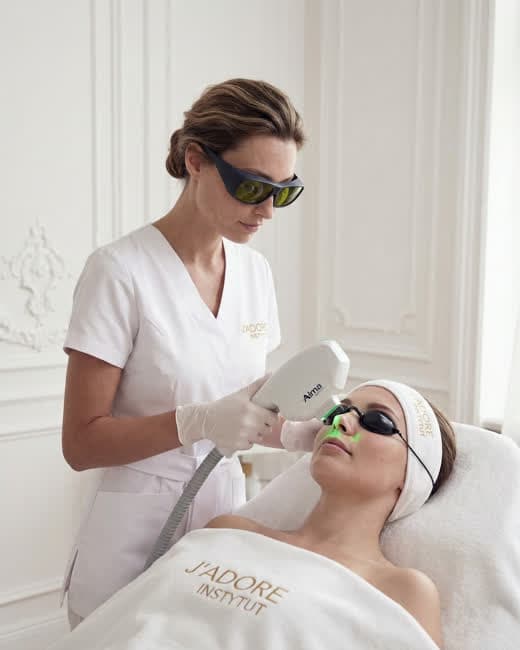
In the salon, a cosmetologist can apply treatments that work precisely on each zone — for example, HydraFacial with different boosters applied separately to the T-zone and U-zone. It's exactly the same multi-masking logic, but using professional-strength concentrations and technologies that aren't available at home.
At J'ADORE INSTYTUT, our cosmetologists specialise in diagnosing and treating combination skin — including this moody winter version. A skin consultation is the first step to understanding what your face really needs, zone by zone. Book a visit in Warsaw (Żelazna, Mińska) or Krakow (Karmelicka) and let us build your winter skincare strategy.


