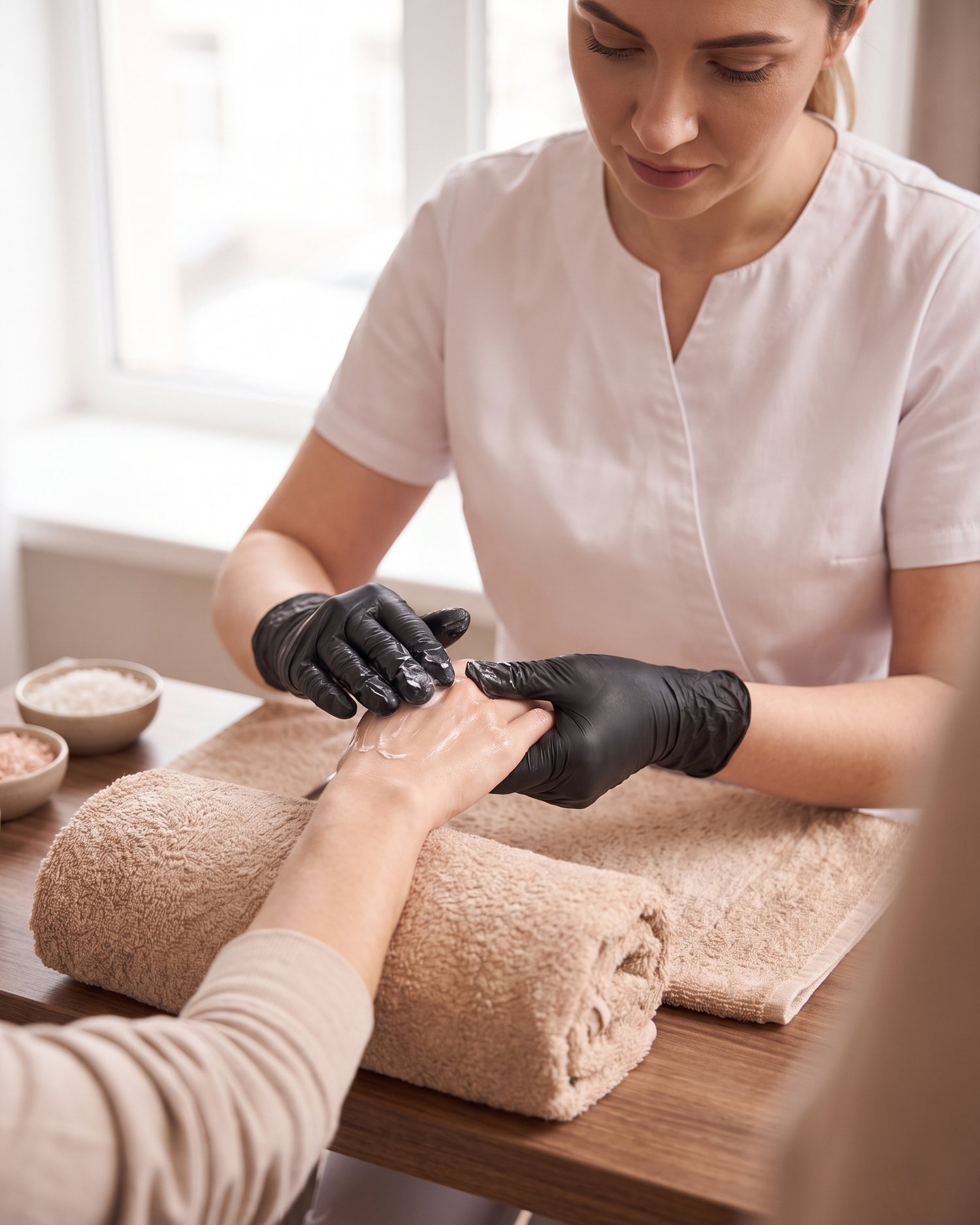
Manicure: work on the nail, not the skin
The word “manicure” comes from the Latin manus (hand) and cura (care) — and in its broad sense, it means caring for the hands. In salon practice, however, a manicure focuses primarily on the nails: their shape, nail plate structure and aesthetic finish.
A standard manicure consists of several elements. They may vary slightly depending on the technique and salon, but the core steps remain the same:
- 01
Nail plate preparation
Removal of old polish and initial shaping with a file. This is when we decide on the nail length and shape — almond, square, oval or pointed.
- 02
Cuticle work
Softening and pushing back or removing the cuticles around the nail plate. This is one of the more sensitive stages — an overly aggressive technique can cause irritation and micro-damage to the nail folds.
- 03
Final shaping
Final smoothing and finishing of the nail edge. This is where we work on symmetry and a consistent appearance across all fingers.
- 04
Preparing the nail plate for colour
Degreasing and, where needed, applying a strengthening or smoothing base coat. The durability of the colour applied later depends on this stage.
- 05
Colour or a natural finish
Application of polish (classic, hybrid or gel) or a natural finish, with an optional conditioning treatment.
A manicure is therefore primarily an aesthetic and hygiene technique focused on the nail. The skin of the hands plays only a minor role, usually limited to applying cream at the end of the appointment. This is what distinguishes a manicure from a hand spa.
Hand spa: skin regeneration, not nail care
A hand spa is a treatment in which the main focus is the skin — not the nail plate. It aims to deeply hydrate, soften and regenerate the skin of the hands, which is often one of the most heavily used parts of the body.
Hands are constantly exposed to factors that dry them out and accelerate ageing: frequent washing and sanitising, detergents, temperature changes and sun exposure without protection. The skin of the hands has no sebaceous glands. It therefore lacks the natural protection found, for example, in facial skin. It ages faster and is less resistant to external factors.
A standard hand spa usually includes several stages that work together at different levels of the skin:
- Peel — removes dead skin cells, smooths the surface and prepares the skin to absorb active ingredients. It may be mechanical (a fine-grain scrub) or enzymatic.
- Hydrating bath or compress — softens the skin in warm water or with oils and active ingredients. Heat opens the pores and increases ingredient penetration.
- Mask or wrap — an intensive dose of nourishing ingredients: ceramides, hyaluronic acid, shea butter and oils. It is often applied under film or gloves to maximise absorption.
- Massage — improves circulation in the hands and wrists, relieves tired joints and tension, and supports the absorption of skincare products.
- Serum or finishing cream — seals in hydration at the surface of the skin.
A hand spa may, but does not have to, include manicure elements. In some salons, it is a separate service before or after nail work. In others, it is a complete ritual in its own right — without polish, but with more extensive work on the condition of the skin.
Comparison: when to choose what
As both treatments work at different levels, a natural question arises: what do I actually need? The answer depends on what is causing the problem and what result you want to achieve.
Manicure
purpose: nail aesthetics and hygiene
- Nails of uneven length or shape
- Colour that has grown out or hybrid polish needing an infill
- Cuticles that need treatment
- You want a specific colour or finish
- Brittle or splitting nails
Hand spa
purpose: skin condition and regeneration
- Very dry, rough or tight-feeling skin on the hands
- Thickened skin, calluses, cracked fingertips
- Tired, tense hands (manual work, keyboard use)
- Hyperpigmentation or loss of firmness
- You want relaxation and intensive care
In practice, both treatments complement each other and work best together. A manicure without skin care means well-groomed nails on neglected hands. A hand spa without a manicure means beautiful, soft skin and untidy nails. Combining both — which is what salons most often mean by “spa manicure” or “luxury manicure” — gives a complete result.
The skin of the hands ages differently from the face — which is why it needs separate care
There is one reason why hand care deserves separate attention — and it applies to both women and men. The skin of the hands does not have the same defence mechanisms as facial skin. It is not covered by a layer of sebum, is constantly exposed to external factors and has a lower capacity for regeneration.
The signs appear over time — loss of subcutaneous volume, more prominent veins and tendons, sun-induced hyperpigmentation, and dryness that can lead to cracked skin. Interestingly, these processes may progress faster than on the face. We tend to give our hands less time and attention than our complexion.
What happens during the treatment — step by step
To understand why the order and completeness of the treatment matter, it is worth looking at what happens to your hand skin during a full spa ritual. Each stage has a different purpose.
- 01
Cleansing
Removal of cosmetics, creams and impurities. Your skin needs to be clean so subsequent ingredients can penetrate, rather than work “on top of” an uncleansed surface.
- 02
Mechanical or enzymatic peel
Loosening and removing dead epidermal cells. After exfoliation, your skin feels smooth to the touch. Its ability to absorb ingredients can increase several times over.
- 03
Warm bath or compress
Heat dilates capillaries and opens hair follicles. Active ingredients applied after this stage penetrate more deeply than they do into cold, “closed” skin.
- 04
Mask or wrap under film
Wrapping the hands in film or warm gloves maintains the temperature and creates occlusion. Ingredients do not evaporate but penetrate the skin. This is the most intensive hydration stage.
- 05
Massage
It relieves muscle tension, improves circulation and supports lymphatic drainage. After the mask, massage also works the remaining product deeper into the skin.
- 06
Serum and finishing cream
Sealing in the result — retaining hydration and creating a protective layer on the skin’s surface. This stage “locks in” the results of the whole treatment.

Regular treatments versus a one-off result
One thing often surprises people after their first hand spa visit: the skin returns to its previous condition sooner than they would like. A hybrid manicure can last for several weeks. Hand skin feels soft and regenerated for some time after a hydrating spa treatment. Without suitable home care and regular visits, however, the result gradually fades.
This is not a promotion of further visits — it is simply physiology. Hand skin is constantly renewing and continually exposed to environmental factors. Regular care works cumulatively. Over time, the skin is better hydrated from the outset, dries out more slowly and responds better to treatments. For many people, results after several months of regular visits are clearly better than after a single, even very extensive, session.
Manicure + hand spa in one visit
A classic combination: first the spa ritual — peel, mask and massage — then the manicure. The skin is softened, cuticles are easier to work with, and the whole ritual gives a complete result — well-groomed nails and well-cared-for skin.
Spa before a hybrid manicure
Exfoliation and hydration before applying hybrid polish improve polish adhesion and nail plate condition. A dry, dehydrated nail plate is more likely to chip. A well-cared-for plate absorbs products and holds colour for longer.
A standalone spa — without colour
For people who prefer natural nails or are taking a break between hybrid manicures. A full spa ritual without colour application gives the entire appointment to skin regeneration — more intensive care within the same visit time.
Men and hand care — briefly, on what many do not do
Men’s hands are statistically more exposed to dryness, hardening and neglect. This is because care routines include them less often. Yet men’s hand skin does not differ anatomically from women’s skin to an extent that would justify no care. It is equally lacking in sebaceous glands and equally exposed to detergents and manual work.
Men’s manicure, increasingly found on salon menus, is usually a more discreet option. It has no colour, a natural finish, and focuses on hygiene and condition. Combined with a hand spa, it can noticeably improve the appearance and comfort of hand skin. Many men experience this with considerable surprise at their first visit.