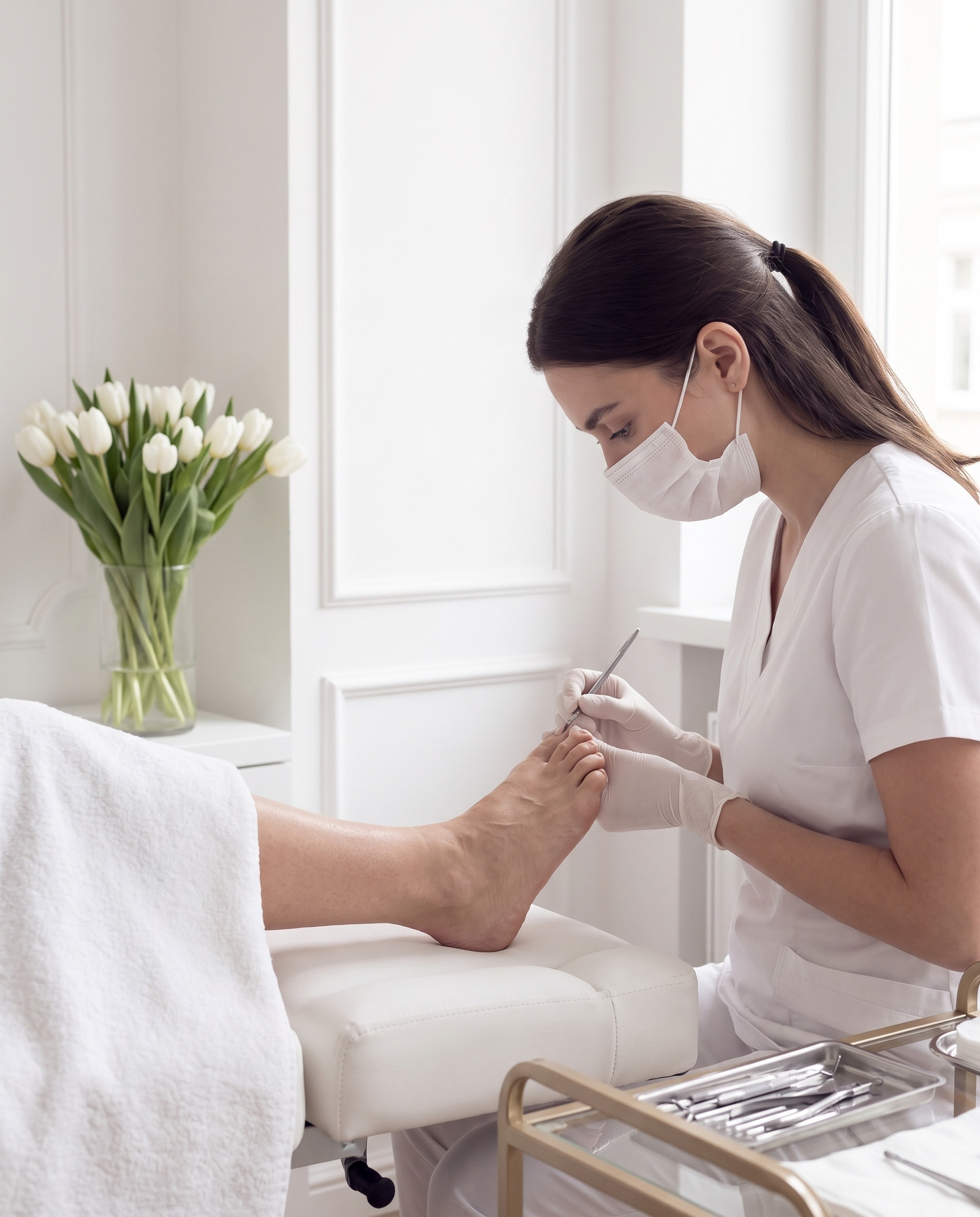
Ingrown nails — put down the pliers
An ingrown nail is one of the most common reasons men come to see a podologist — and one where home experiments can turn a minor issue into a serious one. The pattern is familiar: pain along the side of the big toe, redness, then swelling, sometimes discharge. The instinct is to cut deeper, to dig out the corner. That's exactly how serious ingrowth begins.
A nail grows inward when its edge presses into the nail fold — the skin surrounding the plate. This can result from cutting too short (rounded corners), poorly fitted shoes (too narrow at the toe), or simply genetics and the shape of the nail plate. The longer you wait, the more inflamed and swollen the fold becomes, and the harder the correction.
A podologist removes the ingrown edge using sterile instruments, with no infection risk, and assesses whether a corrective brace is needed — a device that, over several months, gradually draws the nail plate away from the fold and restores its correct growth direction. In many cases this is a lasting solution, not another temporary fix. The treatment needs no special preparation — just come as you are.
Calluses and corns — a hard shell, and a reason behind it
A callus is a thickened, hardened layer of skin that forms wherever the foot is repeatedly exposed to pressure or friction. In active men, the most common spots are the ball of the foot (in runners, or from long periods standing), the heels and the sides of the toes. A callus itself isn't a disease — it's the tissue's natural defence. The problem starts when it grows large enough to cause pain on its own, or when a core forms beneath it — the hard centre of a corn pressing deep into the skin and onto the nerves with every step.
Callus
surface thickening
- a broad, flat area of hard skin
- most often on heels and the ball of the foot
- dull pain, worse after extended walking
- the podologist files it down mechanically + assesses your biomechanics
Corn (clavus)
core driven deep
- small, round, hard centre
- most often on toes and side edges
- sharp, localised pain under pressure
- requires the podologist to remove the core
The podologist removes the thickened skin with a podology scalpel — painlessly (hard tissue has no nerve supply), quickly, without bleeding. But the treatment itself matters less than understanding the cause: if a callus comes back every few weeks, that's a sign that your foot is bearing weight incorrectly, that your shoe is creating friction in the wrong spot, or that you need an orthotic insole. A good podologist asks about your activity, your shoes and your gait — not just filing down the thickened skin and sending you on your way.
Cracked heels and dry skin — more medicine than cosmetics
Cracked heels result from a combination of factors: a thick layer of dry skin that loses elasticity, constant pressure from body weight, and lack of hydration. They look unpleasant, but the problem is more mechanical than cosmetic — deep cracks can reach living tissue, bleed and open the door to infection. In men who play sport, wear open shoes, or spend time barefoot, cracked heels are especially common.
The podologist files away the excess hardened skin (the skin becomes noticeably softer and more receptive to moisturiser straight away), and for deep cracks may apply specialist dressings or healing-support preparations. Many people notice results after the very first visit. Your homework afterwards? Apply an emollient to your feet every day — one of those habits that simply pays off.
Sport and feet — what activity does to your legs
Men who train regularly tend to develop a specific set of podology issues — and often ignore them too long, because "there's no time for salons before competition". Yet well-cared-for feet mean better biomechanics, fewer injuries, and no pain altering your running technique or your court movement.
- Runners: calluses on the ball of the foot and heels, subungual haematomas (black toenail after a long run), ingrown nails after competing in tight shoes.
- Football and squash players: side-of-toe corns from sudden changes of direction, strain around the big toe.
- Gym / barefoot or minimalist-shoe training: increased load on the ball of the foot, faster callus formation, micro-injuries to the nails.
- Climbing: nail deformities from tight climbing shoes, abrasions and hardened toe edges.
- Water sports / swimming pools: risk of nail and foot fungus — moisture combined with walking barefoot poolside is a classic route to infection.
A podologist can assess your foot's loading pattern and recommend an orthotic insole matched to your activity. This isn't an "extra" — proper weight distribution can, for many people, reduce the risk of strain on the knee, ankle and even the lower spine. Mechanically speaking, the foot is the foundation.
Nail fungus — it won't clear up on its own
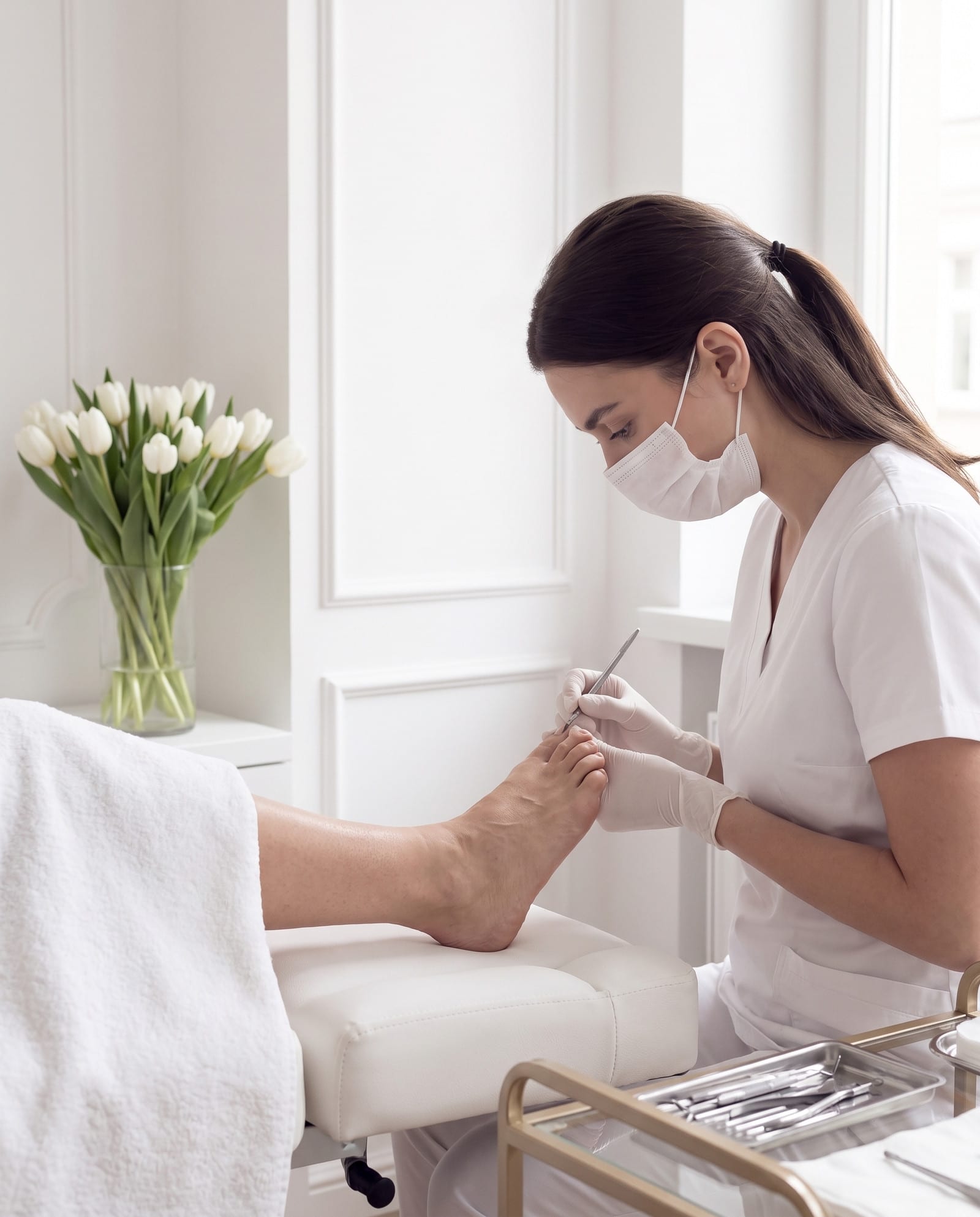
Nail fungus (onychomycosis) looks unremarkable at first — a yellowish or whitish spot at the edge of the plate. Most men ignore it for months because "it doesn't hurt". The problem is that fungus destroys the nail structure from within: the plate becomes dull, brittle, thickened, and eventually starts to crumble and separate from the bed. The further the changes progress, the harder treatment becomes.
The podologist assesses the severity and, if necessary, refers you to a doctor (dermatologist or GP) for a prescription oral antifungal, which is more effective than nail varnishes alone. At the same time, podology treatments mechanically work on the affected plate, which improves how the preparations penetrate and removes infected material. This is a combined approach, not an either-or.
Prevention: dry feet (dry thoroughly between the toes after bathing), your own flip-flops at the pool and in changing rooms, breathable shoes. If you already have fungus — don't share towels, don't walk barefoot at home. Fungus likes to spread to the rest of the family. This isn't something to be embarrassed about, but it is something worth dealing with.
- 01
Early stage
A spot at the edge of the nail, a change in colour — white or yellow. The nail is still firm. At this stage, topical preparations are often enough.
- 02
Progressing
The plate turns dull, starts to thicken and crumble. It spreads to cover more of the nail. Needs a podologist's assessment, possibly a prescription.
- 03
Advanced
The nail is broken down, detached from the bed, heavily discoloured. Treatment takes months, but recovery is possible — a healthy new plate grows back.
What your first podology visit looks like
There's no ceremony involved. You come in, take off your shoe and sock, and sit in the podology chair. The specialist examines your feet — nails, skin, toe alignment, often the arch and heel too — and asks about your shoes, activity and any pain. It's not idle conversation: the answers help pinpoint why a problem keeps recurring or where to look for its cause.
Then comes the treatment — filing down thickened skin, correcting a nail, removing a corn or fitting a brace, depending on what brought you in. In most cases you leave the salon with the problem solved, not with advice to "wait and see". If a medical diagnosis is needed (for example, changes requiring a prescription or an orthopaedic consultation), the podologist will say so directly and point you to the right person.
Podology + orthotic insoles
If calluses or pain keep coming back — the cause is often an incorrect loading pattern. The insole corrects the biomechanics; the podology treatment addresses the result. Together, they give a longer-lasting effect.
Podology + foot care
For advanced cracking and dryness — a combination of mechanical skin treatment and specialist moisturising care. Results are noticeable sooner, and skin stays in better condition between visits.