

Movember — more than moustaches
Since 2003, the Movember Foundation has raised funds for research and prevention of diseases that mainly affect men. The numbers are stark: prostate cancer is the most common malignant tumour in men in Poland — over 18,000 new diagnoses a year. Testicular cancer is the most common cancer in men aged 15–35. And male suicides account for three-quarters of all suicides in Poland (GUS data, 2025).
Growing a moustache is a symbolic gesture — "hey, I see the problem and I want to talk about it." But there's something else in Movember: quiet permission for a man to look after himself. Because if you can say publicly, "I look after my health" — maybe you can also say, "I look after my skin"?
It's not as simple as it sounds. A 2025 Mintel survey shows that 62% of Polish men think facial skincare is "unnecessary" — even though 71% of them complain of dryness, post-shave irritation and a tired look. Put those two figures together, and the message is clear: the need is there, but permission is missing.
This article isn't a guide to "becoming a beauty boy." It's a pragmatic look at what's genuinely worth knowing about men's skin — especially in November, when beards grow, temperatures drop, and your face starts to rebel.
Beards in Movember — the problems nobody talks about
Growing a beard? Congratulations. Now for a few uncomfortable facts.
Ingrown hairs and irritation
Beard hair doesn't always grow in the direction you'd choose. Curly or wavy hairs tend to curl back and reinsert into the skin, causing painful, inflamed bumps. According to the British Journal of Dermatology, ingrown hairs affect as many as 45% of Caucasian men and up to 83% of men of African descent.
What helps:
- Gentle exfoliation twice a week (an enzyme peel or 1–2% salicylic acid) — removes dead skin cells that block follicle openings
- Shaving in the direction of hair growth, not against it
- A warm compress before shaving to soften the hair
Dry skin under the beard
Skin under a beard is, paradoxically, drier than exposed skin. Why? Because facial hair acts as a barrier — it traps heat but not moisture. At the same time, it makes it harder for moisturiser to reach the skin.
The result? Flaking, itching, "beard dandruff" — yes, it's a real thing. Dermatologically, it's seborrhoeic dermatitis within the beard area.
Beard care — the minimum that actually works
You don't need a 12-step routine. You need three things:
- Washing your beard — with a dedicated product, not body soap. Beard shampoo or a gentle gel has a pH suited to facial skin (5.5), not to the skin on your arms, which is less sensitive.
- Beard oil — a few drops a day. It hydrates the skin under the beard and softens the hair itself. Look for jojoba oil (closest to human sebum), argan oil, and possibly vitamin E. No silicones.
- Beard balm or butter — if your beard is longer than a centimetre. It gives you shape control plus extra hydration.
Time for the whole routine: 90 seconds. Literally.
Men's facial skin — what the science actually says
The myth: men's skin is "tough and needs nothing." The facts:
It's thicker — but that doesn't mean it's tougher
Men's skin is, on average, 25% thicker than women's skin (data from Skin Pharmacology and Physiology, 2019). It contains around 16% more collagen, which means it ages more slowly — up to a point.
That "point" comes at around age 40. After 40, collagen decline in men is sharp and linear — with none of the plateau phase women experience before menopause. The result? Men who look effortlessly young in their thirties suddenly "catch up" with women their age by their fifties — sometimes overtaking them when it comes to wrinkles.
A study in Dermatology (2023) confirms it: after age 50, men have deeper expression lines than women of the same age — particularly on the forehead and between the brows.
Shaving = chronic micro-trauma
The average man shaves around 16,000 times in his lifetime. Every shave is a form of micro-exfoliation — you remove not just facial hair, but a layer of epidermis too. In theory, that's a free peel. In practice, it's a chronic state of micro-trauma that leads to:
- Irritation and redness (30% of men after shaving — Gillette/clinical dermatology data)
- Damage to the skin barrier (loss of protective lipids)
- Post-inflammatory hyperpigmentation (PIH) — especially with darker skin tones
- Accelerated photoageing in shaved areas
Shaving is, in effect, a dermatological procedure you carry out without anaesthesia, without sterile tools and without any aftercare. Perhaps it's time that changed?
Sebum — your enemy and your friend
Men's skin produces more sebum than women's — a result of higher testosterone levels. This means:
- A greater tendency towards blackheads and acne (yes, even past thirty)
- Larger pores (especially in the T-zone)
- But also: natural protection against water loss — which is why men notice skin dryness later in life
The problem: excess sebum plus no exfoliation equals blackheads. The solution: moisturising — yes, moisturising, so the skin doesn't have to compensate with excess sebum production — plus regular exfoliation.
What you can do in November — a concrete plan
Weeks 1–2: Start your routine
The absolute minimum — three products, three minutes in the morning:
- A facial cleansing gel (not bar soap, not shower gel). Look for: SLS-free, pH 5–5.5. CeraVe Foaming Cleanser and La Roche-Posay Toleriane are reliable options.
- A moisturiser with SPF (two in one — fewer steps). Minimum SPF 30. Men's skin needs hydration just as much as women's does — it just talks about it less.
- An alcohol-free aftershave balm (if you shave). Alcohol in a balm means instant stinging plus long-term dryness. Look for allantoin, panthenol and bisabolol.
That's it. Three minutes in the morning. No excuses.
Week 3: Your first treatment
If you've never been to a beauty salon — HydraFacial is the ideal first step. Why?
- No needles, no pain — it's a device-based treatment, not an invasive one
- Immediate results — after 30–45 minutes, you'll see a difference: cleaner skin, smaller-looking pores, a better skin tone
- Zero downtime — you leave the salon and go straight to work, and nobody will know
- Works for everyone — suitable for every skin type, regardless of age
HydraFacial combines cleansing, exfoliation, extraction and hydration in a single treatment. For a man who's never had a treatment before, it's the perfect introduction. No drama, real results.
Week 4: A plan for winter
November is a good time to decide what's next. If you enjoyed HydraFacial, there's a whole range of treatments that make sense for men's skin:
- Chemical peel — evens out skin tone and reduces post-shave hyperpigmentation
- Fractional laser — reduces acne scars, wrinkles and enlarged pores
- Mesotherapy — deep hydration and improved elasticity
- LED therapy — reduces inflammation, useful if you struggle with adult acne
You don't need to do everything at once. But it helps to have a plan.
A man in a beauty salon — that's normal
The aesthetic medicine market statistics speak for themselves: the proportion of men undergoing aesthetic treatments in Poland has grown by 340% over the past 10 years (data from the Polish Society of Aesthetic Medicine and Anti-Ageing, 2025). Globally, men already make up 15–20% of aesthetic clinic clients.
This isn't a trend — it's the new normal. Men who look after their skin aren't doing anything controversial. They're doing exactly what they do with their car, their sports gear or their wardrobe — keeping things in good condition.
Your face deserves no less attention than your watch.
Movember at J'ADORE
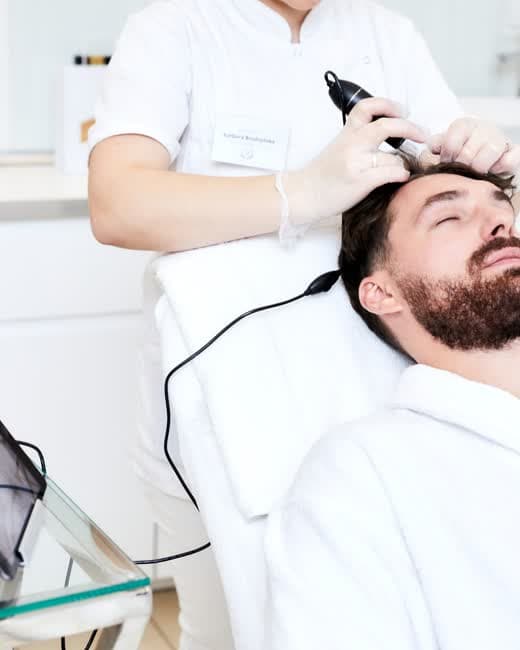
At J'ADORE INSTYTUT, men make up a growing share of our clients — and we have a full portfolio of treatments for them, from HydraFacial through chemical peels to advanced mesotherapy. Our specialists understand that men's skin has its own characteristics — different thickness, different sebum levels, and different needs linked to shaving and facial hair.
If this Movember is going to be more than just a moustache in your profile picture, come in for your first visit. No judgement, no pressure — just results. Looking after yourself doesn't need a manifesto. It just needs a decision.


