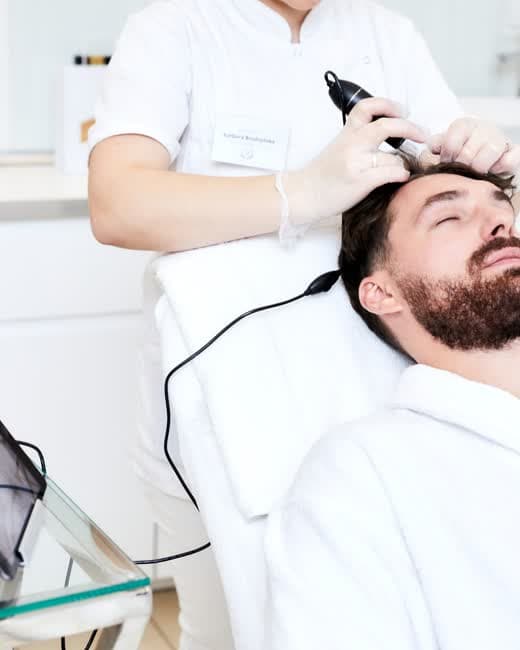
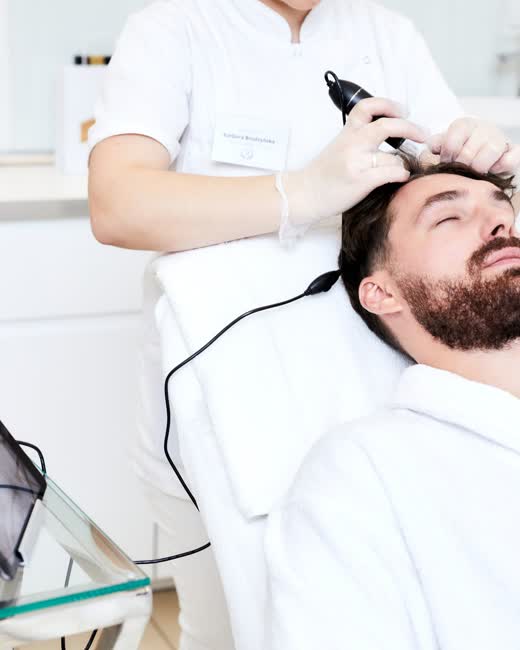
Hair strokes versus pixel shading — not the same procedure
Beard PMU isn't one treatment — it's several techniques that give completely different results. The choice depends on what you want to achieve and your skin condition.
Hair strokes
replicating individual hairs
- the needle draws thin lines that mimic individual beard hairs
- natural even up close — you can see the "direction of growth"
- ideal for filling sparse areas and evening out density
- a gentler, more subtle result
Pixel shading
the illusion of density and colour
- tiny dots instead of lines — build the impression of filled-in growth
- gives the effect of a few days' stubble, or shading
- longer-lasting and less sensitive to skin texture
- can be combined with hair strokes for a full 3D effect
In practice, the best results come from combining both techniques — the artist uses hair strokes where growth is naturally sparse, then reinforces with pixel shading where more volume is needed. The result is three-dimensional and hard to tell from real growth, even from a few centimetres away.
How to choose an artist — portfolio matters more than price
This is where most men go wrong. They look for the lowest price, or the nearest salon. But beard PMU stays on your face for years — this isn't a service where you can compromise on quality.
The portfolio is the only real proof. Look at beard photos taken well after the treatment, not just the results straight after pigmentation — when the skin is red and the colour intense. Look for photos taken 4–6 weeks after the treatment. That's the only point where you see the real, final result. If an artist has none like that in their portfolio, walk away.
- Look for irregularity. Real growth doesn't grow evenly — every hair has a different angle, a different length. A portfolio full of perfectly symmetrical lines is a warning sign.
- Check the contrast. A beard shouldn't look drawn on with a black marker. A good artist works with several shades to build depth.
- Ask about pigments. Specific brands, composition — an experienced artist knows their materials and has no problem discussing them.
- Consultation before the treatment. Any serious specialist will talk to you before booking a date — discussing your skin type, beard colour and expectations. Don't book without one.
- Avoid work that's too dark or too even — these are the two most common mistakes, and they both end in a "painted-on" beard.
The first few weeks: darker, lighter, and only then the real result
Straight after the treatment, the beard will look more intense than you planned. That's normal and expected — the skin is irritated, and the pigment sits close to the surface, looking darker than the final colour. For the first few days, the colour can be 30–40% darker than the end result.
- 01
Days 1–3
Intense, deep colour. Skin slightly red, mild swelling possible. Don't touch it, don't get it wet.
- 02
Week 1
The pigment starts to fade — a natural part of healing. It can look uneven, as if the beard is "coming off". Don't worry — it's just a stage.
- 03
Weeks 2–3
The colour fades significantly — by up to half. Some people panic at this stage. There's no need — this still isn't the final result.
- 04
Weeks 4–6
The pigment has settled in the skin. Only now can you see the real, final result. This is when a touch-up happens, if the artist has planned one.
Once the result has settled, most artists schedule a follow-up session — small touch-ups where the pigment took unevenly. This is a standard part of the process, not a mistake. After this touch-up, the beard looks complete and ready to go for a year or more.
When beard PMU really makes sense
Beard PMU isn't for everyone — and it's worth understanding that before deciding. It's a tool for specific problems, not a treatment for "having a beard despite not having one."
- Uneven beard density — sparse patches, bald spots, asymmetry between left and right.
- Scars from injuries or surgery, where growth hasn't come back.
- Vitiligo — light patches on the beard that break up an even growth pattern.
- Very light or ginger beard growth that doesn't give the contrast you want with certain styles.
- Beard loss after chemotherapy — PMU can fill in the look until growth returns, or permanently.
Beard PMU isn't reversible in the short term — the pigment fades, but you live with the result every day for a year or more. That's why choosing the right artist and having a thorough consultation before the treatment aren't optional — they're essential for a good result.

Touch-ups and removal — when something goes wrong
Even with the best artist, results sometimes don't match expectations after a few months: the wrong tone, a shifted line, pigment that's changed colour. Good salons have a solution for each of these scenarios.
Colour correction — the most common fix. For the wrong tone, the artist can "neutralise" the pigment by applying a different shade. For colour that's too intense, saline or acid-based lightening works well — but this always takes several sessions, not just one.
PMU removal is a separate treatment, usually laser-based — effective, but it needs several sessions and patience. PMU pigments differ in composition from decorative tattoo ink, so not every tattoo removal device gives good results here. It's worth checking beforehand that the salon has equipment dedicated to PMU.
The best strategy, of course, is avoiding these situations altogether — by choosing a proven artist, having a thorough consultation, and keeping realistic expectations about the result.
One factor that decides everything
The whole question of how natural beard PMU looks comes down to one thing: who is holding the needle. With the wrong artist, even the best technique ends up with the very look you wanted to avoid. With the right artist, even a difficult case — sparse growth, scarring, asymmetry — gives a result that looks like years of growth, not a tattoo session.
So before you book a date, take time to look through the portfolio, ask about technique and pigments, and have a consultation. It's a few hours of work before the treatment — work that decides the result for a year or more. On your face.