LASER THERAPY / HIGH-TECH / REMOVAL
Permanent makeup for brows, lips or eyeliner was meant to be years of convenience — but pigment changes colour over time. Brows can drift into grey, pink or green tones.
A shape stops suiting current trends or your face. Or another artist's work simply turned out uneven. Laser PMU removal breaks down the pigment sitting in the skin into microscopic fragments, which your body gradually clears. The makeup fades session by session — either until it's fully gone, or enough for an artist to create a clean, new design. At J'adore Instytut, the treatment is performed by a doctor or experienced cosmetologist using a Q-Switch Nd:YAG laser. PMU isn't an ordinary tattoo: cosmetic pigments can react unpredictably to laser, which is why consultation and a test patch always come first, before we start the series. Below you'll find everything worth knowing before your first visit.
series of several sessions spaced several weeks apart
How it works
Permanent makeup pigment sits in the dermis — that's why it doesn't come off with a peel or a cream. The Q-Switch Nd:YAG laser emits ultra-short pulses of light at very high peak power. The pigment absorbs this energy and breaks apart into microscopic fragments. These fragments are small enough for your lymphatic system and cells to gradually capture and clear them. The makeup doesn't disappear overnight — it fades between sessions.
The laser's action is selective — energy targets the pigment, while the surrounding skin remains largely undisturbed. Right after the pulses, a temporary whitish film (called frosting) often appears on the pigment — this is a normal reaction, a sign that the pigment has responded.
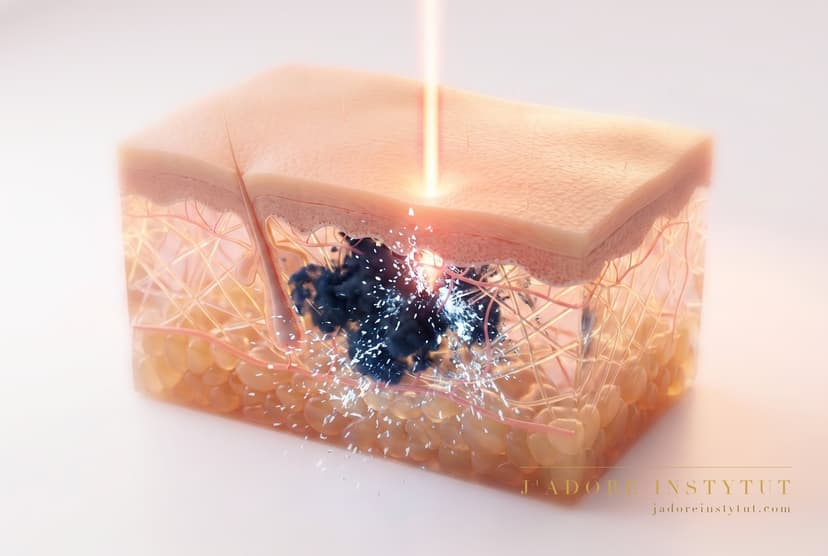
Your body needs time to clear the broken-down pigment — that's why we leave several weeks between sessions, and the effect builds up gradually. How many sessions exactly? That depends on the colour, depth and age of the PMU, and the technique it was originally done with. We set a realistic plan during consultation — honestly, without promising results "in one visit".
Ideal for
We assess every case individually — whether laser is the right method here, and how long removal will realistically take, is decided at consultation, never "blind".
Women's and men's needs
The vast majority of enquiries come from women with brow, lip and eyeliner PMU. The goal varies: complete removal or lightening before new, more current makeup. This is usually where the most emotion comes in — because the pigment has changed colour and the face "stopped feeling like itself". This is classic PMU removal for women.
What we work with
For men, PMU is most often brows and beard/line density enhancement, less often eyeliner. The goal is usually simple: discreetly get rid of an effect that turned out too "done" or unnatural in colour — with no trace that anything was corrected. This is PMU removal for men.
What we work with
Good to know: the same Q-Switch laser that removes permanent makeup is also used for removing tattoos and localised hyperpigmentation. The mechanism is the same everywhere — an ultra-short pulse breaks down the pigment into fragments, which your body clears itself. What differs is how "cooperative" the pigment is: tattoo ink tends to be more predictable than cosmetic PMU pigment.
PMU isn't an ordinary tattoo
This is a crucial point that isn't said loudly enough: permanent makeup pigments respond to laser differently than tattoo ink. A classic tattoo is usually carbon and dyes, which lighten fairly predictably. PMU pigments can be blends containing, among other things, iron and titanium oxides — and these can react to a laser pulse paradoxically: instead of fading, they can temporarily darken (for example, brown turning grey or almost black).
It sounds alarming, but it's manageable — provided whoever performs the treatment knows about it and works carefully. That's why for lips and eyeliner, we almost always start with a laser test patch on a small area and assess the reaction before deciding on the full series.
PMU removal from someone who "just fires a laser at everything" and promises "gone in one session" without a test patch — that's a warning sign. You have the right to ask about the type of laser, whether a test patch will be done, what the plan is if the pigment darkens, and who performs the treatment. A good salon will answer calmly, without pushing you straight into a full series.
Contraindications
Some contraindications are permanent, some temporary — in the latter case, we simply postpone the treatment until the situation passes. We decide on everything at consultation.
From the cosmetologist's chair
The thing most often forgotten around the lips: cold sores. Laser near the mouth can trigger the virus, even when "nothing's visible" right now. If you get recurring cold sores, let us know — we'll plan the treatment with protection, rather than treating an unnecessary flare-up afterwards.
This isn't a complete list — we'll go through your medications, health conditions, previous laser treatments and pigment type individually at consultation.

The most common reason to postpone treatment is a fresh tan on the area. Tanned skin carries a higher risk of hyperpigmentation and an uneven result — better to wait. SPF 50+ on the area is required after every session, no exceptions.
What to expect
Most important: pigment doesn't disappear immediately. Removal is a process spread over sessions — between them, your body clears the broken-down pigment, and the makeup fades gradually. It also happens that right after a session, the area briefly looks darker — especially lips and eyeliner — and this isn't cause for concern, just a known pigment reaction.
The most common call, the day after a lip or eyeliner session: "it's gone darker, something's wrong!" Most of the time, this is exactly the known PMU pigment reaction — a temporary darkening that lightens over the following weeks. That's why we warn you about this BEFORE we start, and always test lips and eyeliner with a patch first.
Once pigment is removed, it doesn't rebuild itself — removed stays removed. That said, we need to be honest: some pigments (especially light, "cold" or very deep ones) can leave a faint shadow. We always name the realistic achievable result at consultation.
Portfolio
A record of the work in our salons — the place where we publish treatment frames and, after photo sessions, results.
A record of results — in preparation. We publish photographs of our clients only with their consent.
PMU removal and your lifestyle
Most questions are about afterwards: tanning, makeup, swimming pools, saunas, new PMU. There's one rule — for the first few days of healing, we protect the area from sun, water and irritation, to minimise the risk of hyperpigmentation and help the pigment fade nicely.
A tan on the treated area increases the risk of hyperpigmentation and complications. We don't treat freshly tanned skin, and between sessions we protect the area with SPF 50+ and avoid sunbeds.
We don't apply makeup to the freshly treated area (brows, eyeliner, lips) until the scabs have fallen off. The rest of your face — no restrictions.
Soaking the area, chlorine and high temperatures interfere with healing and encourage swelling. We put off pools, saunas and long hot baths for the first few days.
Scabs need to fall off on their own — picking at them is a straightforward route to hyperpigmentation or a mark. Gentle washing, no rubbing, no peels on the area.
We only plan new permanent makeup once the area has healed and the pigment is confirmed to be light enough. Here we work alongside your artist.
You return to most daily activities essentially right away — just be mindful of sun, water and not picking at scabs during the first few days.
LASER THERAPY / HIGH-TECH / REMOVAL
Permanent makeup removal (laser)
These three approaches solve different problems and often complement each other — they're not competing as "better/worse":
breaks down pigment, your body clears it
doesn't "pull out" pigment in one visit; requires a series and extra care with lips/eyeliner
introduces a product that "draws out" pigment
a different procedure with different risks (e.g. scarring) — whether it's even an option is assessed individually
covers or corrects existing makeup
doesn't remove the old pigment — it's applied over it; often requires laser lightening first
Combine with
PMU removal itself is a series with gaps between sessions. Skin-supporting treatments and any new makeup are planned around it — the cosmetologist decides on order and spacing, but the logic stays the same:
The most common question: "remove it, or fix it?" Simple rule: want to keep makeup, just nicer → we lighten with laser first, then new PMU with an artist. Want to return to a natural look → we remove it completely with laser. Whether laser is the better route is decided after seeing the pigment and doing a test.
Technology
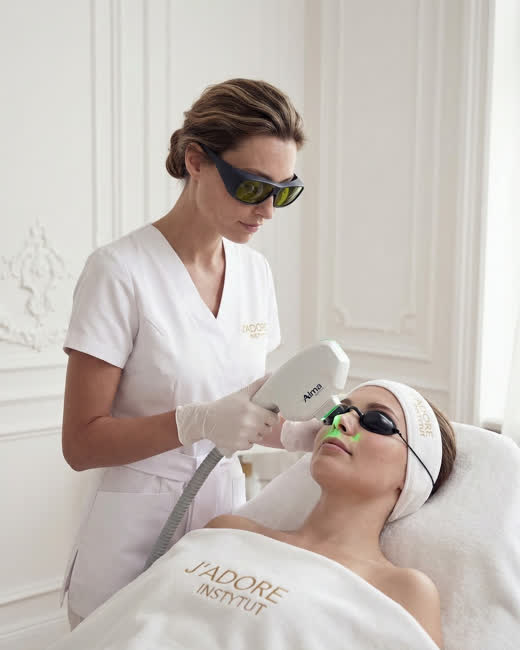
At J'adore Instytut, we use the Q-Switch Nd:YAG laser — recognised as the standard for pigment removal. Its strength lies in a pulse lasting nanoseconds: short and intense enough to break down pigment, while limiting heating of the surrounding skin. It's a laser with two wavelengths, each "seeing" different pigment colours:
A wavelength that penetrates deeper, well absorbed by dark pigments.
Dla kogoDark brows and eyeliner: black, navy, dark brown.
A shorter wavelength, more responsive to warm, lighter pigment tones.
Dla kogoWarm lip and brow colours: reds, pinks, oranges, browns.
Fact: Where do the differences in price and number of sessions come from? It mainly depends on the surface area (a small eyeliner line isn't the same as full brows or lips), the colour and depth of the pigment (light and "cold" tones can be stubborn), the age and technique of the PMU, and the number of sessions in the series needed to clear pigment safely. That's why we set pricing and a series plan at consultation — no fixed figure "upfront".
Price list
Checking free hours…
From the magazine
Editorial pieces on how this treatment works in practice — what happens during the session, how to prepare, where the limits are and what the first days after look like.
See also
The result lastslasting effect — removed pigment doesn't returnJ’adore Instytut
Information. The text above is for informational purposes only and does not constitute medical advice. At J'adore Instytut, laser removal of permanent makeup is performed by a doctor or experienced cosmetologist. Qualification for the treatment, parameter selection, number of sessions and contraindications are all decided individually during consultation (often including a laser test patch). Results vary and depend on factors including the type, colour, depth and age of the pigment.
Home care
Cosmetics matched to what your skin needs after a treatment — so the clinic effect lasts longer.
 post-treatment regenerationCell Fusion CDermagenis pH Biome SerumView in the shop(opens in a new tab)
 sun protectionDermaQuestSunArmor SPF50 30 mlView in the shop(opens in a new tab)
 sensitive skinSesdermaSERENITY mask 50 mlView in the shop(opens in a new tab)
 post-treatment regenerationMedMelanoSkinbiotic Elixir Probiotic Repair Serum 50 mlView in the shop(opens in a new tab)
 sun protectionSkeyndorProtective cream SPF 50+ – Age Photo DefenseView in the shop(opens in a new tab)
 post-treatment regenerationVagheggiEmozioni Plus — Anti-Stress Face Mask 75mlView in the shop(opens in a new tab)
 sun protectionCell Fusion CAquatica Sunscreen 100 SPF 50+/PA++++View in the shop(opens in a new tab)
 post-treatment regenerationMesoesteticMesohyal Post-Procedure Gel CreamView in the shop(opens in a new tab)