WarszawaŻelazna 59WarszawaMińska 29AKrakówKarmelicka 45Warszawa · Kraków

Careers

ENPL

Full perspective

Mandelac — mandelic acid for men

Why men choose a mandelic peel

In the men’s zone, mandelic peel for men most often addresses oily skin, with larger sebaceous glands, wider pores and blackheads, as well as post-acne scars and hyperpigmentation — flat marks left after years of acne. There may also be irritation and hyperpigmentation after shaving, including dark marks and ingrown hairs along the beard line. Men rarely have a regular SPF habit, so sun-induced hyperpigmentation is an added concern. Mandelac regulates sebum, unclogs pores and works against bacteria — while remaining gentle enough to be safe even for skin that has recently been shaved, after allowing time to pass.
Czas
several dozen minutes
Efekt
cumulative result — builds gradually and is maintained with a series and home care
Regeneracja
minimal — usually no downtime (zero downtime)
Seria
a series of 4–6 treatments every 1–2 weeks (often 6–8 for acne), followed by maintenance
Wykonuje
experienced cosmetologist
ListenMandelac — mandelic acid — this whole page read aloud

When it's worth it — indications

  • Acne vulgaris — comedonal acne (blocked pores, “blackheads”) and mild papular acne; it clears pores and limits new breakouts.
  • Post-inflammatory hyperpigmentation (PIH) — dark marks left after spots have healed, particularly troublesome on darker skin.
  • Oily and seborrhoeic skin — excessive shine, a “shiny” T-zone and a tendency towards comedones.
  • Enlarged pores — especially on the nose, forehead and chin; after completing the series, skin looks smoother and more mattified.
  • Uneven skin tone and “grey”, tired-looking skin — when you want to brighten and refresh the complexion without the risk of irritation.
  • Sensitive and reactive skin — that does not tolerate strong acids but needs gentle, effective exfoliation.
  • Skin with visible capillaries and a tendency towards redness — Mandelac is one of the gentler options when stronger peels would be too aggressive.
  • Acne and hyperpigmentation on the back, décolletage and neck — areas that are difficult to reach with home care.

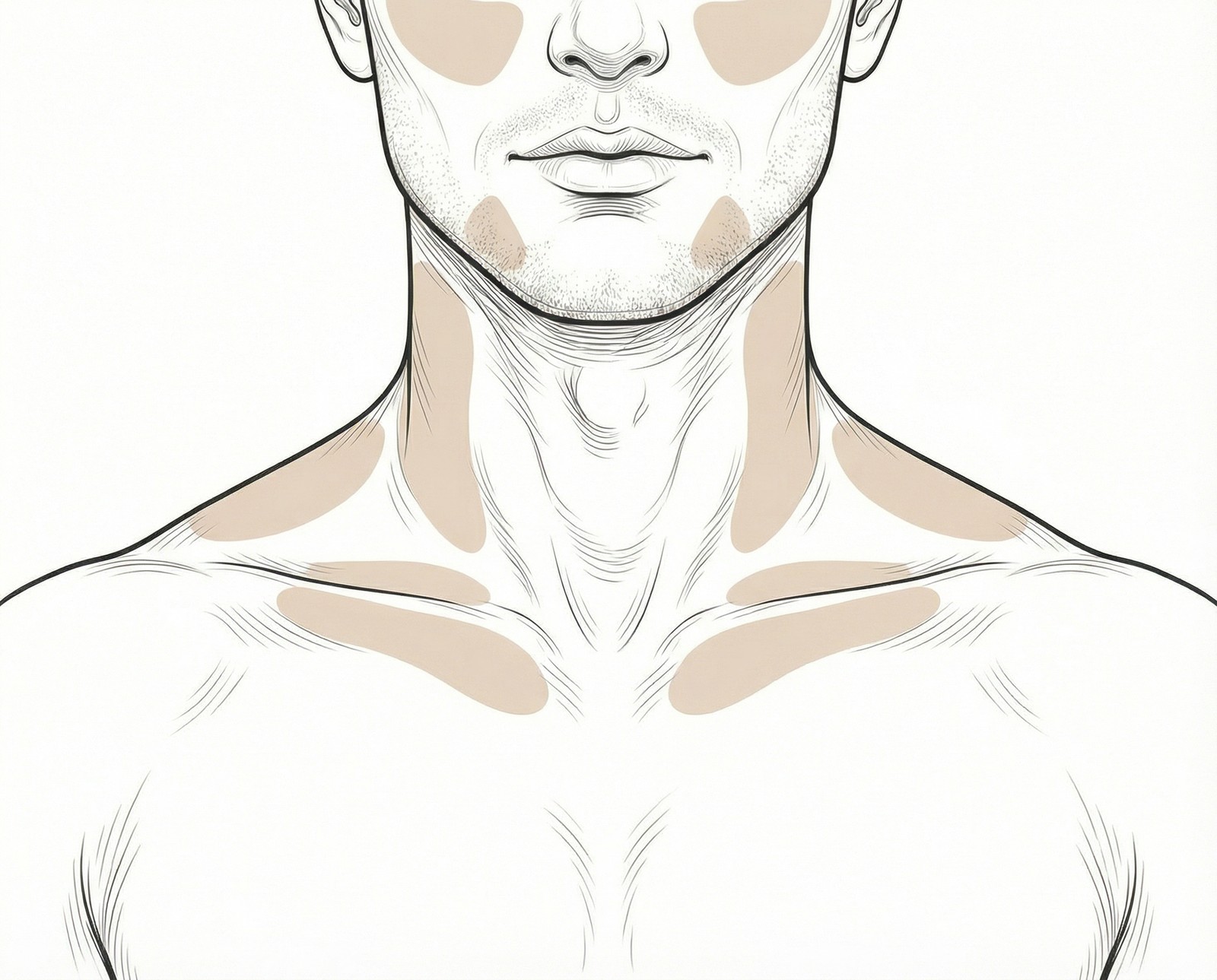
The areas we work on

  1. oily, seborrhoeic skin, blackheads and enlarged pores in the T-zone;
  2. post-acne scars and hyperpigmentation — flat marks left over the years;
  3. dark marks and irritation after shaving and ingrown hairs;
  4. acne and hyperpigmentation on the back — an area difficult to care for at home.
Rysunek stref zabiegowych — twarz i szyja, sylwetka męskaForehead and templesPoliczkiJawlineSzyja
Indicative map of the areas

Why men choose a mandelic peel

Men’s skin has larger sebaceous glands, a thicker epidermis and produces more sebum. This is why enlarged pores, blackheads and oily shine are an everyday concern for many men, rather than a temporary problem. Shaving adds its own challenges: irritation, dark marks and ingrown hairs along the beard line can cause hyperpigmentation that a pharmacy cream will not remove. A lack of regular SPF use also contributes. Melanin is deposited unevenly, leaving the skin dull and tired-looking.
The Mandelac peel addresses several of these concerns at once. It regulates sebum production, unclogs pores, works against acne-causing bacteria and brightens hyperpigmentation — both post-acne marks and post-inflammatory marks after shaving. It is also gentle enough for skin that has recently been shaved, after allowing time to pass, without dramatic peeling or downtime.

How results differ in men

Men’s skin responds to a mandelic peel slightly differently from women’s skin — and to its advantage:
  • A thicker epidermis means the skin is more resistant to irritation. However, it also requires consistency — results develop over a series, not after one treatment.
  • More sebum means faster visible results in mattifying the skin and reducing shine, even after the first treatments.
  • Hyperpigmentation after shaving (dark marks, hyperpigmentation along the beard line) — mandelic acid gradually brightens it over a series, provided SPF is introduced into your routine.
  • Acne and scars on the back — an area men often neglect because it is difficult to care for independently. Mandelac for the back is one of the more common indications in the men’s zone.

Shaving, beard and peel — what does not conflict

Men’s most common concern: can I shave as usual after the treatment? The answer is yes, but allow a 24-hour interval. Skin is more sensitive immediately after a peel. Shaving a freshly exfoliated surface can easily lead to irritation and increased redness. Wait one day before shaving or depilating the treatment area.
If you wear a beard, a peel along the beard line and on the neck, beneath the beard, is possible. Your cosmetologist will assess how to avoid sensitive areas and adapt the protocol to your skin’s needs.

Back acne — a peel for a hard-to-reach area

Acne and hyperpigmentation on the back are concerns that home skincare usually cannot address effectively. It is simply difficult to apply a product evenly and consistently to the middle of your back. A professional concentration of mandelic acid applied by a cosmetologist works faster and more precisely than even the most careful home routine.
A series for the back may be slightly longer than for the face (6–8 sessions every 2 weeks). However, the results — fewer breakouts, reduced hyperpigmentation and noticeably more mattified skin — are visible and long-lasting with ongoing SPF use.

Frequently asked questions

Will it be obvious that I have had something done after the peel — peeling, redness or a visible change?
A mandelic peel is a superficial peel — any peeling is usually light and fine, and almost invisible in many men. Temporary redness generally settles within a few hours. You can return to work straight away — with no downtime. Results develop gradually throughout the series, not through an intense reaction after one treatment.
I have hyperpigmentation after shaving — will a mandelic peel help?
Yes — this is one of the typical indications in the men’s zone. Dark marks after irritation and ingrown hairs are post-inflammatory hyperpigmentation (PIH). Mandelic acid brightens them over a series by limiting excess melanin production and exfoliating excess pigment-containing epidermis. One condition for results: SPF every day (without it, melanin is deposited again).
I do not use SPF every day — is that a major issue with a peel?
Yes, and it is crucial. SPF 50+ after a peel is not a suggestion — it is essential for results. Without sun protection, exfoliated skin is more sensitive to UV. Where hyperpigmentation is concerned, sun exposure intensifies it instead of allowing it to fade. Your cosmetologist will discuss a simple, lightweight SPF cream suited to oily male skin — it does not need to be a heavy cream from the women’s shelf.
Can I have a peel on my back and face during one visit?
It depends on your skin’s response and the treatment plan. Sometimes this is possible. In other cases, your cosmetologist separates the areas into separate visits to avoid placing too much strain on the skin at once. Discuss this during consultation; for back acne, we often plan a longer series and a different visit schedule than for the face.
How many treatments are needed to see a meaningful change in pores and shine?
After just 2–3 sessions, the skin usually looks more mattified, pores appear smaller and shine is reduced. Meaningful improvement in hyperpigmentation and active acne develops over a full series — usually 4–6 treatments every 1–2 weeks, or up to 8 for more active acne or the back.

Where we offer it

Mandelac — mandelic acid for men — we perform it in three J'ADORE INSTYTUT salons: two in Warsaw and one in Krakow.

  • WarszawaŻelazna 59 · Wola · Mirów
  • WarszawaMińska 29A · Praga-Południe · Kamionek
  • KrakówKarmelicka 45 · Stare Miasto · Piasek

Price list

    Book a visit

    Prices come from the salon price lists. The choice of cocktail and the number of sessions is decided by your specialist at the consultation.