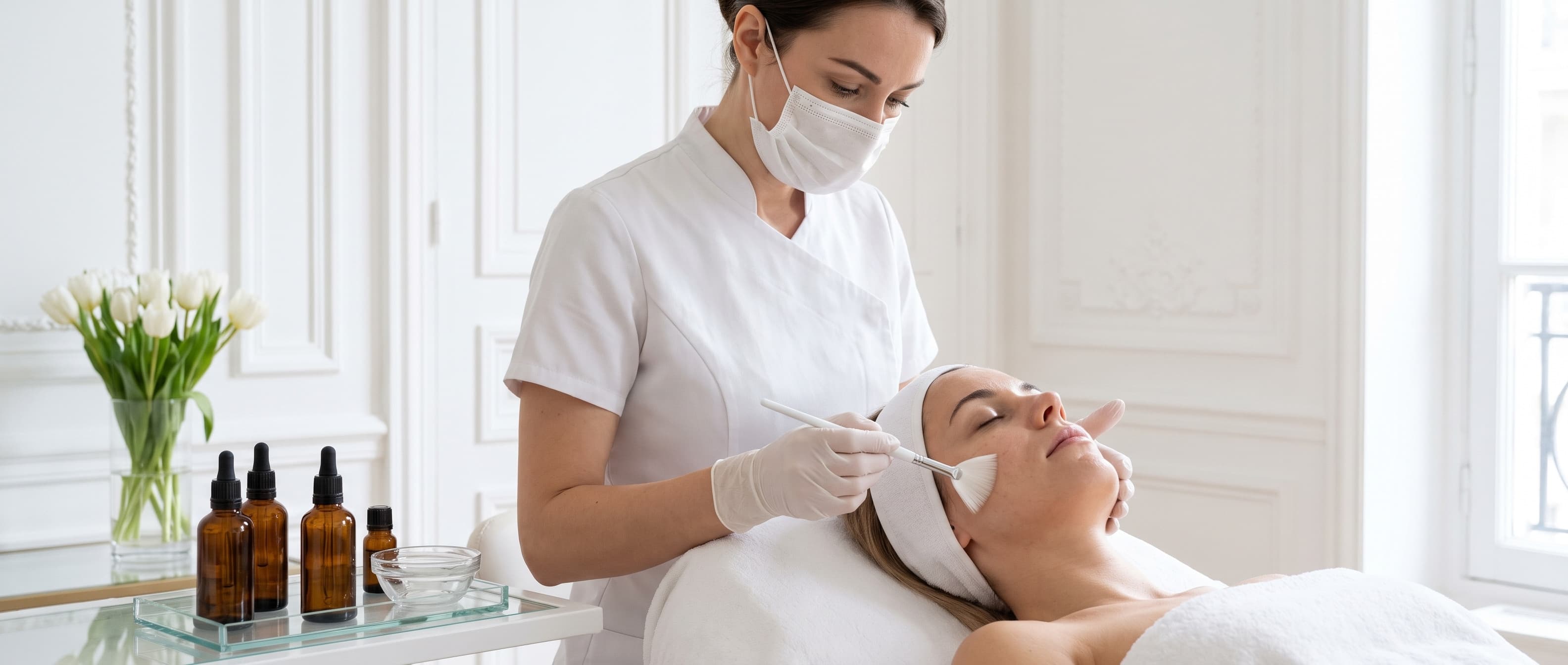
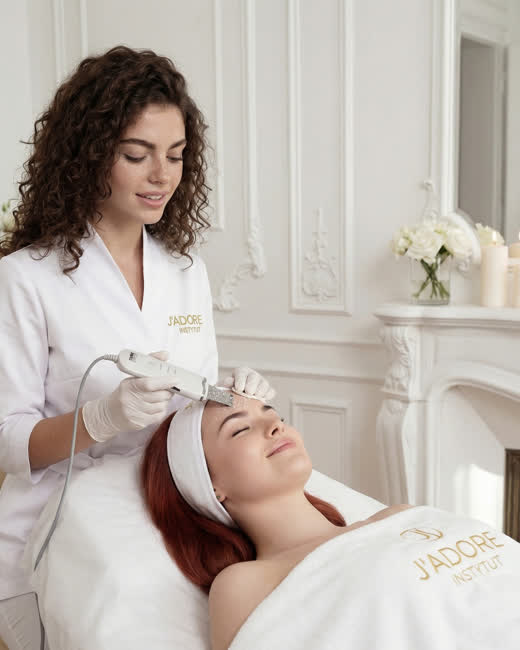
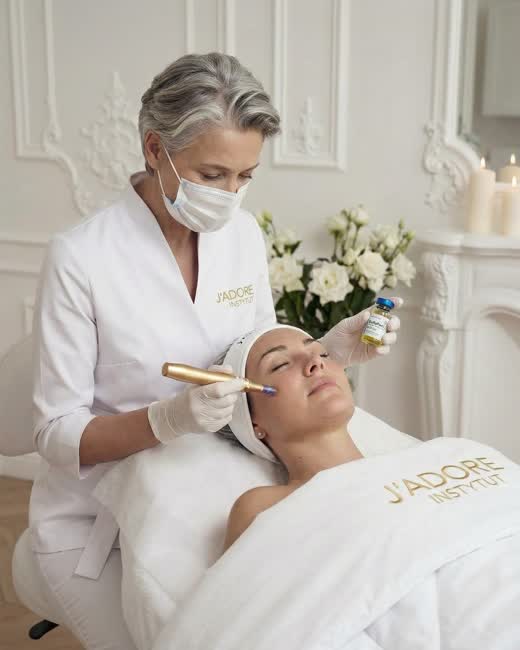
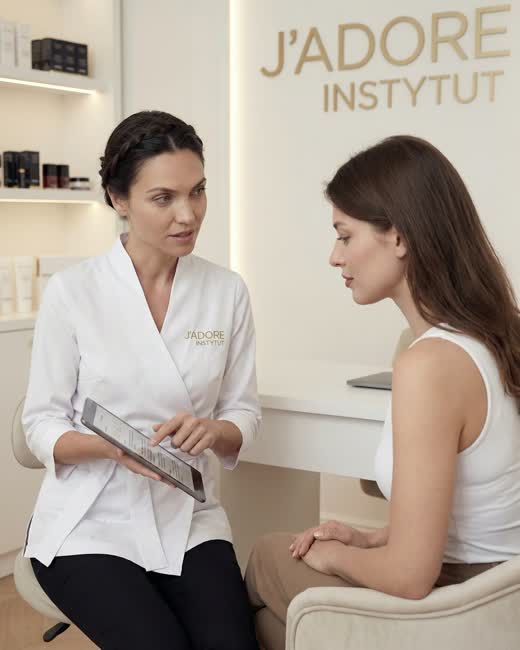
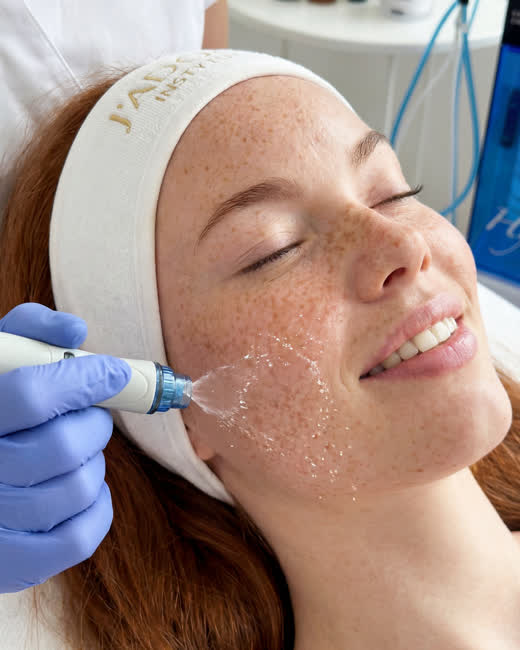
A treatment room at J'adore
MEDICAL PEELS
Acne marks that will not fade. Uneven, dull skin tone.
Enlarged pores and skin that becomes shiny by the afternoon. Your skin may also be sensitive and turn red after even a slightly stronger acid. This is a typical combination of concerns in acne-prone, seborrhoeic skin with hyperpigmentation. An ordinary cream cannot address it all. The Mandelac peel is based on mandelic acid (Mediderma / Sesderma range) — an alpha-hydroxy acid (AHA) with the largest molecule in its group. It penetrates the skin more slowly and gently than glycolic acid. In practice, this means an effective peel with a gentleness tolerated even by sensitive, reactive and darker skin (where other acids can easily leave hyperpigmentation). Mandelac works antibacterially, regulates sebum, clears pores and brightens hyperpigmentation — addressing several concerns at once. At J'adore Instytut, the treatment is performed by an experienced cosmetologist. Below, you will find everything worth knowing before your first visit: whether it really works, whether it stings, whether and for how many days your skin will peel, when to expect results, how many treatments are needed in a series, and why SPF is essential.
a series of 4–6 treatments every 1–2 weeks (often 6–8 for acne), followed by maintenance
How it works
Mandelac is a peel based on mandelic acid — an alpha-hydroxy acid (AHA) with the largest molecule in the entire fruit acid group. It may seem like a small chemical detail, but in practice it is key to everything. The large molecule penetrates the skin more slowly and evenly, so it works effectively without causing a sudden “shock” to the epidermis. This is why it is known as the gentlest of exfoliating acids.
Mandelic acid works in multiple ways: it exfoliates and accelerates epidermal renewal (keratolytic action), unclogs pores and dissolves sebaceous plugs, regulates sebum secretion, acts antibacterially against the bacteria responsible for acne, and additionally brightens hyperpigmentation by inhibiting melanin overproduction. That is why a single treatment addresses several concerns at once — acne, seborrhoea, enlarged pores and uneven skin tone.
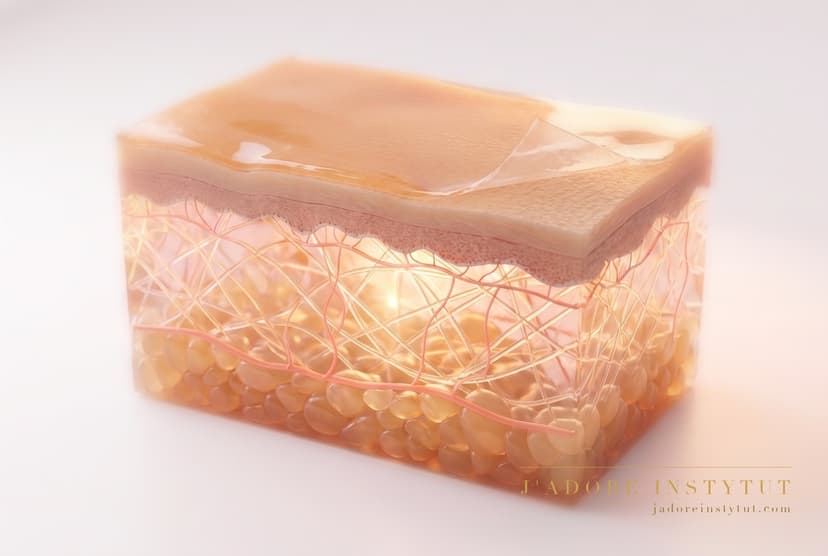
This is a superficial peel — it works mainly in the epidermis, in a controlled and safe way. The aim is not for your skin to “come off in flakes”. It is to become clearer, more even and brighter. This is why Mandelac is one of the first choices for people who want to work effectively on their skin but do not tolerate aggressive treatments well.
Ideal for
Mandelac is often a “first-contact” peel — we start with it for people who have never had peels or have sensitive skin. For more advanced concerns, a cosmetologist may combine it with other treatments or alternate it with stronger peels (more on this below).
Women’s and men’s zones
The most common reason women choose mandelic peel for women is post-acne hyperpigmentation and uneven skin tone — dark marks after breakouts that remain for months, as well as a dull, “dirty” skin tone. The second is acne and enlarged pores in sensitive skin that cannot tolerate strong acids. Mandelic acid is ideal here. It brightens and improves the skin while remaining gentle enough to be safe for darker skin phototypes, where other acids can easily leave new hyperpigmentation.
What we work with
In the men’s zone, mandelic peel for men most often addresses oily skin, with larger sebaceous glands, wider pores and blackheads, as well as post-acne scars and hyperpigmentation — flat marks left after years of acne. There may also be irritation and hyperpigmentation after shaving, including dark marks and ingrown hairs along the beard line. Men rarely have a regular SPF habit, so sun-induced hyperpigmentation is an added concern. Mandelac regulates sebum, unclogs pores and works against bacteria — while remaining gentle enough to be safe even for skin that has recently been shaved, after allowing time to pass.
What we work with
Did you know: mandelic acid is the only popular exfoliating acid that has built-in antibacterial action — its molecule is related to certain antibiotics. This is why it works where concerns overlap: acne-prone skin that develops hyperpigmentation after every breakout. It exfoliates, limits bacteria and brightens the mark — three actions at once, with one ingredient.
Safety
With peels, results and safety depend on several factors worth asking about at every salon:
Mandelac is performed by an experienced cosmetologist — following a skin analysis, medical history and skin phototype assessment. The cosmetologist selects the strength, exposure time and number of treatments. A peel performed “on the spot”, without assessing your skin and phototype, invites irritation or — paradoxically — new hyperpigmentation.
We use only original Mediderma/Sesderma preparations from legal distribution. A peel of unknown origin means unpredictable pH and concentration — that is, risk instead of results.
There is no “one peel for everyone”. Although Mandelac is gentle, the cosmetologist sets the number of treatments and intervals individually. A peel sold as a single “miracle without a plan” rarely delivers lasting results for acne or hyperpigmentation.
Without sun protection after a peel, post-inflammatory hyperpigmentation can develop easily — especially in darker skin tones. A good salon finishes the treatment with sunscreen and provides clear written guidance.
Red flag — when it is better to turn back ·
Contraindications
Some contraindications are permanent, while others are temporary — in those cases, we simply postpone the treatment until the situation has passed. We will go through the full list during consultation.
From the cosmetologist’s salon
The issue most often overlooked: cold sores. “I only have a small blister on my lip, and the peel is on my cheeks” — that is enough to postpone the treatment. An active virus combined with controlled exfoliation carries a risk of spreading the lesion. It is better to wait a few days. If cold sores recur, simply plan antiviral prophylaxis before the series.
This is not a complete list — we will discuss your medications, skin conditions, skin phototype and previous treatments individually during consultation.

Why is the price so “reasonable”
A superficial peel may cost less than intensive salon treatments. This is not a reason for concern — provided it involves an original product, consultation and a plan. A low price only becomes a warning sign when it comes with no skin or skin phototype assessment, an unlabelled product or a series sold “blindly”.
In other words: with Mandelac, you do not pay for “intensive exfoliation”. You pay for accurate selection and safe management of the series. This is why a single treatment is accessible. Real change comes from consistency, not a one-off “burst”.
What to expect
I dose Mandelac for the skin, not for the price list. With sensitive skin or a darker skin phototype, I perform the first treatment more cautiously — with a shorter exposure time and fewer layers — to see how your skin reacts. I can work more intensively during later sessions. This peel rewards consistency, not a single “big hit”.
Portfolio
A record of the work in our salons — the place where we publish treatment frames and, after photo sessions, results.
A record of results — in preparation. We publish photographs of our clients only with their consent.
What to expect
Most importantly: this is a gentle, superficial peel — with no downtime. Do not expect dramatic "skin peeling". Most commonly, temporary redness and a tight feeling occur, and flaking tends to be delicate, sometimes almost invisible — fine, dry flakes for a few days, not large "sheets". For many people, the skin simply looks "fresher" the very next day.
Does it sting? You will usually feel slight tingling or warmth during application — this is a normal acid reaction, monitored by the cosmetologist. Mandelic acid is among the gentlest peels. Sensations are usually well tolerated, including by sensitive skin and skin freshly shaved.
The result does not appear “the next day”. A fresher, brighter complexion may be visible after the first session. However, real improvement in acne, hyperpigmentation and pores builds over a series (most often 4–6 treatments, or 6–8 for acne). It is maintained with home care and consistent SPF use.
From the cosmetologist’s salon
The most common disappointment after the first Mandelac is: “but I barely exfoliated”. And that is good! With mandelic acid, we do not want intense flaking — we want consistent, safe treatment. Measure the result after the series. Notice that your skin is less shiny and acne marks are lighter — not how much skin has “come off”.
Peels and your lifestyle
With peels, most questions concern what happens afterwards: sun, make-up, sauna, acids used at home, exercise and holidays. There is one rule — during the first days, your skin regenerates and is more sensitive to UV. Therefore, sun protection is not a suggestion, but a condition for results (especially when we are treating hyperpigmentation).
This is the most important rule with every peel. With a mandelic peel for hyperpigmentation, it matters twice as much. After the treatment, avoid direct sun and sunbeds. Use SPF 50+ every day for at least several weeks. Without it, you risk post-inflammatory hyperpigmentation — the opposite of the intended result.
With a superficial peel, you can usually apply make-up the following day. On the day of treatment, let your skin rest. The cosmetologist will give you precise guidance based on your skin’s reaction.
High temperatures, chlorine and sweat irritate freshly exfoliated skin and increase redness. Postpone saunas, swimming pools and hot baths for a few days after the treatment.
Stop using strong AHA/BHA acids and retinol in your home care until your cosmetologist allows you to reintroduce them. Applying them immediately after a peel is a simple route to irritation.
Your skin is more sensitive immediately after a peel — wait around a day before shaving the treatment area or having hair removal, so you do not add irritation to irritation.
Intense exercise and heavy sweating straight after the treatment may cause stinging and worsen redness. Give your skin 1–2 days to rest, then you can return to your usual routine without restrictions.
Sunbeds are not an option. Travelling to strong sunshine during a series carries a risk of hyperpigmentation — especially with darker skin phototypes. Tell us about your plans during consultation. We will schedule your treatments so your skin is not exposed at a sensitive stage.
Mandelac — mandelic acid
“A peel for acne and hyperpigmentation” is not one single tool. Mandelac, a stronger superficial peel and a depigmentation protocol do different things. They are selected for your concern and skin phototype — and can sometimes complement one another:
gently exfoliates and brightens
it is not an aggressive “resurfacing” treatment. It will not remove deep scars or advanced melasma on its own
stronger exfoliation and antibacterial action
it may be too strong for very sensitive skin prone to redness — mandelic is then a better option
targets persistent pigment
this is a separate, intensive programme — not a single refreshing peel
Combine with
Mandelac works best as part of a plan, not alone. The cosmetologist decides on the order and intervals during consultation, but the general logic remains the same — first we cleanse and balance the skin, then we refine the result for skin tone and quality:
If your skin is sensitive, darker, or has never had acids before, I start with Mandelac because it does not “punish” the skin. If the concern is very oily skin with numerous blackheads, I often choose salicylic acid. It penetrates deeper into the pores. And if it is persistent melasma, a peel alone is not enough. We then discuss a full depigmentation protocol. Selection is not about “which peel is strongest”. It is about “which one suits your skin and skin phototype”.
Products and options
“Mandelic peel” at J'adore is a specific product from the Mediderma/Sesderma range, but mandelic acid is available in several professional lines. It may also be combined with other ingredients (e.g. mandelic acid + hibiscus, or other AHA acids for a stronger effect). You do not choose a product “from the shelf” — the cosmetologist selects it for your concern, skin reactivity, skin phototype and treatment area. The treatment area and series format also differ:
A classic mandelic peel: keratolytic, antibacterial, sebum-regulating and brightening for hyperpigmentation. Gentle, well tolerated by sensitive skin and safe for darker skin phototypes.
Dla kogoAcne, excess sebum, enlarged pores, post-acne hyperpigmentation, sensitive and reactive skin.
The same product, different treatment area — from the face alone to the face with the neck and décolletage, where blackheads and hyperpigmentation can also appear.
Dla kogoWhen the concern does not end at the face — the neck and décolletage can also become shiny and develop hyperpigmentation.
Application to the back for acne and hyperpigmentation on the back — an area that home care usually cannot fully manage. Often used as part of a longer series.
Dla kogoAcne and post-acne marks on the back, especially before the season for exposed arms.
From the cosmetologist’s salon
I often hear: “perhaps something stronger than mandelic straight away?”. For sensitive or darker skin, or skin without an “acid history”, stronger peels can be a mistake — they irritate and may leave new hyperpigmentation. I choose Mandelac precisely because it is gentle. It allows us to work systematically, improve the skin safely, and only then consider something stronger if needed.
Fact: What causes the difference in strength and sensation? The number of applied layers, exposure time and the way your skin reacts — not simply the name on the packaging. Two mandelic peels using “the same product” may work differently because the cosmetologist doses them differently for a specific skin type and skin phototype. Selection matters, not “stronger = better”.
Price list
Checking free hours…
From the magazine
Editorial pieces on how this treatment works in practice — what happens during the session, how to prepare, where the limits are and what the first days after look like.
See also
The result lastscumulative result — builds gradually and is maintained with a series and home careJ’adore Instytut
Informational text. The description above is educational and does not replace a consultation. Mandelac peel is a beauty treatment (the word “medical” in the category name refers to the class of product and does not mean that it is performed by a doctor). The choice of peel, its strength, the number of treatments in a series and contraindications are determined by a cosmetologist/specialist during an individual consultation, following a skin analysis and assessment of your skin phototype.
Home care
Cosmetics matched to what your skin needs after a treatment — so the clinic effect lasts longer.
 hyperpigmentationSesdermaMANDELAC Liposomal SerumView in the shop(opens in a new tab)
 sun protectionCell Fusion CAquatica Sunscreen 100 SPF 50+/PA++++View in the shop(opens in a new tab)
 post-treatment regenerationMedMelanoSkinbiotic Elixir Probiotic Repair Serum 50 mlView in the shop(opens in a new tab)
 hyperpigmentationPeel MissionMelasma & PIH Cream 50 mlView in the shop(opens in a new tab)
 sun protectionDermaQuestSunArmor SPF50 30 mlView in the shop(opens in a new tab)
 post-treatment regenerationVagheggiEmozioni Plus — Anti-Stress Face Mask 75mlView in the shop(opens in a new tab)
 hyperpigmentationDermoMedicaTRX C Foam Cleanser 150 mlView in the shop(opens in a new tab)
 hyperpigmentationMediderma1+1 Set — FR-Antiox MD Concentrate + Mela 360 Bellis TRX Brighter SPF 50View in the shop(opens in a new tab)