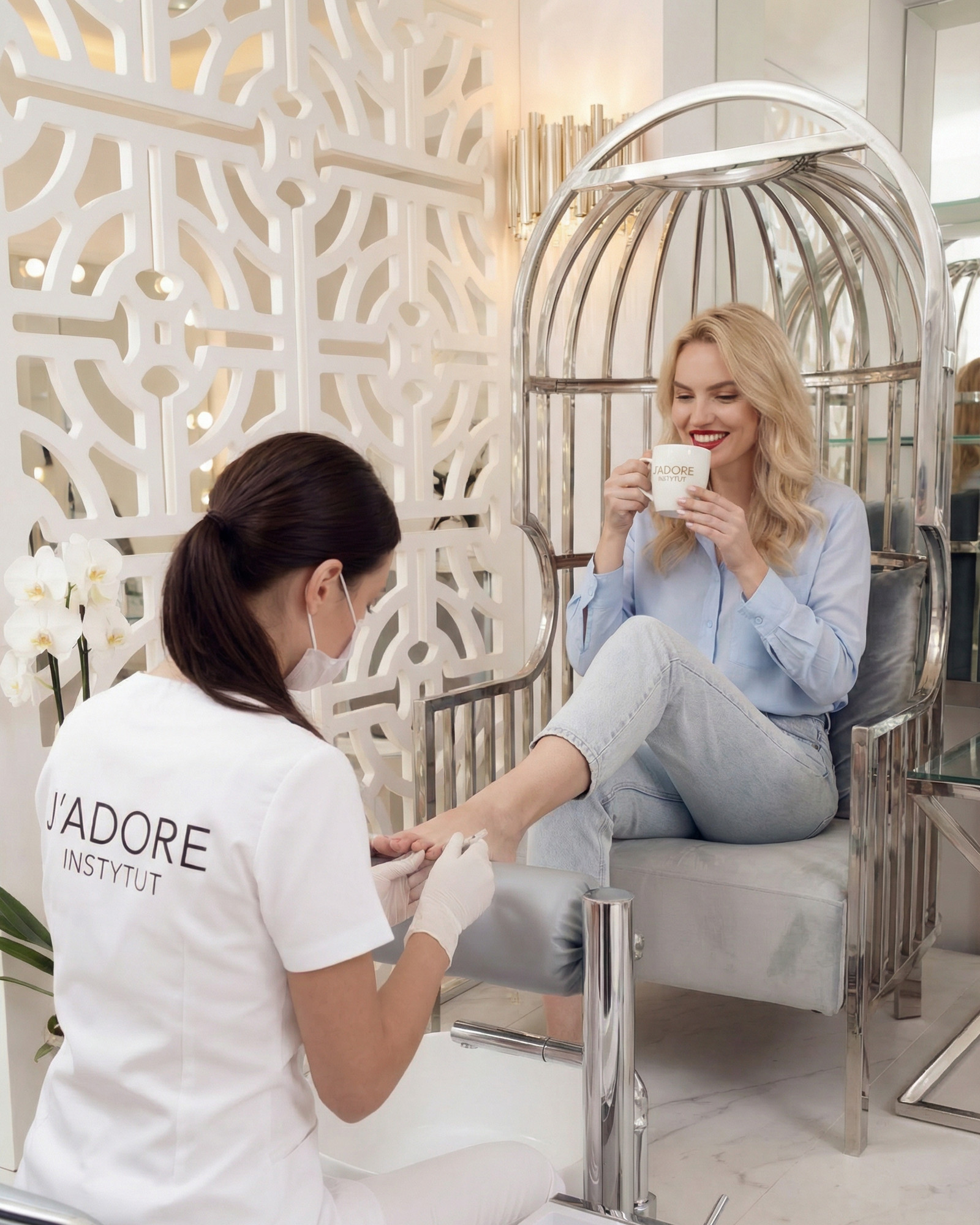
Toenails grow more slowly — and that changes everything
Let us start with the foundation. A nail is not a static piece of keratin — it grows continuously, moving from the base towards the edge. This growth is the first enemy of gel polish on hands. Fingernails grow faster — often twice as fast as toenails. This means that after just a dozen or so days, a visible unpolished section of new growth appears at the base. Visually, there is a gap between the cuticle and the colour. The polish may remain perfectly intact, but aesthetically the manicure has grown out and needs refreshing.
On feet, this problem barely exists on the same scale. Toenails grow slowly enough for regrowth to remain invisible for a long time. The same application and the same quality of polish — but the period of visual wear is much longer, because nature does not push the colour towards the edge as quickly.
A thicker nail plate, a better foundation
The second mechanism is equally simple, yet often overlooked: toenails are usually thicker and harder than fingernails. This is not accidental — the foot carries body weight throughout life, steps on hard surfaces and works under pressure. Toenails have developed greater thickness as a natural response to these demands.
This has a specific effect on gel polish: a thicker, more stable nail plate bends less. Gel polish is hard — once cured under a lamp, it forms a rigid coating. On a flexible, thin fingernail, every bend and every press creates tension at the polish–nail boundary. Slowly, with each movement, this bond weakens. On a thicker toenail, these micro-stresses are much lower — the coating and the base behave more uniformly.
Daily mechanics: hands versus feet
This is probably the easiest reason for the difference to understand. It is also the most underestimated, because it is so obvious that it goes unnoticed. Hands are tools. Literally. For many hours each day, we touch, grip, wipe, wash, open and press. Each of these movements can place mechanical stress on the polish.
Hands — daily mechanical stress
what gel polish does for 16 hours
- Contact with water and detergent: several times a day
- Pressure on nail edges: keyboard, coins, keys
- Sideways friction: opening, unscrewing, gripping
- Temperature changes: alternating cold and hot water
- Exposure to cleaning products and cosmetics
Feet — the gel polish environment
what gel polish does for 16 hours
- Hidden in a sock or shoe: protected from impacts
- Minimal sideways friction on the nails
- Limited contact with water (shower / bath)
- No contact with detergents or chemicals during the day
- Stable temperature inside footwear: fewer temperature changes
The practical conclusion is simple: the environment affects gel polish durability at least as much as the quality of its application. A perfectly applied gel manicure on hands exposed to frequent water or chemical contact will last less long than an average pedicure on the feet of someone who wears closed shoes.
Water — the quiet enemy of every gel polish
Water deserves its own paragraph because it is often underestimated. Keratin, which makes up the nail, is a hygroscopic structure — it absorbs water and swells slightly, then returns to its original size once dry. This cycle is silent and invisible, but it matters for gel polish: each micro-expansion causes minimal movement of the nail plate beneath the rigid polish coating.
On hands, water contact is frequent and intense: hand washing, washing dishes and showering. On feet, it is limited to a few moments during the day. Prolonged soaking of the feet, such as in a bath or during a long shower, can reduce gel polish durability on the feet. Statistically, however, feet are simply in water less often and for less time than hands. This directly affects the cycle of stress in the polish.
How gel polish works — from within
To fully understand why the environment matters so much, it helps to know how gel polish is structured chemically. It is not polish in the traditional sense — it does not “dry”, but polymerises, meaning its structure changes under UV or LED light. Liquid monomers and oligomers combine into a polymer network, creating a hard, flexible coating.
- 01
Base coat
Responsible for adhesion to the nail plate — it determines whether the gel polish stays attached to the nail. Different base coats have different adhesion and flexibility properties.
- 02
Colour (gel polish)
A pigmented polymer layer — once cured, it creates a rigid, richly coloured surface. It is usually applied in two layers for full coverage.
- 03
Top coat
Seals and protects the colour — it is responsible for shine or a matte finish, scratch resistance and UV protection. A weak top coat is the most common cause of lost shine, not chipping.
- 04
Nail plate–base coat boundary
This is where durability is decided. If the nail plate is degreased, dry and matte (filed), the base coat has something to grip. If it is damp, oily or too smooth — the gel polish lifts like a sticker.
This structure makes one thing clear: gel polish is only as durable as the weakest link in the entire system. A perfect top coat will not save gel polish if the base coat does not adhere well to the nail plate. An ideal base coat is not enough if the nail was not prepared properly. And no preparation will help if the polish is exposed every day to an environment that damages it.
What you can do to make gel polish on hands last longer
Now that we know what damages gel polish, we can consciously limit it. None of the rules below is a discovery — but together they create an effect that many people describe as, “suddenly my gel polish lasts 3 weeks instead of 2”.
- Wear gloves when washing dishes and using household chemicals. This is the one piece of advice that makes the biggest difference — and it is most often overlooked because “I only have these dishes to wash”.
- Do not wet your hands for at least one hour after leaving the salon. Fresh gel polish has already been cured under a lamp, but bonding to the nail plate needs several hours to reach full strength.
- Use your fingertip, not your nail, for opening and scraping. The nail edge is the weakest point of gel polish — using it as a tool shortens its durability each time.
- Moisturise your cuticles regularly — dry skin “pulls away” the polish edge, starting at the base.
- Choose a good base coat for your nail type. People with thin, flexible nail plates may need a more flexible base coat than those with thicker, harder nails.
When gel polish on your feet may last for less time
Although feet have a structural advantage, this does not mean gel polish always lasts flawlessly for months. Some situations shorten this time. It is worth knowing them, so you do not blame the product or application when the reason lies elsewhere.
- Shoes with a narrow toe box or shoes that are too tight. Constant pressure on the big toenail from the side speeds up polish lifting beneath the edge.
- Intense physical activity, especially running. Toenails — particularly the big toenails — may hit the shoe with every step. For runners, gel polish on the feet often lasts less time than for people with a sedentary lifestyle.
- Swimming pools, saunas and long baths. Prolonged soaking of the feet works much like soaking your hands — and the difference between feet and hands becomes less noticeable here.
- Skin around the nails that is too thick or callused. It may mechanically “pull away” the polish edge during care or while wearing socks.
- A nail plate that is too thin. Some people have thinner toenails than usual — and the mechanical advantage is then reduced.
Combine gel pedicure with foot care
Gel polish on the feet lasts longer — but this does not mean your feet need less care. Paradoxically, gel polish tends to last best when your feet are well cared for: the nail plate is healthy, the surrounding skin is soft, and the cuticles are removed. A good pedicure prepares the surface and cares for the tissues at the same time — aesthetic and health benefits in one.
Gel pedicure + therapeutic pedicure
For calluses, corns or nail plate concerns — a therapeutic pedicure prepares the foot so that gel polish has an ideal surface and lasts even longer.
Gel pedicure + foot peel
Intensive exfoliation a few days before your appointment removes dead epidermis without the risk of disturbing the polish edge.
Manicure + gel pedicure in one appointment
A practical option for people who want both sets of nails to look well cared for — we arrange the appointments together, and you will see the difference in durability for yourself (and on your nails).
It is also worth remembering that feet are more visible in summer — open shoes, sandals, swimming pools and the beach. This is when gel pedicure serves a dual purpose: it looks great and lasts throughout the season without constant renewal. Winter, in turn, is when many people skip pedicures. Paradoxically, it is the best time to care for your feet “from within”, as the nail plate has time to rest and regenerate without exposure to external factors.