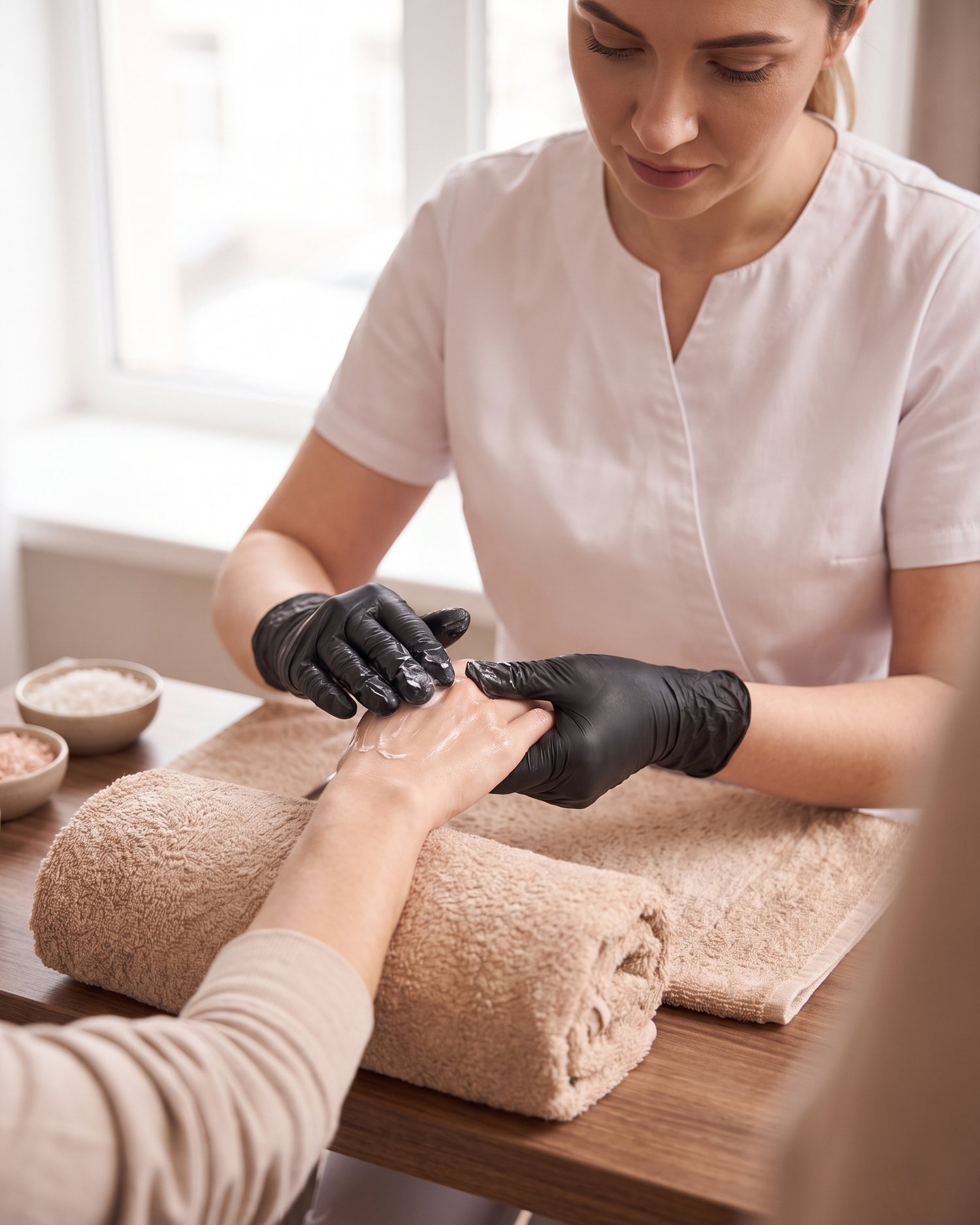
Hands and feet do not use the same result in the same way
Your hand is constantly washed, sanitised, exposed to the weather and rubbed against objects. Your foot spends many hours under pressure, in a sock and a shoe, with less access to air. Both areas can be rough, but the mechanism of daily load is different. A combined package should not lead to identical expectations.
After the treatment, your hands often give the first impression through the contact of your fingers with your own skin. You notice your feet only when walking, putting on socks or resting in the evening. This changes how you evaluate the result. Do not compare only the before and after photos; check the touch, friction and comfort during everyday activities.
Example: after leaving, both areas are soft. The next day, a person working in protective gloves washes their hands a dozen times, while their feet are in comfortable shoes. By evening, the hands return to dryness faster. For another person, who walks all day in hard footwear, the heels give up first. The treatment did not change in quality; the environment changed it.
Peeling removes what is loose on the surface, it does not remodel the foot
- Exfoliating action. It helps to remove part of the uneven, dry layer of the epidermis, which directly reduces the noticeable roughness of the skin.
- Location of the problem. On your hands, you feel the difference mainly around the knuckles and the sides of your fingers, whereas on your feet, it is most often on the heel and sole.
- Choosing intensity. The scope of the treatment should always be tailored to your individual skin needs, as intense friction is not the way to achieve a more professional result.
Thicker epidermis forming under repetitive pressure has a protective function. If the shoe still presses in the same place, the surface will harden again. Cosmetic smoothing does not remove the biomechanical cause. Therefore, we should not promise that one peel will end the problem for the whole summer.
A mask reduces tightness until daily life washes away the protective layer
- Factors affecting hands. The result is shortened by hot water, cleaning agents and the lack of protective gloves when doing housework.
- Factors affecting feet. Skin condition is affected by sweat, friction, swimming pool visits, walking barefoot on rough surfaces and the type of footwear worn.
- Importance of regularity. Home care does not have to be extensive, as a known cream applied regularly gives more than an occasional layer of a random product.
Consistency tolerance is important. A person who hates a greasy layer on their fingers will wash their hands immediately after the treatment. It is better to mention this beforehand and choose a finish that is wearable. The result should fit your actual day, not just look impressive in the first minute.
Hands show the result at work, not just in the salon light
Evaluating your hands is simple: does the skin pull less when you clench your fist, are your knuckles less rough, and do paper and fabric not catch on dry edges? These are more useful indicators than the shine from an oil. A product can temporarily smooth the appearance, even when the surface still needs regular protection.
An office manicure creates a good test. Nails may be groomed, but the skin by your thumb cracks from sanitiser. A spa will improve surface comfort, but if your hands return to frequent contact with detergent without protection, the result will quickly fade. Protective gloves and a cream after washing are part of the plan, not a marketing addition.
The ritual does not remove sun discolouration, does not replenish lost hand volume and does not treat eczema. If your main need is one of these issues, the description "hand regeneration" is too broad. You must choose a consultation or treatment that addresses the real problem.
A good control scene is cooking after your visit. Your hands have contact with water, a chopping board, vegetables and several washes. If they are still comfortable afterwards, and not just slippery from the product, the care has fulfilled its surface goal. If burning or a rash appears after the first detergent, do not add a scented cream. Stop contact with the irritant, observe the reaction and, if necessary, seek a proper assessment.
Feet are evaluated during load, not just on the chair
A foot massage provides temporary comfort and awareness of a place we usually ignore. It does not correct foot alignment, does not change the construction of footwear and does not remove the cause of pressure. If the pain returns after putting on a specific pair of shoes, further spa sessions should not be used to constantly soften the effects of the same pressure.
Imagine someone preparing for a wedding. After the ritual, the heels are soft, but the new shoes have a hard seam. Walking in them all night can create an abrasion regardless of the care. A reasonable result is a smooth surface at the start; safety further depends on proven footwear and observing your skin.
- Daily activity. A runner may enjoy a less rough heel in the evening, and the next day perform a long run in socks that roll up under their toes.
- Impact of external factors. Moisture and repetitive movement quickly overwrite part of the result, as the ritual does not create a friction-resistant layer.
- Preparation strategy. If the goal is to prepare your feet for a competition or a trip, combine cosmetic softness with tested footwear, dry socks and an early reaction to every abrasion.
Massage can bring relief, but swelling has its own causes
A slow touch of your hands, forearms, feet or calves can give a sense of relaxation and lightness. Such an effect is subjective and temporary. It does not mean treating circulatory disorders, neuropathy, injury or swelling of an unknown cause. The ritual should not be given medical tasks just because it includes a massage.
Sudden unilateral swelling, clear warmth, colour change, severe pain or shortness of breath are not material for a cosmetic attempt. The massage must be postponed, and you should seek help appropriate for the symptoms. The statement "I have heavy legs" requires clarification, especially after a long journey or a new injury.
If both feet are tired after an ordinary day, and there are no warning signs, a gentle massage can be a pleasant element. It is worth naming the effect precisely: for the evening it was more comfortable, it was easier to rest, and your feet demanded less attention. This is not the same as solving recurring swelling.
Nails, cuticles and polish belong to a different scope
The spa focuses on skin and comfort. It does not shape the nail plate, does not process cuticles according to a full manicure or pedicure protocol and does not apply colour if these elements have not been booked separately. A soft hand with growing-out polish is a possible result, not a failure of the ritual.
Combining services can give a coherent picture, but the order must be established before the visit. Greasing preparations and occlusion can affect the preparation of the plate for a specific styling. Do not assume that every addition can be spontaneously attached in the middle of the session without significance for the technique and time.
The boundary is also important for nail problems. Ingrown nails, lifting of the plate, pain, colour change or suspected infection are not a matter of choosing a polish. First, a proper assessment is needed. A cosmetic ritual should not cover up a change or delay a diagnosis.
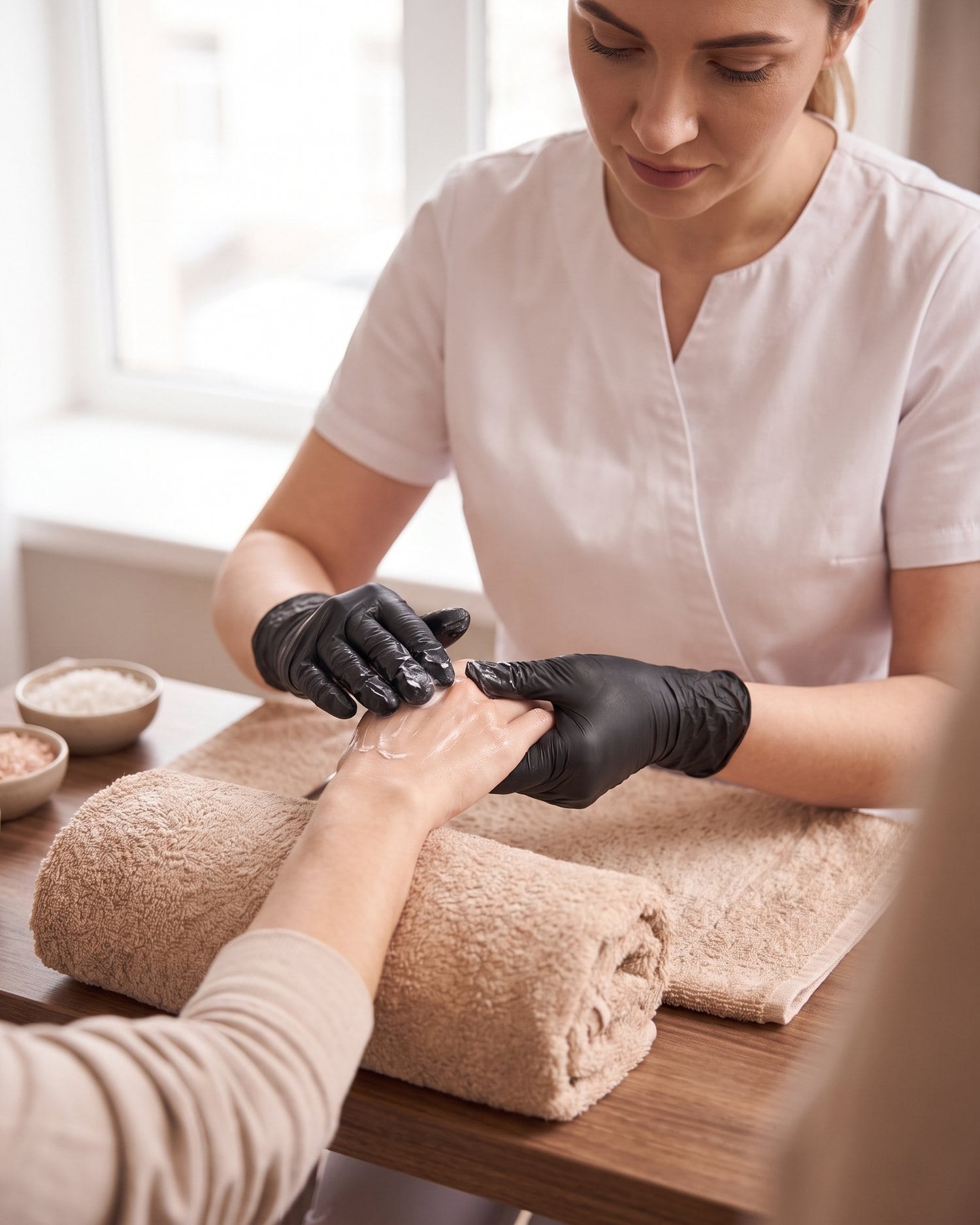
A podiatrist and medical consultation begin where care ends
- Deep cracks and calluses. They require specialist processing by a podiatrist, as they fall outside the scope of a standard peel or mask.
- Corns and ingrown nails. These are changes requiring professional assessment, and if necessary, a referral for a medical consultation.
- Warts and suspected fungal infection. In the case of these changes, the path of action must be different than for routine cosmetic care.
Diabetes, sensory disorders and circulatory problems require special caution. A small injury may be noticed later, which is why aggressive abrasion or very hot preparations are not a reasonable home experiment. Before the service, tell us about your diagnosis and follow the recommendations of the practitioner.
The spa can return later as a gentle supplement if the skin is healed and specialist recommendations allow it. It does not compete with podiatry. The sooner you choose the right scope, the lower the risk that a pleasant cosmetic service will be burdened with a task it cannot perform.
The longevity of the result is measured by habits, not a universal number of days
One person will notice softness for a long time, another will lose it after a few shifts at work. The pace depends on initial dryness, washing, weather, footwear, activity and home protection. Giving one promised number would ignore all these differences.
Do a simple test after two evenings. For your hands, check your knuckles and the area around your thumb after the last wash. For your feet, evaluate your heel after taking off your regular shoes, not right after cream. Write down where the effect has faded. The next decision may concern the care of one place instead of automatically repeating the whole package.
A home plan should be feasible: a gentle cleanser, cream after the last hand wash, a foot product used as needed, protection against detergents and footwear that does not create new friction. Another aggressive peel will not replace these simple actions.
Hand and foot spa in Krakow: choose a variant according to your real need
When booking, please let us know if your priority is your hands, feet, or both areas. Also, describe any cracks, pain, nail changes, sensory disturbances, or diagnoses that may affect your care. This information may indicate that a different consultation is required before a cosmetic appointment.
A walk around Krakow after your visit will quickly put your feet to the test, but do not plan a long route in stiff, new shoes immediately. As for your hands, carrying shopping in the cold without protection will not help. Your local plan does not require a ceremony: just a calm return and conditions that do not undo the fresh care.
If you are combining your visit with another nail service, please mention this when booking. The order should not be improvised upon arrival, especially when a rich preparation leaves a film on the nail plate or when the skin requires very gentle work. For the ritual itself, arrive in footwear that does not press on your freshly cared-for feet, and avoid plans for an immediate long walk. Such small details will not extend the results indefinitely, but they will ensure they are not lost in the first hour.
The best result has a clear limit
After a well-chosen ritual, the skin on your hands and feet may feel softer, smoother, and less tight, and the massage may bring temporary comfort. However, your nails will not automatically change shape, a callus will not disappear at the source, and an infection will not become a cosmetic issue.
Before your visit, identify one change you expect. After the visit, check it during daily activities: when washing your hands, putting on socks, or walking in familiar shoes. Then, define the limit. If it still hurts, cracks, grows inwards, or changes colour, choose the right path instead of adding a stronger peel.
Cosmetic care is valuable precisely when it does not pretend to be podiatry, a manicure, or medical treatment. It can quickly improve the surface feel and give your hands and feet a rest. Results last longer when built on simple decisions: protection from irritation, sensible footwear, regular moisturiser, and responding to symptoms that a SPA should not handle.