

Where did the idea of injecting CO2 come from?
The history of carboxytherapy begins in 1932, at the French spa town of Royat. Doctors there noticed something interesting. Patients who bathed in naturally carbonated thermal springs, rich in CO2, healed wounds faster, had fewer circulation problems and had healthier-looking skin. Researchers began to investigate why.
The answer turned out to be fascinating. Carbon dioxide, applied topically or subcutaneously, triggers a cascade of physiological reactions. These improve blood flow, oxygenation and tissue regeneration. Over the following decades, carboxytherapy evolved from spa medicine into a tool used in angiology (vascular disease), dermatology and aesthetic medicine.
Today it's a treatment performed in clinics worldwide — from Brazil, where it's hugely popular, to South Korea, Italy and Poland.
The Bohr effect — why CO2 under the skin is genius, not madness
The mechanism behind carboxytherapy rests on a phenomenon described in 1904 by the Danish physiologist Christian Bohr — yes, the father of Niels Bohr, the Nobel laureate in physics. The Bohr effect is a fundamental principle of respiratory biochemistry:
As CO2 concentration in tissue rises, haemoglobin releases oxygen more readily.
Normally, haemoglobin carries oxygen from the lungs to tissues and releases it where needed. But a raised CO2 concentration in a given area acts like an alarm signal. Haemoglobin reads it as "this tissue is active, it needs more oxygen" — and releases oxygen more readily.
What happens step by step after CO2 is injected under the skin:
- Local pH drop — CO2 reacts with water in the tissue, forming carbonic acid. pH falls.
- The Bohr effect — haemoglobin in the capillaries releases more oxygen.
- Vasodilation — CO2 has a vasodilatory effect. Blood vessels widen, and blood flow can increase 3–5 fold.
- Local "paradoxical hypoxia" — the body reads the sudden influx of CO2 as a sign of oxygen deprivation and triggers repair mechanisms.
- Neoangiogenesis — new capillaries form, and microcirculation improves for the long term.
- Lipolysis — in fatty tissue, CO2 damages the membranes of fat cells. The released fat is then metabolised by the body.
- Fibroblast stimulation — improved blood flow and oxygenation stimulate fibroblasts to produce collagen and elastin.
It sounds counterintuitive. You inject a "waste" gas, and you get better circulation, less fat and more collagen. But that's biochemistry for you. And more than 90 years of research confirm it.
What does carboxytherapy help with?
The list of indications is surprisingly wide.
Cellulite
This is probably the most popular indication. Cellulite — gynoid lipodystrophy — isn't just about fat. It's a structural problem. Fibrous septae pull the skin downward, and disrupted microcirculation causes swelling and unevenness.
Carboxytherapy tackles cellulite from two directions. It improves microcirculation — less swelling, better drainage. And it mechanically loosens the septae, as pressurised CO2 breaks up fibrous adhesions. Studies published in Aesthetic Plastic Surgery showed a reduction in cellulite of 1–2 grades on the Nürnberger-Müller scale after a series of 8–10 sessions.
Dark circles
Dark circles under the eyes are usually a vascular problem — thin skin, visible blood vessels underneath, poor microcirculation. Carboxytherapy in the under-eye area improves circulation, thickens the skin and lightens the shadows. The effect can be spectacular, especially when the dark circles have a vascular rather than pigmentary cause.
Stretch marks
Stretch marks — striae — are scars in the dermis, caused by ruptured collagen and elastin fibres. Carboxytherapy stimulates the rebuilding of these structures. It improves blood flow to the scar tissue and evens out its colour. Young stretch marks, red or purple, respond best. Older white ones improve too, but more slowly, and need more sessions.
Skin laxity
On the arms, inner thighs, the abdomen after pregnancy — anywhere the skin has lost its spring. Collagen stimulation and improved microcirculation deliver a firming effect that builds with every session.
Localised fat
The chin, love handles, the "banana roll" under the buttocks — carboxytherapy isn't an alternative to liposuction. But for small fat deposits, it can reduce them effectively. CO2-induced lipolysis is confirmed by research: fat cells undergo mechanical damage and apoptosis.
What does the treatment involve?
Picture a visit that takes 15–30 minutes and needs no preparation.
Step 1: The doctor or cosmetologist disinfects the skin in the treatment area.
Step 2: A fine needle — 30G, thinner than a blood-draw needle — connected to a medical CO2 device is inserted under the skin to a depth of 2–4 mm.
Step 3: CO2 is delivered in controlled doses. The device precisely regulates gas volume, flow and pressure.
Step 4: You'll feel a characteristic sensation of pressure or crackling under the skin. That's the CO2 spreading through the tissue. Discomfort is mild to moderate. It's definitely not a painful treatment, though it isn't entirely without sensation either.
Step 5: After the treatment, you may notice mild redness, swelling or crackling under the skin at the injection site — subcutaneous emphysema — which resolves within 30–60 minutes. CO2 is absorbed by the tissue and expelled through the lungs. You literally breathe it out within minutes.
Back to daily life: Immediate. You can go to work, to the gym, out for dinner. There's no downtime.
Series of treatments — what to expect?
Carboxytherapy works best as a series. A single session gives some effect, but real results come with repetition.
Standard protocol:
- Cellulite: 8–12 sessions, 1–2 times a week
- Dark circles: 4–6 sessions, once a week
- Stretch marks: 8–10 sessions, once a week
- Skin laxity: 6–10 sessions, 1–2 times a week
Results build up. Each session builds on the last. Improved microcirculation and neoangiogenesis — the formation of new blood vessels — take time. First visible changes appear after the 3rd–4th session. Full results show once the series is complete.
Results last 6–12 months after the series. We recommend maintenance sessions every 4–6 weeks.
Is it safe? (Yes, very)
This is one of the most common questions, and rightly so. Injecting gas under the skin sounds alarming. But the facts say otherwise:
CO2 is a natural metabolite. Your body produces around 200–250 ml/min of it through cellular respiration. The amount of CO2 delivered during a session — 50–100 ml — is a fraction of what your body processes in a single minute.
CO2 is expelled through the lungs. It doesn't accumulate in tissue and doesn't need to be metabolised by the liver or kidneys. Within 5–10 minutes of the treatment, all the gas delivered has been cleared from your body.
No systemic toxicity. In more than 90 years of using carboxytherapy, no serious systemic adverse effects have been recorded. Studies involving thousands of patients confirm a safety profile comparable to needle mesotherapy.
Contraindications are standard: pregnancy, clotting disorders, severe respiratory insufficiency, active infection in the treatment area. This is common sense, not a list of horrors.
Carboxytherapy vs. mesotherapy — which one?
This comparison comes up often, since both treatments use a needle and work under the skin. But the mechanism is completely different.
Mesotherapy = injecting a cocktail of active substances — hyaluronic acid, vitamins, amino acids, peptides. A chemical action: you deliver ingredients the skin then uses.
Carboxytherapy = injecting a gas, CO2. A physical and physiological action: you trigger the body's own repair mechanisms, without introducing any external substance.
- Mechanism — Physical (Bohr effect, vasodilation) — Chemical (delivering active ingredients)
- Best for — Cellulite, microcirculation, fat, stretch marks — Hydration, nourishment, revitalisation
- Pain — A sensation of pressure, mild — Pinpricks, mild to moderate
- Downtime — None — None to minimal
- Effect on microcirculation — Very strong — Moderate
- Lipolysis — Yes — No (unless combined with phosphatidylcholine)
The best answer? You don't have to choose. These treatments complement each other beautifully. Carboxytherapy improves microcirculation and prepares the tissue. Mesotherapy delivers nourishing ingredients. Many protocols combine both — carboxytherapy one week, mesotherapy the next.
Who should NOT have carboxytherapy?
Let's be precise:
- Pregnant women — there isn't enough research on the pregnant population
- People with severe clotting disorders — risk of haematoma
- Severe respiratory insufficiency — advanced COPD, for example — additional CO2 could disrupt the body's gas balance
- Active skin infections in the treatment area
- Epilepsy — a relative contraindication
For the remaining 95% of the population — the green light is on.
Julia Reology — carboxytherapy at J'ADORE
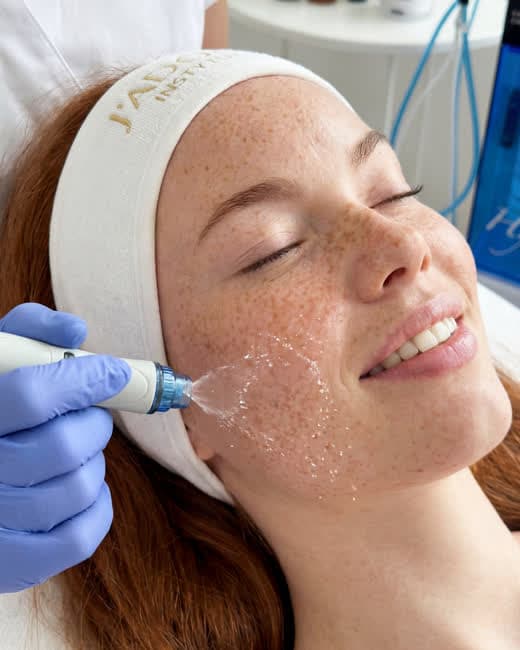
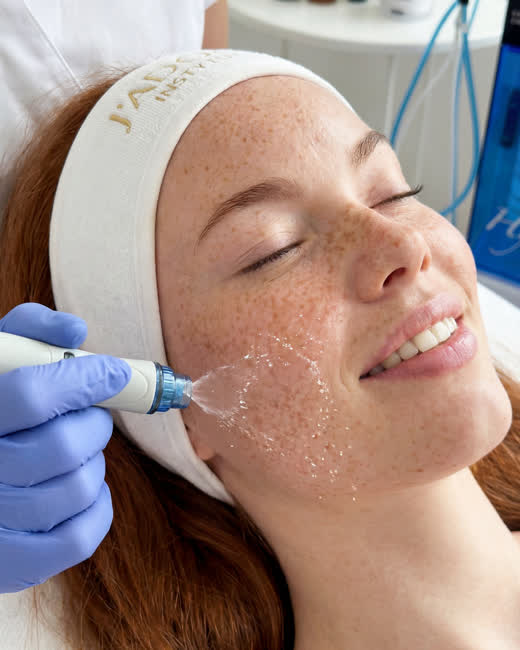
At J'ADORE INSTYTUT, we perform carboxytherapy using the Julia Reology system — an advanced medical device that gives precise control over treatment parameters: CO2 flow, pressure and gas temperature. This isn't "a needle attached to a canister". It's a certified medical device that delivers repeatable, safe and effective treatments.
We invite you for a consultation at our salons in Warsaw (Żelazna, Mińska) and Krakow (Karmelicka). Let's talk about your goals — cellulite, dark circles, stretch marks, or anything else — and put together a plan that really works.
Because CO2 under the skin sounds strange. But once you understand the science behind it, the only strange thing is that you haven't tried it sooner.
