

Statistics that normalise the regret
According to a 2023 Harris Poll survey, 30% of American adults have at least one tattoo. Of that group, one in four (25%) reports regret — partial or total. In the 18–34 age group, the "regret" figure reaches 36%.
Polish data are harder to come by, but the trend is global. The tattoo removal market grows by double digits every year and is approaching several billion dollars globally by 2030. This isn't a niche — it's mainstream.
The most common reasons for regret:
- An ex-partner's name — a classic. Number one on the list for years.
- Poor-quality work — done cheaply, crooked, with blurred lines.
- A change in taste — tribal designs, Chinese characters, "motivational quotes" from 2015.
- Career — a role that requires a formal appearance.
- Location — neck, hands, wrist — places that are always visible.
- Lack of coherence — a collection of random tattoos that don't form a whole.
How laser removes a tattoo — physics in the service of aesthetics
A Q-switched laser (or its more modern version — picosecond) emits ultra-short pulses of light at very high energy. Each pulse lasts nanoseconds in Q-switched lasers or picoseconds in picosecond lasers. The pulse duration must be shorter than the thermal relaxation time of the pigment particles — otherwise the energy spreads into the tissue instead of breaking up the ink.
What happens in the skin, step by step:
- Absorption — tattoo pigment absorbs laser energy. Different wavelengths target different colours.
- Photomechanical effect — the pulse energy causes rapid expansion and fragmentation of the pigment particles. Large clumps of ink break down into microscopic fragments.
- Phagocytosis — macrophages (immune system cells) recognise the fragments as foreign bodies and engulf them. They transport them through the lymphatic system to the liver, where they're metabolised.
- Repetition — each session breaks up another "layer" of pigment. Session by session, the tattoo fades until it's invisible or light enough for a cover-up.
How many sessions you really need — the honest answer
There's no single figure here, because every tattoo is different. However, there's a scoring system called the Kirby-Desai Scale, which takes 6 factors into account and gives realistic estimates.
- Skin phototype — fair skin (I–III) responds better; dark skin (IV–VI) needs more caution and may give less predictable results.
- Location — the torso and arms (good lymph flow) respond faster; feet, hands and fingers (poor flow) — slower.
- Ink colour — black and dark navy are the easiest; green, turquoise, yellow and white — the hardest.
- Amount of ink — amateur work (shallow, little pigment) is easier; dense, saturated professional work is harder.
- Layering — a first tattoo is easier; a cover-up on a cover-up (multiple layers) is much harder.
- Scarring — its presence blocks the laser's effectiveness.
Realistic session estimates:
- Amateur tattoo, black ink, fair skin: 4–6 sessions
- Professional, black, fair skin: 6–10 sessions
- Professional, multicoloured: 8–12+ sessions
- Cover-up (multiple ink layers): 10–15+ sessions
Colours — a hierarchy of difficulty
Not all inks are equal when faced with a laser. The better a pigment absorbs a specific wavelength, the faster it fades.
For a multicoloured tattoo, a specialist assesses each colour separately and presents a realistic plan — what can be removed effectively, and where you should expect an imperfect result.
Pain — honestly, no sugar-coating
"Does it hurt?" is the question everyone asks, but few get an honest answer. Here it is: yes, it hurts. Usually more than getting the tattoo itself.
Comparisons clients use: "hot oil splashing on the skin", "a rubber band snapping repeatedly", "welding sparks". Pain depends on location (ribs, neck, wrist > arm, calf), the size of the treatment area and individual tolerance.
Ways to ease the pain:
- Numbing cream (EMLA or similar) — applied 45–60 minutes before the treatment under occlusion. Standard practice in most salons.
- Cold cooling (cryo cooling) — a stream of cold air on the skin during the treatment. Significantly reduces pain.
- Short sessions — a small tattoo takes a few to a dozen or so minutes. A large one requires breaks.
Cover-up vs. full removal vs. fading for cover
You have three strategies, and each makes sense in a different situation:
Aftercare — how to look after your skin after the treatment
Skin is irritated after a laser session — that's a normal reaction. How you care for it between visits has a direct impact on the result and healing time.
What to watch out for — red flags at a salon
Tattoo removal is a laser treatment performed by a specialist. The choice of salon is crucial for both results and safety.
- No information about the laser type — a professional will always tell you: Nd:YAG Q-switched and the wavelength.
- A promise of removal "in 2–3 sessions" — every reliable specialist knows this is unrealistic for most tattoos.
- No initial consultation or individual assessment of the tattoo.
- No questions about skin phototype, photosensitising medications or autoimmune conditions.
- Pricing "per tattoo" instead of an assessment of size and complexity.
- No written aftercare instructions after the treatment.
At J'ADORE, we remove tattoos with an Nd:YAG laser
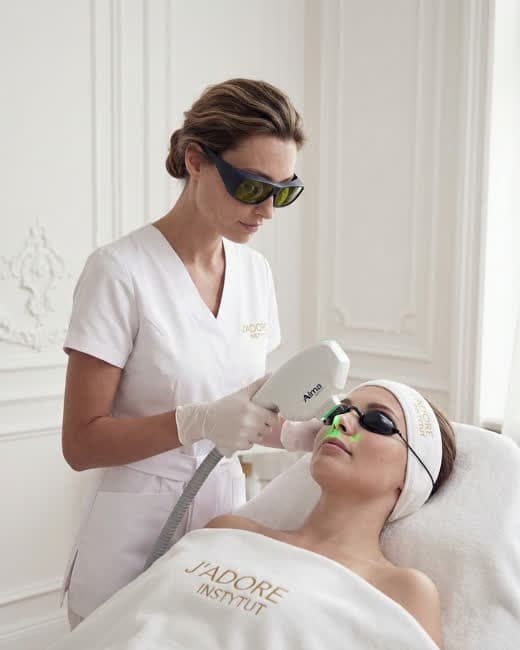
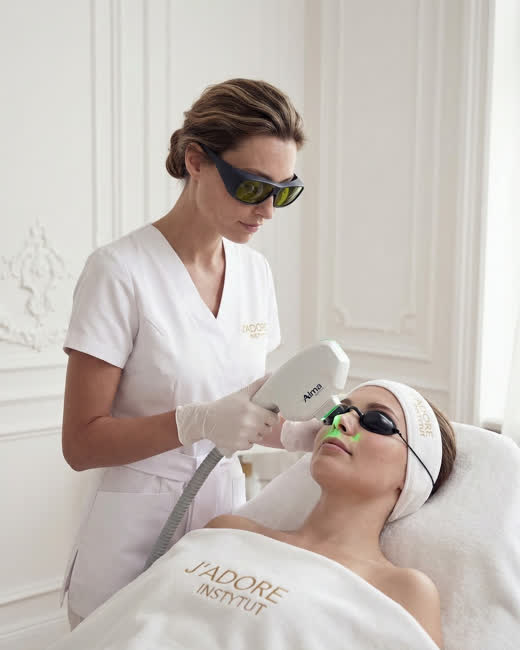
At J'ADORE INSTYTUT, we work with the Nd:YAG Q-switched laser — the industry gold standard — with access to two key wavelengths, which lets us target a broad spectrum of ink colours.
Every client starts with a free consultation, during which we assess the tattoo (colour, density, depth, location, skin phototype) and present a realistic plan — how many sessions, what interval between them. No empty promises. We also perform a test spot so you can see how your skin reacts.
