

Where the myth came from
It isn't entirely a myth. Rather, it was true once — and over time became an oversimplification.
For years, the main laser tools in salons were the CO2 laser (ablative) and IPL (Intense Pulsed Light). Both work on a principle that demands absolute caution around sun exposure.
That's where the rule "lasers only from October to March" came from — and for years it was correct. The problem is that technology moved on, while the rule stayed put.
A new generation of lasers — different rules of the game
Modern medical lasers are a completely different class of device compared to those from 10–15 years ago. And this is where the most important part begins: there's no single answer to "can I have laser treatment in summer?" — there are dozens of different lasers, and each follows its own rules.
Diode laser hair removal — safe in summer
Diode laser hair removal (Soprano ICE Platinum, for example) is the treatment relevant to the largest number of people. A diode laser targets melanin in the hair follicle, not the epidermis.
Why is it safe in summer? Three reasons:
- SHR technology (Super Hair Removal) — instead of one powerful pulse, Soprano delivers a series of short, low-intensity pulses that gradually warm the hair follicle. The epidermis isn't exposed to a sudden thermal shock.
- Contact cooling system — the ICE tip keeps the temperature close to 0°C throughout the treatment. The epidermis is actively protected from overheating.
- Less dependence on melanin contrast — SHR works by accumulating heat rather than delivering a single strike at melanin. This can make it more effective and safer on darker, tanned skin than traditional alexandrite lasers.
ClearLift — the anti-ageing laser that ignores the calendar
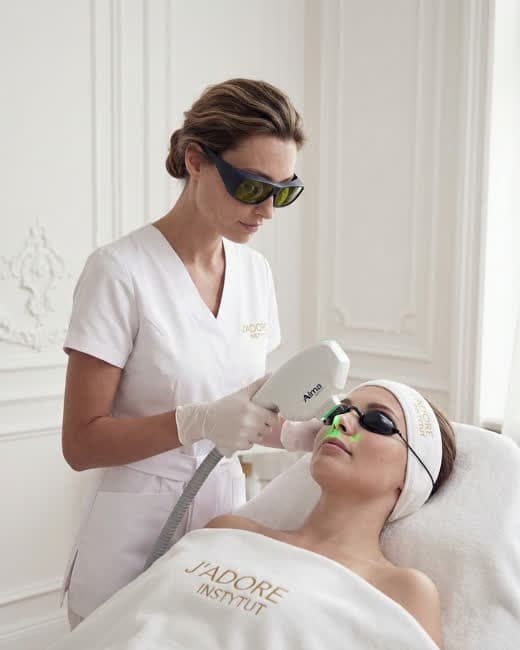
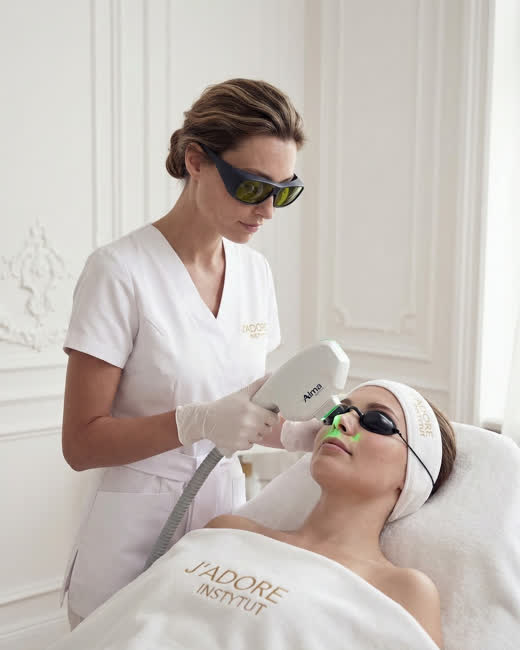
ClearLift (Harmony XL Pro, Alma Lasers) is a Q-Switched Nd:YAG laser that uses non-ablative fractional rejuvenation technology. The idea is simple: the laser passes through the epidermis without damaging it and creates thermal micro-columns in the dermis.
Result: collagen stimulation, improved elasticity, reduced fine lines, and a more even skin tone — with no visible damage to the epidermis.
- Zero downtime — literally. You leave the salon with no redness, swelling or flaking.
- The epidermis stays intact — the skin's protective barrier remains whole.
- The 1064 nm wavelength is poorly absorbed by melanin, so the risk of hyperpigmentation is minimal.
- You can apply makeup immediately after the treatment.
This is a laser after which you go straight back to work or a meeting, and no one knows you've had a treatment. Underneath the surface, remodelling processes are already under way, delivering results over the following weeks.
Vascular lasers — caution, not a ban
Lasers that target haemoglobin, used to treat telangiectasia (broken capillaries), redness and rosacea, need a little more caution in summer. But they aren't automatically off-limits.
- Nd:YAG 1064 nm for vascular treatment — penetrates deeper and interacts less with epidermal melanin. It can be used in summer with standard sun protection.
- KTP 532 nm — more superficial, more strongly absorbed by melanin. Here, extra caution applies — on tanned skin, it's often better to skip it or lower the treatment settings.
A rule worth remembering
Non-ablative lasers (ClearLift, fractional 1540 nm), SHR diode hair removal, and gentle vascular treatments can be performed safely all year round, provided you follow basic sun protection rules.
SPF after treatment — not optional
Whatever the laser type and time of year, one rule never changes: SPF 50 after a laser treatment is an absolute must.
Not SPF 15 in your foundation. Not a "moisturiser with SPF". A dedicated product with SPF 50+, PA++++ protection, applied in the right amount and reapplied whenever you're exposed to sunlight.
When to genuinely wait until autumn
Some treatments are genuinely better postponed in summer:
- Fractional CO2 laser — the gold standard for rejuvenation, but it needs around two weeks of recovery and several weeks of strict sun protection afterwards. In summer, that's almost impossible to maintain.
- IPL for hyperpigmentation — effective in autumn and winter, when skin is paler and the contrast between the pigmented patch and surrounding skin is greatest. In summer, the risk of burns rises.
- Deep chemical peels (TCA 30%+, Jessner, phenol) — remove the epidermis. They need weeks of recovery without UV exposure.
- Alexandrite laser for hyperpigmentation — on tanned skin, the risk of complications rises significantly.
How to decide — a practical approach
Before calling the clinic to ask "can I have this done?", ask yourself three questions:
- Is my skin currently tanned? If so, wait at least 2–3 weeks without sun exposure, whatever laser you're considering.
- Am I planning intense sunbathing within 2 weeks of the treatment? If so, postpone it. No sunscreen offers 100% protection on the beach for hours at a time.
- Does the treatment I'm planning damage the epidermis? If not, it's probably safe. If it does, it's better to wait until autumn.
A summer laser break is a waste of time
Many men treat laser hair removal as an autumn-and-winter project — a few sessions from October to March, then a pause until the next season. The problem? Losing continuity.
Hair grows in cycles — anagen, catagen, telogen — and a laser only works on hair in the active growth phase. A 6-month break means some follicles "sit it out", and you end up starting almost from scratch.
Laser treatments at J'ADORE — all year round
At J'ADORE INSTYTUT, we work with the Harmony XL Pro platform (Alma Lasers) — one of the most versatile laser systems on the market, with multiple interchangeable applicators. We also use Soprano ICE Platinum for laser hair removal.
This means we can match the technology to the season, your skin phototype and your specific concern, rather than sticking to the rule "laser equals autumn". ClearLift for rejuvenation, all year round. Soprano for hair removal, with no summer break. Nd:YAG for vascular concerns, assessed individually.
