What biostimulators actually are (and what they are NOT)
Let's start with the fundamentals, since this is where most confusion begins.
Why does this matter? Because biostimulation improves the quality of your skin — its thickness, elasticity, hydration and firmness — not just its shape. It answers a question many women ask themselves in the mirror: "Why does my skin look so... tired?"
Hyaluronic acid skin biostimulator — bioremodelling
Some skin biostimulators are based on high-purity hyaluronic acid (HA). Some formulas combine high- and low-molecular-weight HA. Composition and mechanism of action depend on the product; they are not shared by all skin biostimulators.
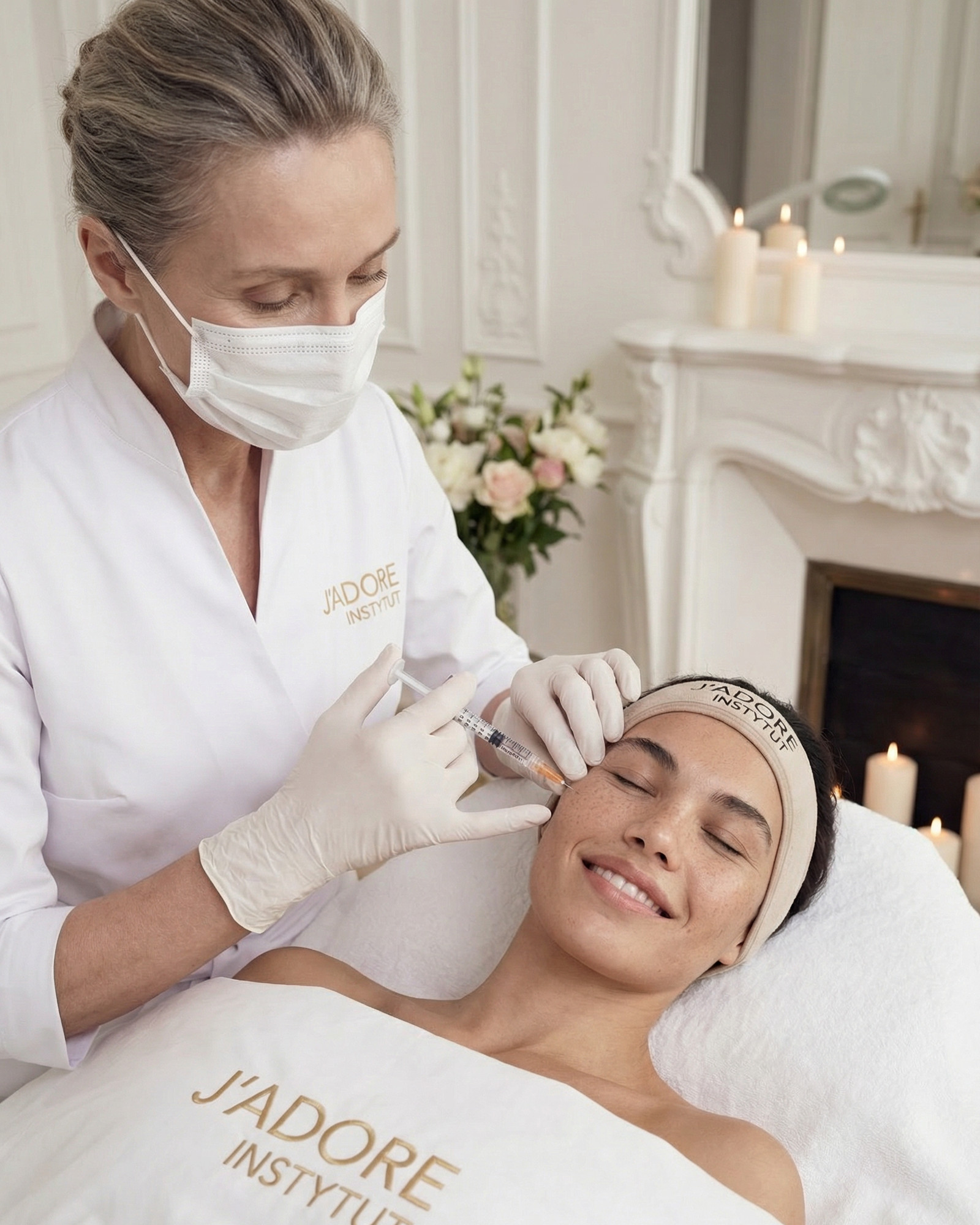
The skin biostimulator doesn't fill or contour — it remodels the skin from within. After injection, it spreads through the tissue and stimulates the production of various types of collagen, elastin and your own hyaluronic acid.
Ideal for: thin, dehydrated, "paper-like" skin; loss of elasticity on the cheeks, neck, décolletage or hands. Suitable both as prevention for women in their 30s and as regeneration for women past 60.
Not suitable if: you need volume correction (that's a job for fillers) or you have very deep wrinkles that need stronger support.
Sculptra — a marathon of collagen rebuilding
Sculptra (poly-L-lactic acid, PLLA) has been on the market for over 20 years — originally used to treat lipoatrophy. In aesthetic medicine, it's enjoying a second youth, quite literally. It's a biostimulator for the patient — but the results it leaves behind are often spectacular.
Once injected, PLLA triggers a controlled, microscopic inflammatory response. Sounds alarming? It's precisely this response that prompts fibroblasts to start mass-producing type I collagen — the "structural" kind, the most durable. The preparation itself is absorbed within weeks, but the collagen it leaves behind can remain for over two years.
Ideal for: significant facial volume loss, "sunken" cheeks, nasolabial folds caused by tissue loss, "tired" hands. Most common after 40, though increasingly used from 35.
Not suitable if: you're looking for a fast result (full results appear after several months) or you have thin, sensitive skin under the eyes — Sculptra isn't applied there.
Nithya — the Italian newcomer with an amino acid base
Nithya is a relatively new player on the market, but with a powerful composition. It's based on calcium hydroxyapatite (CaHA) — the same ingredient as in Radiesse — but in an innovative formula enriched with amino acids identical to those found in human collagen. This combination creates a dual mechanism: immediate tissue support plus long-term stimulation.
CaHA microspheres form a "scaffold" for new collagen fibres — something like a structure that ivy climbs. Amino acids supply fibroblasts with ready-made "building blocks" for collagen. New collagen production can be faster and more effective than with CaHA alone.
Ideal for: loss of firmness and volume, "sagging" facial contours, lax body skin (arms, abdomen, knees). Women roughly between 35 and 60 who want something between simple hydration and full volume restoration.
Not suitable if: you have a calcium allergy (extremely rare) or expect the effect of a surgical lift.
Comparison — one glance, a clear decision
- Skin biostimulator — high- and low-molecular-weight hyaluronic acid in some products; bioremodelling and hydration; product selection and timing of results assessment depend on skin condition and the treatment plan
- Sculptra — poly-L-lactic acid (PLLA); collagen and volume restoration; full results after several months; ideal for significant volume loss, from around age 40
- Nithya — calcium hydroxyapatite + amino acids; stimulation plus tissue support; results after 2–3 months; ideal for laxity and loss of contour, aged 35–60
Each of these preparations works differently. The right choice depends on your skin condition, your expectations and how much time you have to wait for results.
Nucleofill and Linerase — worth knowing about as complementary options

2026 trend: biostimulator instead of filler
This isn't a fad — it's a shift in approach. More and more aesthetic medicine doctors are choosing biostimulators as their first tool, reserving fillers for targeted corrections.
- Naturalness. Biostimulators don't change your features — they improve tissue quality. There's no risk of an artificial look.
- Prevention. You can start early, before deep deficits appear. A 32-year-old using the skin biostimulator isn't excessive — it's wise.
- Complementarity. Biostimulators work beautifully alongside other treatments — Botox, lasers, peels. They improve the "foundation" on which everything else often performs better.
- Lower risk. No risk of the preparation migrating, no artificial look, no "pillow" effect.
What should you choose? A quick guide
- "I want my skin to look rested and hydrated" → skin biostimulator
- "I've lost volume, my face looks sunken" → Sculptra
- "I need both firmness and light support" → Nithya
- "I'm 30+ and want to start prevention" → skin biostimulator or Nucleofill
- "I want an effect that lasts the longest" → Sculptra
And the best answer? It's the one you'll hear during a consultation with a doctor who knows your skin, your history and your expectations.
J'ADORE INSTYTUT — all biostimulators in one place
At J'ADORE INSTYTUT salons in Warsaw (Żelazna, Mińska) and Krakow (Karmelicka), we work with a full portfolio of biostimulators — skin biostimulator, Sculptra, Nithya, Nucleofill and Linerase. We don't have a "favourite" preparation — we have a favourite approach: matching the treatment to you, not you to the treatment.
Consultation is the starting point. We assess skin quality, the degree of volume loss, your priorities and realistic possibilities. Sometimes the best solution is a single preparation. Sometimes it's a combined strategy spread over several months. But it's always transparent, evidence-based and free of pressure.