

The skin barrier — what it is and why you have one
Picture a brick wall. The bricks are epidermal cells (corneocytes). The mortar between them is lipids — a mixture of ceramides (50%), cholesterol (25%) and free fatty acids (25%). This "wall" is your skin barrier, known scientifically as the stratum corneum — the outermost layer of the epidermis, just 10–30 micrometres thick (thinner than a sheet of paper), yet absolutely essential for the health of your whole skin.
What does the barrier do?
- It keeps water in — it prevents transepidermal water loss (TEWL)
- It keeps pathogens out — bacteria, allergens, pollutants
- It maintains skin pH (4.5–5.5) — the acid mantle inhibits microbial growth
- It regulates permeability — it decides what gets absorbed into the skin and what doesn't
A healthy barrier means hydrated, smooth, resilient skin. A damaged barrier means chaos.
November: the perfect storm for your skin
Why now specifically? Because in November three factors converge, attacking the skin barrier with a force no other month brings.
Factor 1: Central heating
You switch the radiators on in October. By November they're running at full power. Humidity in a heated flat drops to 20–30% — while skin needs at least 40–60% to function properly.
Dry air acts like a sponge — it literally draws water out of your skin. A study published in the Journal of Investigative Dermatology (2023) found that exposure to air below 30% humidity for 8 hours a day leads to a 25% increase in TEWL within just a week.
You spend 15–18 hours a day in heated spaces (home plus office). That's 15–18 hours of continuous skin dehydration.
Factor 2: Thermal shock
In the morning, you step out of a 22-degree flat into a 3-degree morning. Blood vessels dilate and constrict, temperature shifts by 19 degrees within seconds. In the evening — the same, in reverse.
Each shock is a micro-stressor for the barrier. Skin lipids lose elasticity in low temperatures — they literally "set" like butter — which makes the lipid mantle brittle and prone to cracking.
Factor 3: Wind and low outdoor humidity
A November wind in Warsaw or Krakow is no gentle breeze. It's a dry, cold current of air that physically strips the thin protective layer from the skin's surface. Combined with low outdoor humidity (40–60% in a Polish November, versus 70–80% in summer), skin is attacked from both sides: from within (heating) and from outside (wind and cold).
The result? The barrier cracks. Quite literally — under a microscope, a damaged skin barrier looks like a wall with gaps in the mortar.
How to recognise a damaged barrier — 7 warning signs
A damaged skin barrier doesn't announce itself with a rash or swelling. Its symptoms are subtle, but distinctive:
- Tightness — a "too-tight skin" feeling after cleansing that doesn't ease even after applying cream
- Stinging from products — a cream, toner or serum you've used for months suddenly stings. Nothing changed in the product — your skin changed
- Dryness that doesn't respond to moisturising — you apply cream, and within an hour skin is dry again. Water escapes through the damaged barrier faster than you can replenish it
- Redness — especially on the cheeks and around the nose. A damaged barrier lets allergens and irritants through, triggering inflammation
- Flaking — dry patches, especially around the mouth and on the forehead
- Overreactivity — skin reacts to everything: wind, hot water, a new product, even touch
- "The cream won't absorb" — you apply a moisturising product and it just sits on the skin's surface instead of sinking in. It's a paradox: a damaged barrier loses water and refuses to accept it from outside at the same time, because disorganised lipids disrupt the transport of substances
If you recognise three or more of these signs, your barrier needs help.
How to repair the barrier — a step-by-step protocol
Step 1: Ceramides — rebuilding the "mortar"
Ceramides are the absolute foundation of barrier repair. They make up 50% of the epidermis's intercellular lipids, and without them, the barrier simply doesn't exist. Look for these on the label:
- Ceramide NP (ceramide 3) — the most commonly used, best-studied form
- Ceramide AP (ceramide 6-II) — supports exfoliation and epidermal renewal
- Ceramide EOP (ceramide 1) — forms the "scaffold" of the lipid barrier
Proven products: CeraVe Moisturising Cream (a classic with 3 ceramides), Dr. Jart+ Ceramidin Cream, Illiyoon Ceramide Ato Concentrate Cream (a Korean favourite).
Important: ceramides work best alongside cholesterol and fatty acids — the so-called "golden ratio" of 3:1:1 (ceramides:cholesterol:fatty acids). That's why a cream containing ceramides alone, without these other components, is less effective.
Step 2: Cholesterol and fatty acids — reinforcement
Layer a fatty-acid-rich oil or balm over your ceramide cream:
- Rosehip oil (Rosa Mosqueta) — rich in linoleic and linolenic acid, supports epidermal regeneration
- Squalane — a biomimetic lipid (identical to human squalene), lightweight, non-comedogenic, ideal under makeup
- Shea butter — an occlusive layer that "seals" the barrier from above
Technique: start with a ceramide cream (rebuilding), then an oil (reinforcement), then — if needed — an occlusive layer at night (shea butter or petroleum jelly on the driest areas).
Step 3: What to avoid — the "temporarily off-limits" list
For 2–4 weeks of barrier repair, shelve these:
- Retinol / retinaldehyde / tretinoin — powerful but irritating. Barrier repair plus retinol equals sabotage. You'll return to retinol once your skin has stabilised
- AHAs (glycolic, lactic acid) — they exfoliate the epidermis, and right now you need to rebuild it, not strip it away
- BHA (salicylic acid) — it works its way into pores and dissolves sebum, which is great for blackheads but adds irritation to a damaged barrier
- Vitamin C in the form of ascorbic acid — its low pH irritates sensitive skin (stable forms like ascorbyl glucoside are fine)
- Denatured alcohol in toners and mists — instant dehydration
This isn't forever. It's 2–4 weeks — the time your skin needs to piece itself back together.
Step 4: Hot water — your quiet enemy
A hot shower on a November morning is one of life's great pleasures. And one of the worst things you can do to your skin.
Water above 37°C dissolves the skin barrier's lipids — you're literally washing the "mortar" off the wall. A study in Acta Dermato-Venereologica found that washing your face with water at 42°C (a typical "warm-but-not-hot" temperature) causes a 40% increase in TEWL lasting several hours.
The fix: lukewarm water for washing your face (around 32–34°C — pleasant, not hot). If you can't give up hot showers, wash your face separately, at the basin, with lukewarm water.
Step 5: A humidifier — simple, yet transformative
A clinical study in the British Journal of Dermatology (2024): patients with atopic dermatitis who slept in a room with a humidifier (50% humidity) for 8 weeks showed a 35% improvement in TEWL and a 42% improvement in hydration compared with the control group.
Even if you don't have atopic dermatitis, your skin barrier will thank you.
Professional help: when home remedies aren't enough
Sometimes the barrier is damaged to a degree where a ceramide cream and a humidifier simply aren't enough. That's when professional help is worth considering.
Skin biostimulator — hydration at dermis level
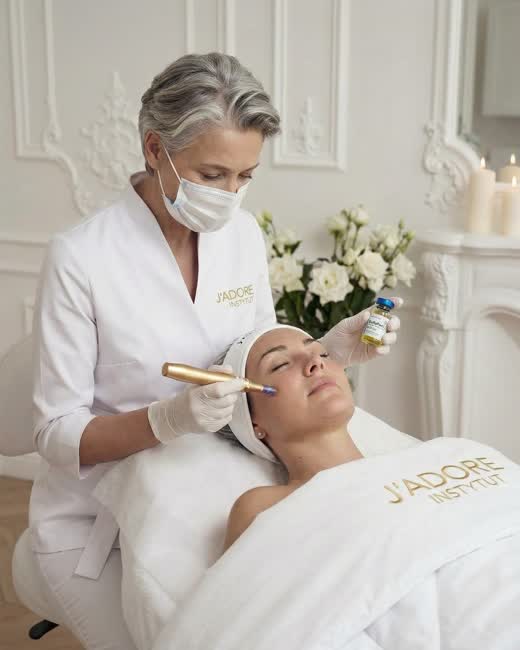
The skin biostimulator isn't a filler, and it isn't mesotherapy in the traditional sense. It's skin bioremodelling — pure, non-cross-linked hyaluronic acid injected at several points on each side of the face. The product spreads through the tissue and may support the production of collagen, elastin and your body's own hyaluronic acid.
The result? Skin is hydrated from within — not at epidermal level, as a cream would work, but at dermis level. Your face looks rested, hydrated, plump. No added volume, no artificial look.
Protocol: 2 sessions, 4 weeks apart. Results last 6–9 months.
Occlusive masks in the salon
Professional occlusive masks (alginate, hydrogel) form an airtight layer over the skin's surface that:
- Retains water in the epidermis for 20–30 minutes (while the mask is on)
- Allows deep penetration of the serum applied underneath
- Lowers TEWL immediately — and importantly, the effect lasts up to 48 hours after the treatment
Sonophoresis with ceramides
Sonophoresis uses ultrasound to drive active substances — ceramides, hyaluronic acid, niacinamide — deep into the skin. Ultrasound waves temporarily loosen the epidermis's structure, allowing ingredients that would normally never cross the barrier to penetrate.
Think of it as briefly opening a door to bring in building materials — then closing it again.
Timeline: how long does barrier repair take?
Here are the specific numbers, because we know that's what you're after:
- Week 1: Stinging and tightness ease. Skin starts to tolerate basic products.
- Week 2: Flaking and redness reduce. Hydration starts to "work" — cream finally absorbs, and the effect lasts longer than an hour.
- Week 3: Visible improvement in smoothness and tone. Skin regains its radiance.
- Week 4: Full barrier recovery for most people. You can gradually reintroduce actives (retinol, acids) — but slowly, starting with the lowest concentrations.
Research from the International Journal of Cosmetic Science confirms it: full skin barrier recovery after damage takes 14–28 days with proper care. Without it, the process can drag on for months, with relapses.
Don't wait until December
The worst thing you can do is ignore the signs and "wait it out" until spring. A damaged barrier in November is a damaged barrier in December, January and February — because the aggravating factors don't go away. If anything, the heating season peaks in January and February.
At J'ADORE INSTYTUT, November is when we focus on regeneration and hydration. Skin biostimulator, ceramide treatments, occlusive masks — everything your skin needs to get through winter in good condition. Come in for a consultation — we'll assess the state of your barrier together and put together a plan that actually works. Because "the cream isn't helping" isn't a diagnosis — it's the start of a conversation.


