
WarszawaŻelazna 59WarszawaMińska 29AKrakówKarmelicka 45Warszawa · Kraków

Careers

ENPL

Full perspective

Depigmentation camouflage (vitiligo) for men

Vitiligo in men — what camouflage is, and why it's not "a women's thing"
Vitiligo camouflage for men most often concerns the hands, face and beard area — spots hard to hide at work and in personal contact. The aim is the same: discreet evening-out of skin tone, without a "made-up" look. The procedure, the caution, and the requirement for a stable condition are the same as for women — vitiligo reacts to puncturing regardless of gender.
Czas
determined individually, depending on the size and number of patches
Efekt
long-lasting, though on skin with vitiligo it can be less predictable — it may fade faster and need more frequent refreshing
Regeneracja
a few days of gentle aftercare of the area
Seria
tolerance test → treatment → mandatory touch-up (repigmentation) after around 4–6 weeks
Wykonuje
a qualified linergist experienced in medical micropigmentation
ListenDepigmentation camouflage (vitiligo) — this whole page read aloud

When it's worth it — indications

  • Stable, non-spreading vitiligo — patches that haven't grown or changed for a longer period, usually around a year.
  • Small, well-defined patches in visible areas — around the lips, brows, corners of the eyes, parts of the face, hands.
  • Healed, calm skin around the patch — no inflammation, irritation or fresh changes.
  • After a dermatologist's assessment — with a confirmed diagnosis and confirmed disease stability.
  • People for whom vitiligo genuinely weighs on daily life — at work, in contact with others, in self-esteem; here camouflage has a mainly psychological dimension.
  • Ready for a process, not "one treatment" — including a tolerance test, a touch-up, and the understanding that the result will need refreshing.

The areas we work on

  1. hands and wrists — the most common, constantly visible location;
  2. patches on the face and in the beard area;
  3. a discreet, "masculine" effect — evening out, not emphasising;
  4. the same requirement: stable vitiligo, dermatologist's approval, tolerance test.
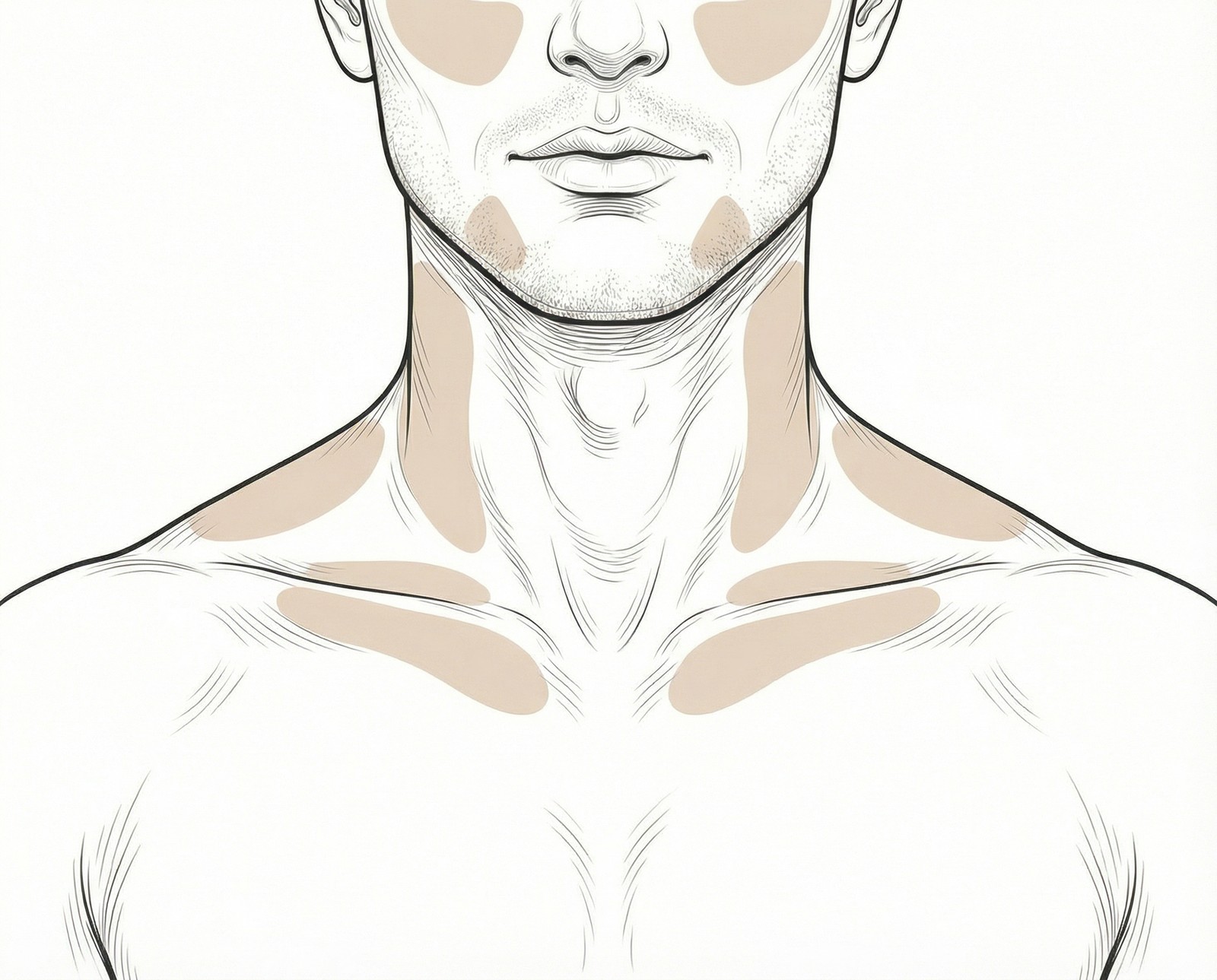
Rysunek stref zabiegowych — twarz i szyja, sylwetka męskaForehead and templesPoliczkiJawlineSzyja
Indicative map of the areas

Vitiligo in men — what camouflage is, and why it's not "a women's thing"

Men with vitiligo rarely talk about it openly. A white patch on the hand, the face, in the beard area — and silence. Questions when shaking hands, glances in the sauna, explaining it to a new partner the first time. Vitiligo is an autoimmune condition — not the result of neglect, not contagious, not a hygiene issue — but that doesn't stop people from having to explain themselves.
Vitiligo camouflage is medical micropigmentation: pigment matched in colour to the skin around the depigmented patch, introduced into the skin so the difference is no longer obvious at a glance. This isn't makeup that washes off, it isn't body ink, it isn't anything that will show you've "done something". A well-matched shade looks like your own skin tone — just a bit more even.
And straight away, honestly: this is camouflage, not treatment. We don't reverse the condition, we don't restore your skin's own pigment. Treatment — phototherapy, medication — is a dermatologist's domain. We work only with appearance, on stable, non-spreading vitiligo, after a doctor's assessment. The result is long-lasting but needs refreshing. No miracles, just concrete work.

Where vitiligo troubles men most

Location matters. In men, vitiligo on the hands, face and beard area sits in places that are practically impossible to hide in professional and personal life.
The rules are the same for every location: first, a dermatologist's assessment confirming that the vitiligo is stable; then, a tolerance test on a small area; and only after a good result — camouflage on a larger area.
  • Hands and wrists — the most common location and the most common reason for a visit. Visible with every handshake, every gesture, every report discussed across a desk. A patch on the back of the hand is hard to ignore, because others don't ignore it either.
  • Face — around the lips, corners of the eyes, brow area, cheeks. A patch on the face changes the expression, disrupts proportions, and is often the first thing people notice.
  • Beard area — a specifically male location. A white patch where dark facial hair normally grows can be especially high-contrast and hard to mask. Camouflage here requires precision, because the pigment has to work with both the natural skin tone and the colour of the beard.

Pigment-free skin and puncturing — why we start with a test

With vitiligo, a needle isn't neutral for the skin. In some people, mechanical damage alone — a scratch, a puncture — can trigger a new patch of depigmentation at the site of the injury. This is the Köbner effect: the skin reacts to injury by developing the condition in the same spot. That's exactly why we don't touch active, "spreading" vitiligo, and why we always start with a tolerance test on a small, discreet area.
The test isn't a bureaucratic formality. It checks whether your skin takes pigment well, how it heals and — most importantly — whether it reacts with a new patch of depigmentation. A good result opens the way to full camouflage. A poor one means we stop at the test and protect you from a worse outcome.
Skin with vitiligo also holds pigment differently. The result can be less predictable than with standard PMU, and in some people it fades faster. Think of camouflage as something refreshed periodically — not a one-off, permanent solution.

Frequently asked questions

Will it be obvious that I've had something done to my skin?
The goal is for it not to show. Good camouflage means even skin tone — people around you see more even-looking skin, not a "painted-on" patch. We select pigment individually for your shade and aim subtly; we deepen the colour at the touch-up a few weeks later, once we know how your skin has taken the pigment. The result of permanent makeup lasts far longer than concealer or body ink, but it doesn't look like makeup.
I have vitiligo on my hands and in my beard area — can both be camouflaged at once?
We don't do everything at once. We start with a tolerance test on one, discreet area and wait. If the result is good, we plan further stages. Different locations may need different sessions — especially the beard area, where the pigment has to work with the natural colour of the hair and the skin beneath it. Treatment duration depends on the size and number of patches; the linergist sets out a plan after consultation and the test.
Do I need a dermatologist's approval if my vitiligo hasn't changed in years?
Yes — and it's not a formality. Disease stability is assessed by a dermatologist, not by you or by the linergist. Vitiligo can lie dormant for years and suddenly become active; if we puncture skin in an active phase, we risk the Köbner effect — new patches. We ask for confirmation of diagnosis and disease stability from the treating physician before every camouflage session — it's a safety condition, not red tape.
How do I combine camouflage with shaving or beard care?
Once fully healed, you return to normal aftercare. During healing (a few days after the treatment and after the touch-up), avoid mechanical friction around the treatment area — hold off on shaving and heavy acid-based creams until the skin is fully healed. After healing: normal shaving, normal skin care. One thing stays permanently: SPF 50+ on areas with vitiligo, because depigmented skin has no natural UV protection and the pigment burns out faster.
Can I have camouflage if I'm taking medication for vitiligo prescribed by a dermatologist?
It depends on the type of treatment and the timing — and it's the dermatologist who should assess whether the treatment isn't in an active phase and whether the procedure is safe. Both paths (treatment and camouflage) can run in parallel, but deciding on camouflage during active drug treatment or phototherapy requires the dermatologist's approval. Tell the linergist about all medications and treatments you're using before the consultation.

Where we offer it

Depigmentation camouflage (vitiligo) for men — we perform it in three J'ADORE INSTYTUT salons: two in Warsaw and one in Krakow.

  • WarszawaŻelazna 59 · Wola · Mirów
  • WarszawaMińska 29A · Praga-Południe · Kamionek
  • KrakówKarmelicka 45 · Stare Miasto · Piasek

Price list

    Book a visit

    Prices come from the salon price lists. The choice of cocktail and the number of sessions is decided by your specialist at the consultation.