A treatment room at J'adore
MICROPIGMENTATION (PMU)
Vitiligo doesn't hurt and isn't dangerous — but it can weigh heavily on you. White patches on the face, hands or other visible areas can mean explaining yourself to strangers, avoiding the sun, avoiding the mirror.
It's an autoimmune condition in which skin in a given area loses its pigment cells and becomes lighter than the surrounding skin. Vitiligo camouflage is medical micropigmentation: we introduce pigment into the depigmented, healed and stable skin, matched in colour to the surrounding complexion, so the patch blends visually into the background and stops drawing attention. Let's say this clearly from the start, because it matters most: this is camouflage, not treatment. We don't reverse the condition, we don't restore your own pigment, we don't stop vitiligo — that's the job of a dermatologist. We work with appearance: we even out tone where it's safe to do so, to give you more peace of mind day to day. The treatment is performed by a qualified linergist experienced in medical micropigmentation. We work carefully and only on stable, non-spreading vitiligo, after consultation with a dermatologist and — where relevant — with their approval — because puncturing active disease can make it worse. Below we explain everything without embellishment: what this treatment can do, what it can't, and when it's better not to have it.
tolerance test → treatment → mandatory touch-up (repigmentation) after around 4–6 weeks
What this involves
In vitiligo, skin in a given area loses the cells that produce pigment (melanin) — and becomes noticeably lighter than the surrounding area. Camouflage doesn't restore these cells and doesn't make the skin produce its own pigment again. It does something different: the linergist introduces pigment into the depigmented skin, matched in colour to the skin around the patch, so the difference between "light" and "normal" is no longer obvious at a glance. This is an optical evening-out — a play of colour, not an intervention in the disease.
That's why it needs to be said plainly: this is camouflage, not treatment. This treatment doesn't reverse vitiligo, doesn't stop it spreading, and doesn't replace a dermatologist's care. It won't eliminate the cause and won't make the condition disappear. What it does give you is what most people come for: fewer stares, less explaining, more peace of mind — when a patch in a visible spot stops standing out in colour.
Treatment of vitiligo is handled by a dermatologist — it's with them that you arrange phototherapy, medication and disease management. A linergist deals only with appearance: camouflaging a stable patch. Ideally both paths run in parallel — first the condition under a dermatologist's control, then, once the skin is calm and stable, camouflage.
How it works
Skin tone is governed by melanocytes — cells in the deepest layer of the epidermis that produce melanin and pass it on to surrounding cells. In vitiligo, they stop working in a given area, and the skin loses its own pigment. Camouflage has no effect on them at all: the linergist introduces pigment deeper than the layer where melanin forms, building a colour that mimics the surrounding complexion. This is purely colour camouflage — the pigment sits in the skin alongside the disease mechanism, without interfering with its course.
This particular skin sets its own terms, though. Without pigment, it behaves differently to healthy skin: it can be less predictable in taking pigment, and the result may fade faster, requiring more frequent refreshing. There's also the Köbner phenomenon — in some people, simply disrupting the skin can trigger a new depigmented patch — which is why we only work on vitiligo that is stable and not spreading, starting with a tolerance test on a small area. We qualify you in cooperation with a dermatologist, who confirms the diagnosis and assesses whether the condition is in a calm phase.
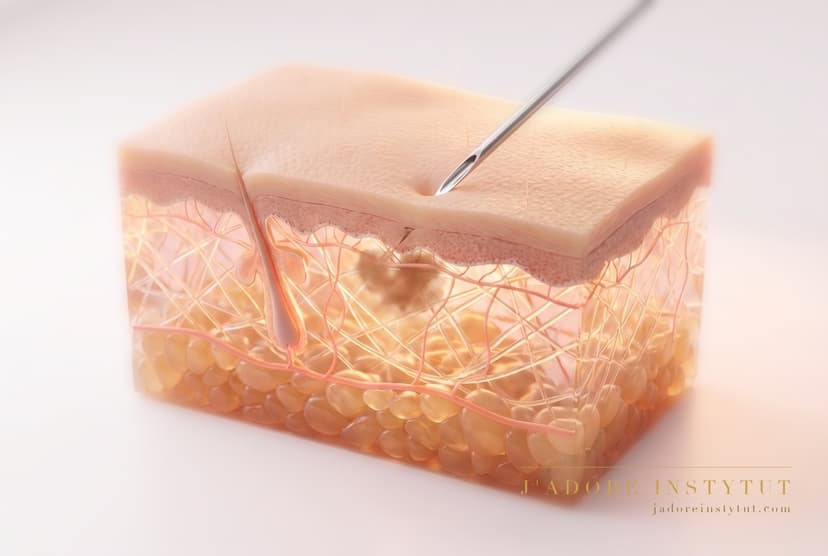
Did you know? Melanocytes make up a tiny fraction of epidermal cells, yet they're responsible for its entire skin tone — a single melanocyte supplies pigment to a whole group of surrounding cells. That's why the loss of such a small population of cells creates a patch that's so distinct and sharply defined — and why camouflage has to rebuild colour from scratch, rather than reinforce what's left.
Ideal for
The decision is always yours. You can come for a consultation, do a tolerance test, and decide calmly later, once you see how your skin reacts. Nothing happens "on the spot across the whole patch".
For women and for men
Vitiligo camouflage for women most often concerns the face and areas hard to permanently hide with makeup — around the lips, brows, corners of the eyes, sometimes hands or the décolletage. The goal is to even out skin tone so the patch stops drawing attention, and for you to spend less time thinking about "covering up". This is camouflage that supports wellbeing, not "beautifying".
What we work with
Vitiligo camouflage for men most often concerns the hands, face and beard area — spots hard to hide at work and in personal contact. The aim is the same: discreet evening-out of skin tone, without a "made-up" look. The procedure, the caution, and the requirement for a stable condition are the same as for women — vitiligo reacts to puncturing regardless of gender.
What we work with
Did you know? The Köbner effect, which we're so careful about with vitiligo, has a second, "good" side — the same skin sensitivity means that, for some people, controlled micro-damage can be part of treatment carried out by a dermatologist. The difference is fundamental: there it's a deliberate medical procedure on active disease; here, camouflage is only ever performed on stable disease. It shows just how much everything here depends on whether vitiligo is "dormant" or active.
Vitiligo doesn't discriminate by gender — it affects women and men equally, and it can weigh on both in daily life. However, where the patches appear and what troubles people most can differ — so we set out both perspectives. The safety rules (stability, dermatologist's approval, tolerance test) are identical for everyone.
Safety
With vitiligo, caution isn't overcaution — it's the whole point. In some people with vitiligo, skin damage alone (a scratch, a graze, or a puncture) can trigger a new patch of depigmentation exactly where the injury occurred. This is called the Köbner effect. Pigmentation involves puncturing the skin — so in someone with active, "spreading" disease, it could paradoxically trigger further patches. That's why we hold to three rules without exception:
We only pigment patches that haven't grown or changed for a longer period — usually around a year. We don't touch active, progressing disease.
We ask for confirmation of diagnosis and disease stability from the treating physician — they're best placed to judge whether vitiligo is "dormant" or active.
We start by pigmenting a small, discreet area and wait — checking how the skin heals, takes colour, and whether it reacts with a new patch of depigmentation. Only a good test result opens the way to a larger area.
Red flag: when we do NOT perform camouflage ·
Contraindications
Some contraindications are permanent, others temporary — in which case we simply postpone the treatment until the situation passes. We discuss everything individually at the consultation, and disease stability itself is confirmed by a dermatologist.
From the linergist's chair
The most common reason I postpone a treatment is that I'm not sure the condition is stable. And that's a good reason. Vitiligo can be unpredictable — it can "sleep" for years and suddenly become active. That's why I don't rely solely on what I see, and I ask for a dermatologist's opinion. It's better to wait than to puncture skin that's just starting to change.
This isn't a complete list — we'll go through your medical history, medication, how your vitiligo is being treated, and your skin's condition together at the consultation, and a dermatologist will confirm stability.

How it works
The hardest conversation is about patience. Someone arrives with a patch they'd like "covered today" — and I suggest a small test first and a few weeks of waiting. I understand the impatience, but on skin with vitiligo, that waiting genuinely protects you. I'd rather you see for yourself, on a small area, that it works, than risk the whole visible area.
Portfolio
A record of the work in our salons — the place where we publish treatment frames and, after photo sessions, results.
A record of results — in preparation. We publish photographs of our clients only with their consent.
Healing and aftercare
The calmer the skin's healing, the better the pigment holds — and with vitiligo, there's one more thing: we protect the area from anything that could irritate it and trigger a reaction. Sun exposure matters especially here, because depigmented skin has no natural protection against radiation.
Don't scratch off scabs or rub the area — with vitiligo, any irritation of the skin is unwise (risk of reaction). Follow the linergist's aftercare instructions precisely; this is what determines how much pigment remains.
Fresh pigment fades in the sun, and depigmented skin has no natural protection and is easily irritated. During healing, shield the area from the sun, and use SPF 50+ permanently afterwards — with vitiligo this is a rule for life, not just after the treatment.
Pools, saunas, hammams and jacuzzis are off-limits during healing — water, chlorine and high temperatures weaken pigment retention and irritate the fresh area.
Avoid strong acids, peels and mechanical exfoliation around the treatment area — irritated skin heals worse and reacts more easily with vitiligo. Return to them only once fully healed and with the linergist's approval.
Use gentle cleansing and the regenerating ointment exactly as shown by the linergist. The skin needs to heal calmly — less is more.
Watch the area and the whole of your skin. If you notice a new patch of depigmentation or a concerning reaction — report it to your linergist and dermatologist. A watchful eye is part of safety with vitiligo.
Depigmentation camouflage (vitiligo)
Vitiligo is sometimes confused with other situations where skin "has no colour" — and with treatment of the condition itself. These are different things, handled by different people:
evens out the tone of the depigmented patch
doesn't treat the condition, doesn't restore your own pigment, doesn't stop vitiligo
works on the condition itself
not us — treatment always stays with the dermatologist; we only do camouflage
masks a light or depigmented scar
a scar isn't vitiligo — there's no risk of the condition "spreading", but qualification is separate
What we combine this with
Vitiligo camouflage is rarely a "standalone" matter — it works best as part of a broader, structured plan. The linergist decides on the order and timing; the dermatologist decides on the condition itself. The logic stays constant: first a stable, controlled condition, then the test, then camouflage.
The most common misunderstanding sounds like: "I'll come in and you'll cover my vitiligo forever." I calmly explain two things then. First — not "forever": pigment fades, and on this kind of skin, often faster. Second — I don't "treat" it: the condition stays, we only work with the appearance of a stable patch. Anyone promising you treatment with a needle isn't telling the truth.
Pigments and options
You don't choose a shade "from a palette" — the linergist selects it for your complexion, the skin tone around the patch, and the test result. With vitiligo there's an added layer of caution: this skin takes pigment differently, so we aim carefully and on the subtle side.
Pigmentation of a small, discreet area and observation: how the skin heals, holds colour, and whether it reacts with a new patch of depigmentation.
Dla kogoFor every person with vitiligo before full camouflage — no exceptions.
Introducing pigment matched in colour to the skin around the patch, so tone evens out optically.
Dla kogoStable, well-defined patches after a good test result.
Working on the most visible, delicate areas of the face — with extra care and subtlety.
Dla kogoSmall patches in exposed areas, when discretion matters.
A shade mixed for your complexion; it lightens after healing, so we start more subtly and deepen it at the touch-up.
Dla kogoA natural, discreet result matched to the surrounding skin.
Fact: The result is long-lasting, but not "forever" — and on skin without its own pigment it can be less predictable and may fade faster than with standard PMU. This is the honest trade-off of this method: think of camouflage as something refreshed and adjusted to your current skin tone, not a one-off "cover for good".
Price list
Checking free hours…
From the magazine
Editorial pieces on how this treatment works in practice — what happens during the session, how to prepare, where the limits are and what the first days after look like.
See also
The result lastslong-lasting, though on skin with vitiligo it can be less predictable — it may fade faster and need more frequent refreshingJ’adore Instytut
Notice. Vitiligo camouflage is an aesthetic camouflage treatment (medical micropigmentation) that introduces pigment into the skin; it does not treat vitiligo or any underlying condition, does not restore the skin's own pigment, and does not stop the progression of vitiligo — it only produces a visual evening-out of the depigmented patch with the surrounding skin. Treatment of vitiligo is managed by a dermatologist. We only perform this treatment on stable, non-spreading vitiligo, on healed tissue, after consultation and — where relevant — with the approval of the treating physician (dermatologist); it is preceded by a tolerance test. Because of the risk of skin reactions (including the Köbner effect) and the nature of pigment-free skin itself, the result may be less predictable and less durable than standard PMU; it is long-lasting and requires refreshing. This text is provided for informational purposes. The treatment is performed by a qualified linergist experienced in medical micropigmentation.
Home care
Cosmetics matched to what your skin needs after a treatment — so the clinic effect lasts longer.
 post-treatment regenerationCell Fusion CDermagenis pH Biome SerumView in the shop(opens in a new tab)
 sun protectionDermaQuestSunArmor SPF50 30 mlView in the shop(opens in a new tab)
 post-treatment regenerationMedMelanoSkinbiotic Elixir Probiotic Repair Serum 50 mlView in the shop(opens in a new tab)
 sun protectionSesdermaREPASKIN Silk Touch Color SPF50View in the shop(opens in a new tab)
 post-treatment regenerationVagheggiEmozioni Plus — Anti-Stress Face Mask 75mlView in the shop(opens in a new tab)
 sun protectionCell Fusion CAquatica Sunscreen 100 SPF 50+/PA++++View in the shop(opens in a new tab)
 post-treatment regenerationMesoesteticMesohyal Post-Procedure Gel CreamView in the shop(opens in a new tab)
 sun protectionSesdermaRepaskin Silk Touch Color Facial SPF50View in the shop(opens in a new tab)