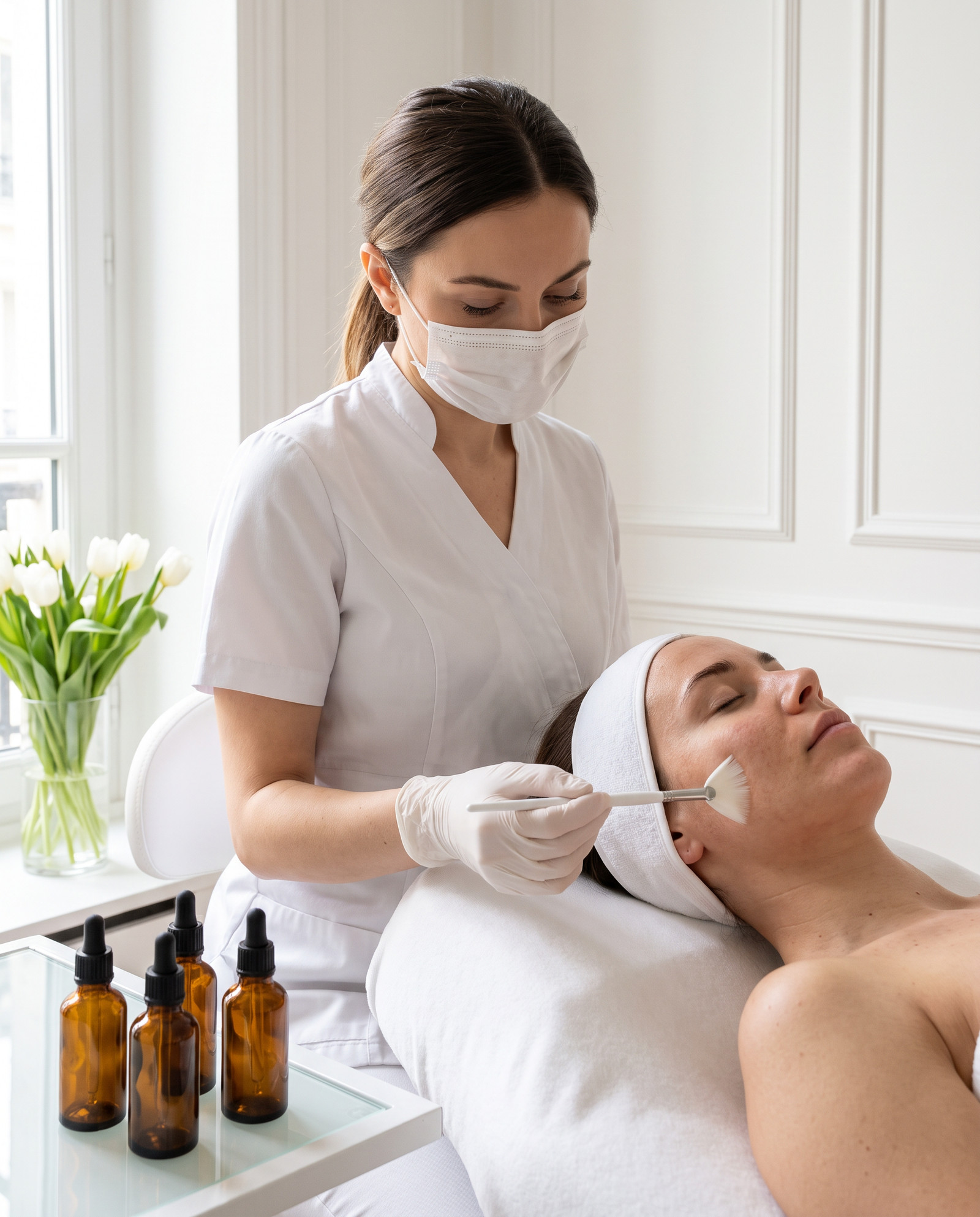
Mandelic acid works superficially and usually more slowly than smaller AHAs
Mandelic acid belongs to the AHA (alpha-hydroxy acid) group, but it stands out from the more popular glycolic acid with one feature: it has a larger molecule. Thanks to this, it penetrates the skin more slowly, acts more gently and less frequently causes irritation. This is precisely why it works so well for people who have sensitive skin, a tendency to redness or are simply taking their first steps with acid peels.
However, this does not mean that every mandelic acid peel is gentle to the same degree. Concentration, pH, complementary ingredients and the application method — all these determine how intensely the treatment will work. Hibiscus Mandelic and Mandelac are two different answers to the question: what else is worth adding to mandelic acid to achieve a specific effect.
Mandelac and the mandelic formula with additives are not the same procedure
Instead of multiplying parameters, it is worth understanding the logic of both formulas. Hibiscus Mandelic leans towards brightening and anti-oxidation — mandelic acid is supported here by hibiscus extract and other plant ingredients that can help fade hyperpigmentation and add radiance to the skin. Mandelac targets smoothing, sebum regulation and texture improvement — it combines mandelic acid with lactobionic acid, which hydrates and supports the renewal of the skin barrier.
Hibiscus Mandelic
brightens and evens out skin tone
- skin with sun-induced or post-acne hyperpigmentation
- uneven, dull skin tone, lacking radiance
- combination and normal skin, sensitive to hyperpigmentation
- can bring a brightening effect after just a few sessions
Mandelac
smooths and regulates
- oily, combination skin with visible pores
- uneven texture, small blackheads
- comedonal acne and inflammatory lesions (mild)
- can improve hydration while exfoliating
Reactive skin needs a barrier assessment before choosing an acid
You do not need to be an expert to have an initial understanding. A few questions are enough:
- You have hyperpigmentation — brown sun spots, dark marks after breakouts, uneven skin tone? A more likely direction is Hibiscus Mandelic.
- You have enlarged pores, an oily T-zone, a tendency to blackheads? Mandelac may work better.
- You have combination skin with both problems at once? Here, it is decided by which one bothers you more — and stick to that for the first few sessions.
- You have sensitive skin but no specific problems — are you looking for prevention? Both are gentle; the choice depends on the priority: radiance vs. regulation.
Sessions make sense when the goal can be observed under constant conditions
Acid peels are series-based treatments. One mandelic peel can leave the skin refreshed and more radiant, but a lasting change — smoothing texture, reducing hyperpigmentation, shrinking pores — usually appears after a series. Different skins react at different speeds, and the intervals between sessions depend on how the skin tolerates the acid and what effect we want to achieve.
- 01
Consultation
Skin assessment, interview (medications, recent sun exposure, other treatments), selection of the formula and concentration appropriate for the current condition.
- 02
First treatment
Often a gentler variant — to see how the skin reacts. Immediately after, you may feel slight tingling and redness, which usually passes quickly.
- 03
Sessions (3–6 treatments)
Intervals determined individually, usually every 2–4 weeks. Gradual deepening of the effect — smoothing texture, evening out skin tone, improving skin condition.
- 04
Maintenance
After the desired effect is achieved, some people continue treatments less frequently — once every few weeks or as part of seasonal care.
Frequently asked questions reveal whether the problem has been correctly named
A few doubts appear regularly before someone decides on their first visit:
- "Will my skin peel?" — Not always and not dramatically. For many people, exfoliation is microscopic, invisible to the naked eye. It depends on the concentration, the skin and the history of peels.
- "How much time for recovery?" — Usually a few days of calmer care and avoiding makeup. For the first few sessions, it is worth leaving yourself a week without important events.
- "Can I use retinol?" — It is usually discontinued around the time of the treatment. The specialist will inform you when you can return to it.
- "Which is better for acne?" — Mandelac is more often chosen for oily acne-prone skin; Hibiscus Mandelic may help with post-acne marks. These are two different stages of the same problem.
Lactic acid is more often chosen when dryness dominates over blackheads.
Lactic acid and mandelic acid are the two most popular AHA acids in professional cosmetology. They share a mechanism of action — both exfoliate dead epidermal cells, accelerate cell renewal, and improve skin texture. However, the similarity largely ends there. They differ in molecule size, depth of penetration, and what they additionally do for the skin. This determines which one will work for you.
Lactic acid
gentle renewal and intense hydration
- dry, dehydrated, dull skin
- first signs of ageing and fine lines
- sensitive and vascular skin (low concentrations)
- brightening sun-induced hyperpigmentation
- result: hydration, radiance, even skin tone
Mandelic acid
deeper exfoliation and sebum regulation
- oily, combination, and acne-prone skin
- enlarged pores and blackheads
- adult acne and post-acne hyperpigmentation
- tanned skin (higher tolerance)
- result: mattifying, cleansing, sebum regulation
Mandelac is often more accurate for uneven skin tone and a tendency towards imperfections.
Instead of looking for a "better" exfoliating acid, it is worth asking: what is my main problem? The following mirror test will help you ask the first question — the one from which a good consultation begins:
- Skin seems dry, tight, dull or grey — it lacks radiance, and fine lines are more visible by the end of the day → direction: lactic acid.
- Skin is shiny during the day, pores are visible, and blackheads or breakouts sometimes appear → direction: mandelic acid.
- Combination skin — dry around the cheeks and oily in the T-zone → a combination of both acids or alternating treatments will likely work well.
- Sensitivity and redness — both acids can work on sensitive skin, but lactic acid is usually the first choice; mandelic acid in lower concentrations is often surprisingly well-tolerated due to its antibacterial properties.
It is also worth remembering that skin changes seasonally. In summer, when it is tanned and more resistant to acids, mandelic acid can work without a "redness" effect. In winter, when dry air takes its toll, lactic acid can be the answer to the loss of radiance and hydration.
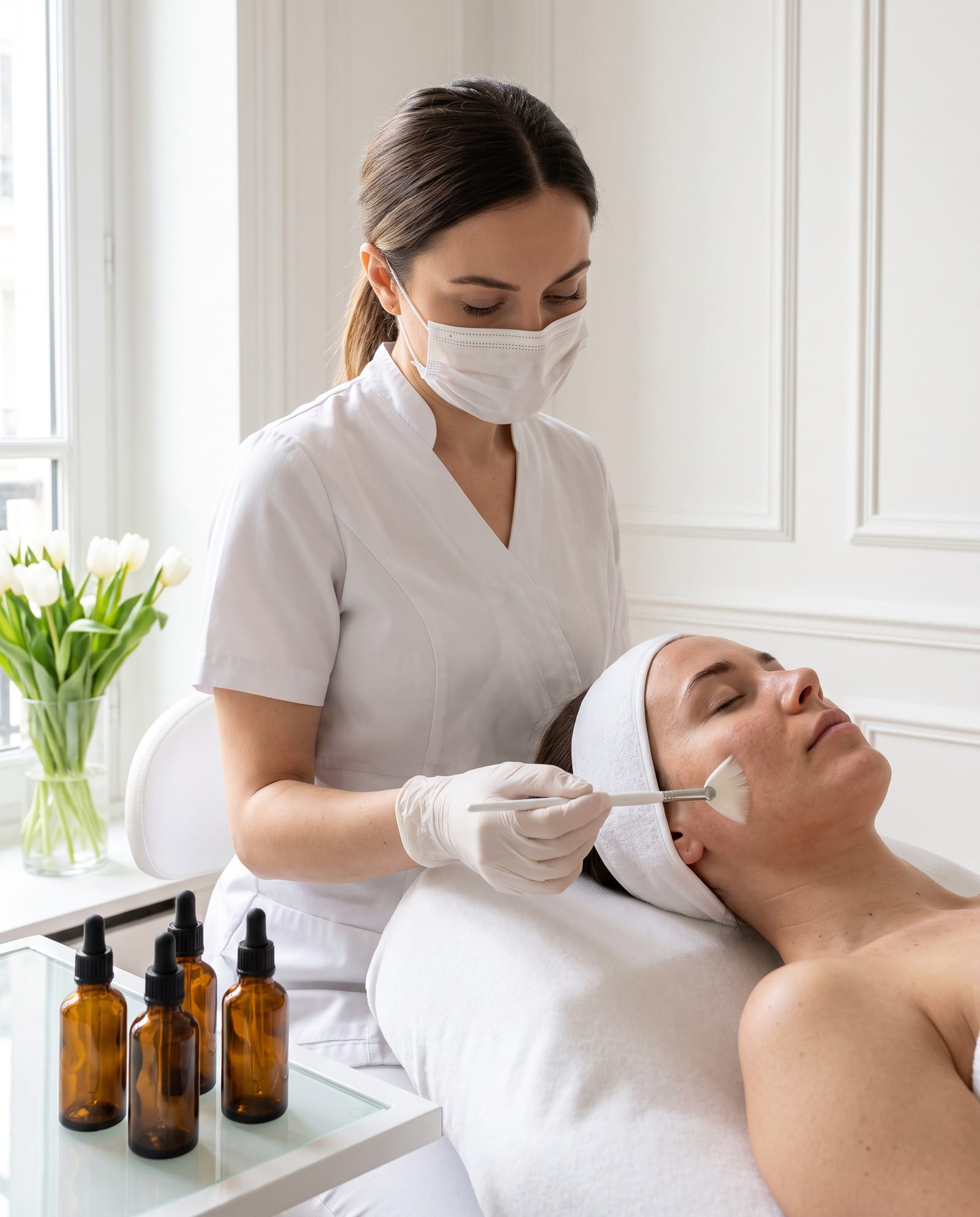
Pores tell a story about sebum, keratinisation and skincare, not just one cause.
Combining acids without a plan easily overloads the barrier.
Lactic and mandelic acids are not mutually exclusive — they can complement each other if the skin requires it. The combinations used in salons vary: ready-made preparations containing both acids simultaneously, alternating treatments (a session of lactic, a session of mandelic every few weeks), or mandelic acid as a cleanser and lactic acid as a barrier sealer. A cosmetologist decides on the sense of a specific combination — after a skin analysis, not after a list of ingredients.
Peel + mesotherapy
Exfoliated epidermis allows active ingredients to penetrate better — a peel often precedes mesotherapy, enhancing its effects.
Peel + hydrating mask
After acid peels, especially lactic, salons often finish the treatment with intense hydration — this stabilises the barrier and extends the radiance effect.
Series of peels + photorejuvenation
Peels prepare the skin before a laser or IPL: removed epidermis = more even energy absorption and a better final result.
Peel + ultrasonic cleansing
Sonic cleansing and acid peels often go hand in hand — together they address both mechanical impurities and uneven texture.
BHA has an advantage when the problem lies inside the follicle openings.
Acid peels have an established position in cosmetology — and well-documented results. However, it is important to approach them with a realistic attitude. These are not "one-off" treatments and they do not work the same way for every person.
- After a series of sessions, many people can notice an even skin tone and less visible minor hyperpigmentation.
- The skin often seems smoother to the touch — texture improvement is one of the most quickly noticeable effects.
- For oily and acne-prone skin, mandelic acid can reduce the frequency of breakouts — but for some people, the effect is gradual and requires several treatments.
- Lactic acid for dry and dull skin often gives an effect of immediate radiance after just the first session.
- Collagen stimulation — both acids, especially in higher professional concentrations, can support skin remodelling, although the effects are subtle and spread over time.
One letter, two completely different worlds.
Let's start with the basics — because to understand the difference in action, it is worth understanding what lies behind the abbreviations. AHA are alpha-hydroxy acids, BHA are beta-hydroxy acids. The difference in the name reflects the difference in chemical structure — and it is this structure that determines how each of them behaves in contact with the skin.
There is one key difference, but it is fundamental: BHA is soluble in fats, AHA — in water. This sentence, which looks like a chemical detail, translates in practice into everything: where the acid goes, what skin type it acts on, and what problems it is able to solve. BHA deals with fat — so it enters where fat collects. AHA works on the surface — so it deals with what happens on the very top of the skin.
- AHA (alpha-hydroxy acids): glycolic, mandelic, lactic, citric, malic. They work on the skin surface — they loosen the connections between dead cells, facilitating their exfoliation. They act primarily in the stratum corneum of the epidermis.
- BHA (beta-hydroxy acids): practically one player — salicylic acid. It dissolves in fats, so it penetrates through the sebum layer and enters deep into the pore opening. It is the only substance among popular skincare acids that reaches where blackheads collect and bacteria multiply.