How does laser hair removal work?
The laser only affects hair in its active growth phase (anagen) — at any one time, roughly 20–30% of hair sits in this phase. That's why effective hair removal needs a series of sessions, not a single visit.
How many sessions are needed?
As a guide, anywhere from a few to over a dozen sessions, depending on the body area and skin phototype. Everyone responds differently — hormones, genetics and hair colour all play a role.
- Underarms — usually 4–6 sessions
- Bikini line — usually 6–8 sessions
- Full bikini — usually 6–10 sessions
- Legs (calves + thighs) — usually 6–10 sessions
- Face (upper lip, chin) — usually 8–12 sessions
- Back (men) — usually 6–10 sessions
- Chest (men) — usually 6–10 sessions
How often are sessions scheduled?
The gaps between sessions are matched to the hair growth cycle — they vary by body area:
- Face — every 4–6 weeks
- Body — every 6–8 weeks
- Intimate areas — every 6–8 weeks
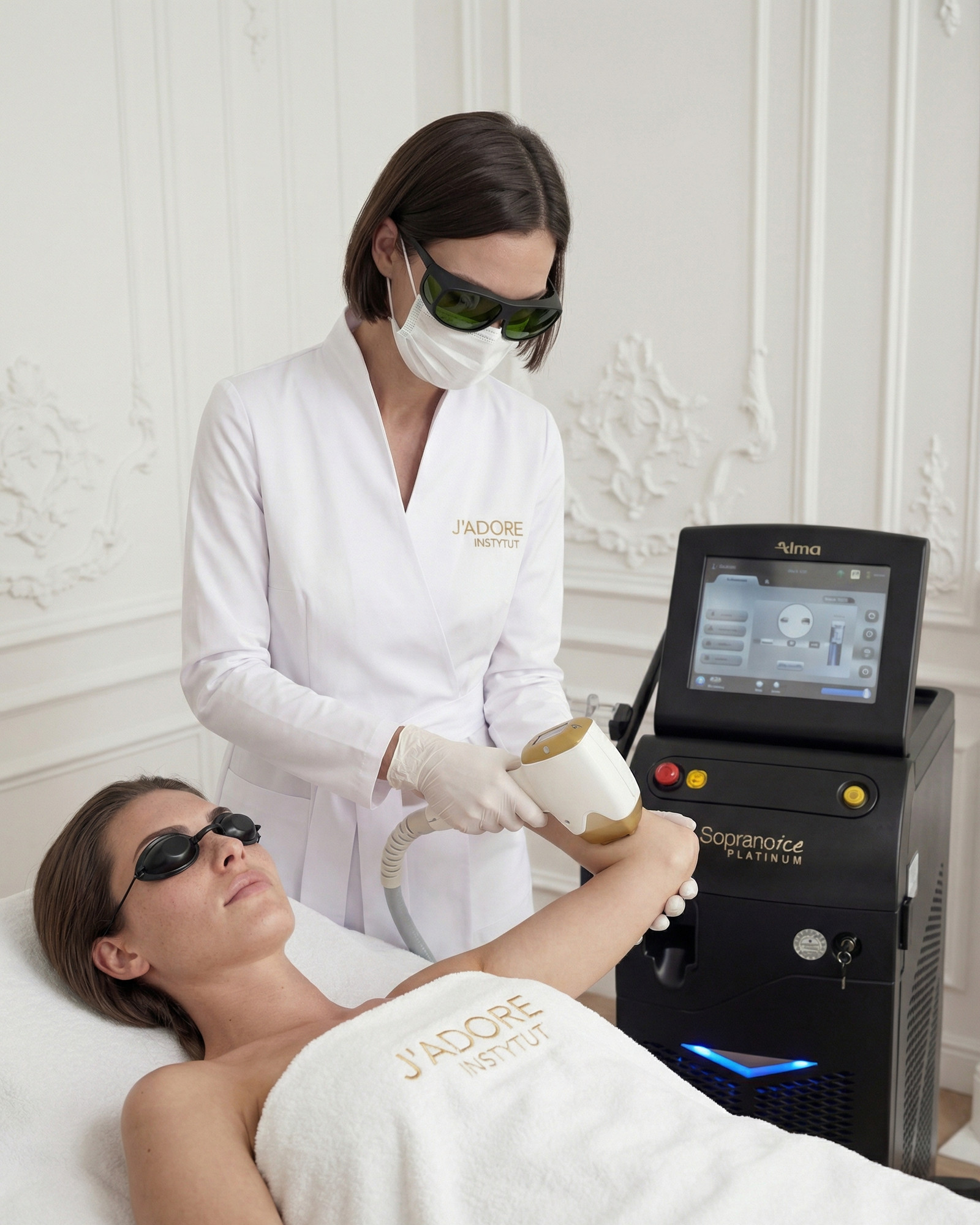
Which laser do we use for hair removal at J'ADORE?
Depending on your skin colour and other factors, a specialist may also use a complementary laser or Nd:YAG — designed for darker skin tones and tanned skin.
Does it hurt?
Soprano ICE SHR stands out for its minimal discomfort. Clients often describe the sensation as "warmth" or "a mild tingle" — far less than waxing.
- Sensitive areas (intimate areas, underarms, face) can feel more noticeable
- The first few sessions tend to feel more intense — more hair is active at this stage
- Tanned skin absorbs more energy, which can heighten sensation

How to prepare for a session
Who might laser hair removal not be right for?
- Light blonde, red and grey hair — no melanin means no target for the laser; electrolysis can be an alternative
- Active tanning — higher risk of skin irritation
- Pregnancy — most salons recommend caution and postponing the treatment
- Active retinoid treatment (e.g. Roaccutane) — a break of at least 6 months is required
- Certain photosensitising medications (tetracyclines, some diuretics) — consultation required
Are the results permanent?
The precise term is permanent hair reduction — not "permanent removal". After a series of sessions, most people find the majority of hair no longer grows back, and any hair that does return is often finer and lighter.
- After a few years, new hair may appear from hormone-dependent follicles
- 1–2 maintenance sessions a year help preserve the result
- Hormonal changes (pregnancy, menopause, hormone treatment) can trigger hair regrowth