

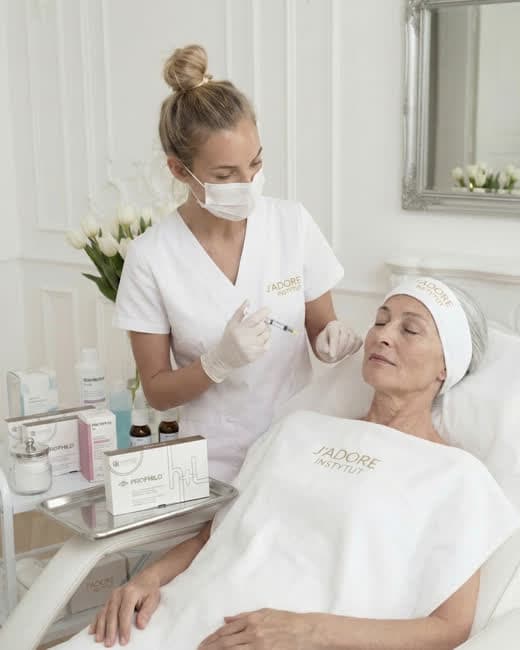
What are "baby Botox" and "preventive Botox"?
Let's start with definitions. These terms are floating around the internet without any order.
Baby Botox — this is a colloquial term for injecting a very low dose of botulinum toxin. The goal is not to completely block facial muscles, as in classic Botox, but to gently weaken them. Your face still moves, but expression lines are shallower.
Preventive Botox — this is the concept of injecting botulinum toxin BEFORE static wrinkles (visible without movement) appear. The logic is that if the muscle does not crease the skin, wrinkles will not set in.
Both terms were born on social media, not in medicine. Doctors simply speak of "low-dose botulinum toxin" or "early botulinum intervention."
What does the law say?
In Poland, botulinum toxin (Botox, Dysport, Bocouture, Xeomin) is a prescription medicine. It is not a cosmetic. It is not a supplement. It is a medicine.
This means:
- It can be administered only by a doctor (not a cosmetologist, not a beautician, and not a nurse acting independently).
- It requires a medical history and qualification for the treatment.
- Formally, it is registered for use from the age of 18. Administering it to a minor is an off-label use that requires specific medical justification.
- Advertising botulinum toxin directly to consumers is prohibited by pharmaceutical law.
If someone online is encouraging you to get Botox and they are not a doctor, they are breaking the law. If a salon offers Botox without a medical consultation, it is not a place you should visit.
What does science say?
Right, let's put the law aside. What does science say about preventive Botox?
Does Botox prevent wrinkles? YES — but...
A study published in Dermatologic Surgery (2006) followed identical twins for 13 years. One used Botox regularly, the other did not. The difference was visible: the sister who used Botox had shallower wrinkles even at rest.
A study from JAMA Facial Plastic Surgery (2019) confirmed that regular use of botulinum toxin slows down the formation of static wrinkles.
So, does Botox work preventively? Yes. But the key question is not WHETHER, but WHEN.
When do expression lines appear?
Expression lines (the ones Botox prevents) begin to set in — becoming visible without movement — on average between the ages of 28 and 35. This depends on:
- Genetics (skin phototype, skin elasticity)
- UV exposure (the main external factor)
- Facial expressions (whether you frown intensely or squint your eyes)
- Smoking (it accelerates collagen degradation by 10–15 years)
At 17, your skin produces collagen at full speed. Elastin is in peak form. Cell turnover is fast. You do not have static wrinkles. You may have expression lines visible ONLY when you frown, but this is normal muscle anatomy, not the ageing process.
Injecting Botox into 17-year-old skin is like putting a cast on a healthy leg "just in case."
Why do you want Botox? Ask yourself this question honestly.
I am not asking rhetorically. This is a clinical question that a good doctor should ask you during a consultation.
Filters have changed the definition of a "normal" face.
A study from JAMA Facial Plastic Surgery (2019 — yes, it is no coincidence that two key studies were released in the same year) showed that 55% of plastic surgeons had patients who brought filtered selfies to the consultation as a treatment goal.
Instagram and TikTok filters do what Botox, lip filler, and contouring do combined — in real time:
- They smooth the skin (removing pores, texture, and imperfections).
- They enlarge the eyes and lips.
- They slim the face.
- They symmetrise features.
The problem? You see this version of yourself 3–5 hours a day. Your brain starts to treat the filtered face as the "real you" and your mirror reflection as inferior or flawed.
This is not paranoia. It is a documented psychological mechanism.
Body dysmorphia (BDD) is rising among teenagers.
Body Dysmorphic Disorder (BDD) is a condition where a person obsessively focuses on imagined or minimal appearance defects. In the teenage population, BDD affects 2–4% (data from the Journal of the American Academy of Child & Adolescent Psychiatry), but psychiatrists warn that since 2020, the number of diagnoses has been growing by 10–15% annually.
Symptoms of BDD:
- Repeatedly checking appearance in a mirror or phone.
- Avoiding photos without filters.
- Obsessively comparing oneself to others.
- The conviction that others see the "defect" you are looking at.
- Desiring aesthetic treatments as a way to alleviate anxiety.
BDD is not treated with Botox. It is treated with cognitive-behavioural therapy (CBT) and sometimes pharmacologically. An aesthetic treatment for someone with BDD does not bring relief — it shifts the obsession to the next "defect."
I am writing this not to scare you. I am writing this so you know that if you feel a strong need to change your appearance at 17, it is worth talking to someone who will help you decipher where this need truly comes from.
What you CAN do at 17 — and what really works.
The good news: the most effective anti-ageing methods are available immediately, cost a fraction of Botox, and have zero risk of side effects.
1. SPF — the best anti-ageing in the world.
This is not an exaggeration. UV is responsible for 80% of visible skin ageing (data from The New England Journal of Medicine). The famous photo of the truck driver, whose left side of the face (by the window) looked 20 years older than the right — that is UV.
- SPF 30 minimum, every day, 365 days a year.
- Apply 2 mg/cm² (half a teaspoon for the face).
- Reapply every 2 hours when exposed to the sun.
- Do not forget your neck and ears.
If you only do one thing from this list, make it SPF. Your 40-year-old self will thank you.
2. Moisturising — simple but effective
At 17, you do not need a 10-step Korean routine. You need:
- A gentle cleansing gel (pH 5–5.5, SLS-free).
- A moisturising cream/serum (hyaluronic acid, glycerin, niacinamide).
- SPF (see above).
That is all. Seriously. Every extra step at 17 is marketing, not dermatology.
3. Lifestyle — boring but true
- Sleep: 8–9 hours. Your skin regenerates during this time. Growth hormone works at night.
- Water: Hydration affects skin turgor. You do not need to drink 3 litres, but 1.5–2 litres is the minimum.
- Diet: Antioxidants (fruit, vegetables, nuts) protect collagen from free radicals. Sugar and processed food accelerate collagen glycation. They literally "caramelise" it, making it stiff and brittle.
- No smoking: If you do not smoke, do not start. If you do, quit. Smoking accelerates skin ageing more than anything else, except for UV rays.
4. Retinol — but not yet
Retinol (vitamin A) is the second most proven anti-ageing ingredient after SPF. HOWEVER:
- In OTC concentrations (0.1–0.5%), it makes sense from the age of 20–22 as part of prevention.
- Before 20, your skin does not need help with cell turnover; it does it perfectly well on its own.
- If you have acne, a doctor may prescribe therapeutic retinoids (tretinoin, adapalene). This is different from "anti-ageing retinol".
When does Botox make sense?
Botox is not bad. It is a bad solution at the wrong time.
A reasonable time to consider preventative Botox:
- 25–28 years old — if you start noticing set lines on your forehead or between your brows (frown lines).
- Earlier — only for medical indications (e.g. bruxism/teeth grinding — Botox in the masseter muscle, excessive sweating — Botox in the hands/underarms, chronic migraine).
Botox makes sense when:
- You have visible static wrinkles (at rest, without facial expressions).
- You want to slow down their deepening.
- You have realistic expectations (Botox will not change your facial features).
- You consult a doctor, not an influencer.
The role of the doctor — when to say "no"
A good aesthetic medicine doctor is not a salesperson. They are a specialist who:
- Refuses a treatment when there are no medical or aesthetic indications.
- Asks about your motivation — why do you want this treatment? Who "inspired" you?
- Assesses your mental state — is the desire to change your appearance proportional to the real "problem"?
- Suggests an alternative — SPF, skincare, time. Yes, "come back in 5 years" is an honest answer.
- Educates — explains what botulinum toxin does, how long it lasts, and what the real effects and risks are.
An ethical clinic is not a clinic that "will do anything". It is a clinic that does what makes sense — and refuses what does not.
If a clinic accepts a 17-year-old for Botox without blinking, run away. Literally.
Your skin at 17 is better than you think
I know you do not want to hear this. I know you look at filtered photos and think your skin is "not smooth enough" or that you have "too many" lines on your forehead.
But your 17-year-old skin:
- Produces collagen faster than at any later point in your life.
- Has optimal cell turnover (28 days — it slows down later).
- Is elastic and resilient.
- Heals quickly and effectively.
What you see as a "problem" is the natural texture of living skin — pores, fine expression lines, uneven skin tone from the sun. Filters remove all of this. But filters do not show skin — they show plastic.
Real skin has texture. And that is OK.
Summary — cheat sheet
- Age: 15–17 — What to do: SPF, moisturising, healthy lifestyle — What NOT to do: Botox, fillers, aggressive acids.Age: 15–17What to do: SPF, moisturising, healthy lifestyleWhat NOT to do: Botox, fillers, aggressive acids.
- Age: 18–22 — What to do: as above + gentle retinol (0.1–0.3%), niacinamide — What NOT to do: Botox (unless for medical indications).Age: 18–22What to do: as above + gentle retinol (0.1–0.3%), niacinamideWhat NOT to do: Botox (unless for medical indications).
- Age: 23–28 — What to do: as above + retinol 0.5%, vitamin C, consultation — What NOT to do: Consider Botox only if static wrinkles are present.Age: 23–28What to do: as above + retinol 0.5%, vitamin C, consultationWhat NOT to do: Consider Botox only if static wrinkles are present.
- Age: 28+ — What to do: Full anti-ageing strategy, Botox if indicated — What NOT to do: Panic — it is never too late to start.Age: 28+What to do: Full anti-ageing strategy, Botox if indicatedWhat NOT to do: Panic — it is never too late to start.
Educational consultation at J'ADORE
At J'ADORE INSTYTUT, we believe that education is more important than treatment. If you are 17, 18, or 20 and are thinking about aesthetic medicine, come for a consultation. Not to "do" anything. Just to talk.
Our doctors will tell you honestly what your skin really needs (spoiler: probably SPF and moisturising), when to consider treatments, and — just as importantly — when to tell yourself "not now."
Because true luxury is not Botox at 17. True luxury is healthy, well-cared-for skin and someone who tells you the truth instead of selling you something you do not need.
Warsaw: Żelazna, Mińska. Krakow: Karmelicka. We are waiting for you — with knowledge, not a needle.


