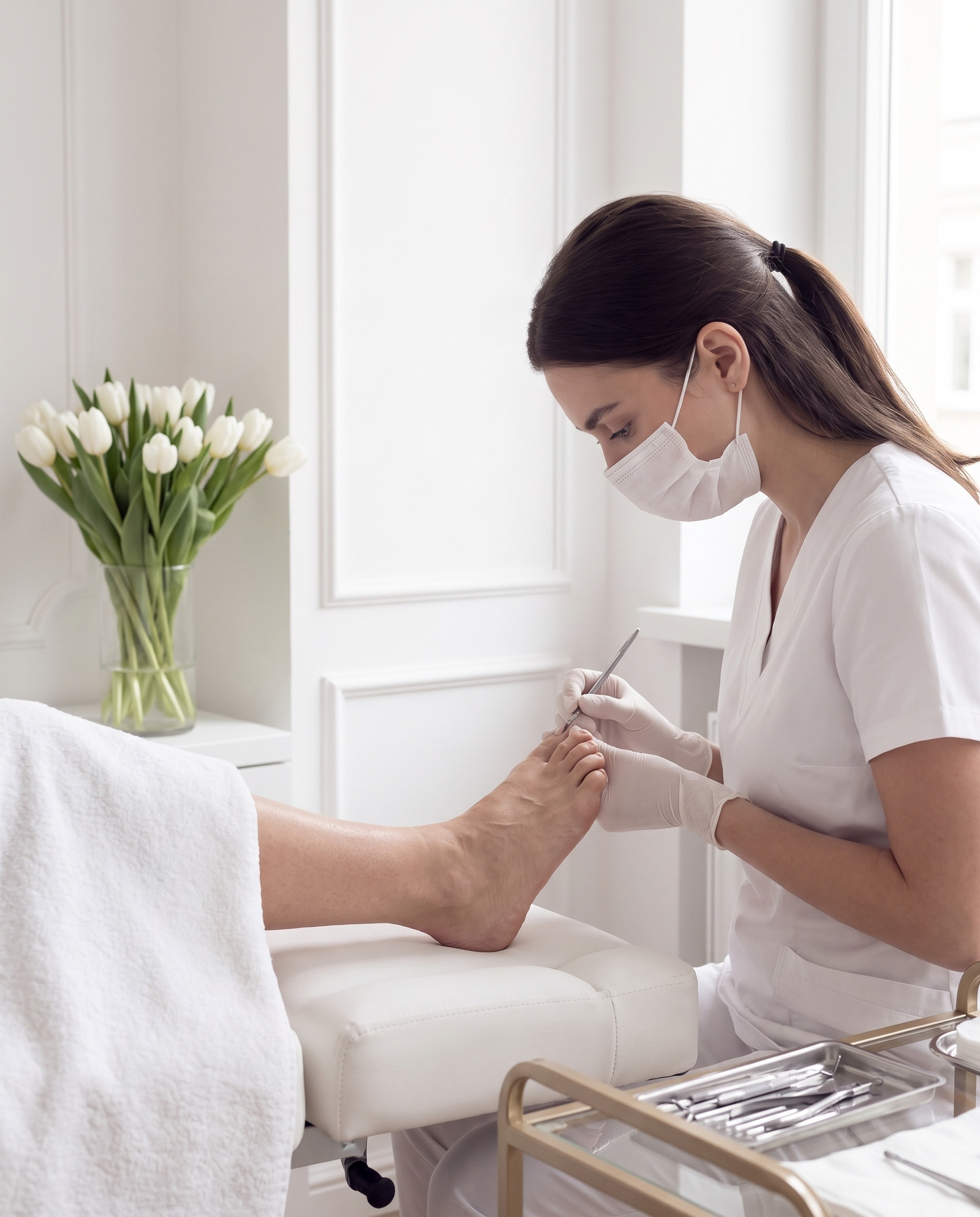
Reviews describing qualification and recommendations are the most informative
- Were questions asked before the treatment about illnesses, medications, diabetes, circulation and sensation in the feet?
- Did the specialist explain what they could perform and when they would refer you to a doctor?
- Did the client receive a plan for care, pressure relief or follow-up, instead of just a promise of smooth skin?
- Does the review describe the condition after a few days or weeks, rather than just the appearance upon leaving the chair?
Photos and enthusiasm about speed can be misleading
A photograph after callus removal will show smoother skin, but it will not reveal the quality of sterilisation, the consultation or subsequent healing. Conversely, a short visit is not always an advantage: time depends on the type of problem, the state of the tissue and the scope of safe work.
Check signs of credibility beyond the star rating
- The service description clearly separates podiatric care from medical treatment.
- The clinic does not promise permanent removal of a recurrence without knowing the cause.
- You can provide information about illnesses and medications before your visit.
- You receive clear rules regarding follow-up, hygiene and warning signs.
- Negative reviews have factual responses, without disclosing the client's health data.
A review about relief does not yet say whether the problem will stop returning
Immediate relief after treating a painful corn is real and important information. However, it does not answer the question about the cause of the pressure. If the client returns to the same footwear, way of walking or activity, the lesion may rebuild in the same place. A review written at the reception desk does not yet have the perspective to assess this.
A description after a few weeks has greater value: whether the recommended pressure relief was possible to use, whether footwear was discussed, whether the pain returned and what the further plan was. It is not about every review being a medical record. It is about distinguishing a pleasant first impression from the durability of the result.
The phrase "problem solved forever" should raise caution, especially when it concerns calluses, ingrown nails or deformities. Podiatry can limit the ailment and support work on the cause, but it will not disable the mechanics of the foot or change the structure of a toe in one visit.
A negative review can be valuable if it describes a specific stage
A rating without content says little. A review describing a lack of consultation, unclear recommendations or difficulty in contact after the visit indicates a point that can be verified. Conversely, a complaint that a specialist refused to treat a lesion and referred the client to a doctor does not have to indicate poor service. It may show a correct boundary of competence.
Also read the clinic's response. It should relate to the process, not disclose the client's health data and not engage in public diagnosis. A factual explanation of how to submit a complaint is a better signal than aggressive defence or a promise that every case always ends in success.
A single negative review does not decide the quality of the entire place, just as a single praise does not give a guarantee. Look for a repeatable pattern: similar comments about hygiene, communication, time or recommendations. Repeatability is more informative than the emotional strength of one entry.
A before and after photo must show the same thing
After callus removal, the skin is smoother and cleaner, so the photograph may look spectacular. However, check the light, skin moisture, angle and distance. Cream applied before the "after" photo changes the shine and visibility of fissures. A strong close-up before and a distant frame after make comparison difficult.
A photo of a nail without information about time also has limited value. The nail plate grows slowly; the result of work on a lesion is assessed along with its regrowth, not an hour after cleaning the surface. Removing discoloured mass does not yet prove that the cause has been established and that a healthy plate will grow back without recurrence.
The most honest photographs are described: what the goal was, when the control shot was taken and what part of the effect comes from the treatment and what from further care. The lack of such data does not make the photo false, but it limits its significance when choosing a place.
The words "sterile" and "hygienic" require specifics
A client can reliably describe the cleanliness of the station, the use of gloves and the method of preparing tools, but they do not always know the entire decontamination process. Therefore, supplement the review with a question to the clinic: which elements are disposable, how multi-use tools are handled and how surfaces are secured between visits.
The response should be calm and understandable. A warning sign is trivialising the question, mocking concerns or providing assurance without any description of the procedure. You do not need to know the names of all devices to expect a clear explanation of what happens to a tool after the previous client.
Equally important is the handling of bleeding or breaking the continuity of the skin. The opinion "it didn't hurt" does not say whether the station was prepared for such a situation. Comfort and safety are two different dimensions of quality; assess both.
A specialist should be able to say "I am not doing this today"
A refusal may result from an active inflammatory state, a wound, suspicion of a lesion requiring diagnostics, a general illness or a lack of conditions for a safe treatment. A client who expected immediate treatment may perceive it as a disappointment. From the perspective of quality, this decision is often the most important.
A good place does not promise that it will recognise and solve every foot lesion on its own. It knows how to refer to a dermatologist, surgeon, diabetologist or another specialist when the problem goes beyond the scope of podiatric care. However, the redirection should not be an empty sentence; the client should understand which symptom requires further assessment.
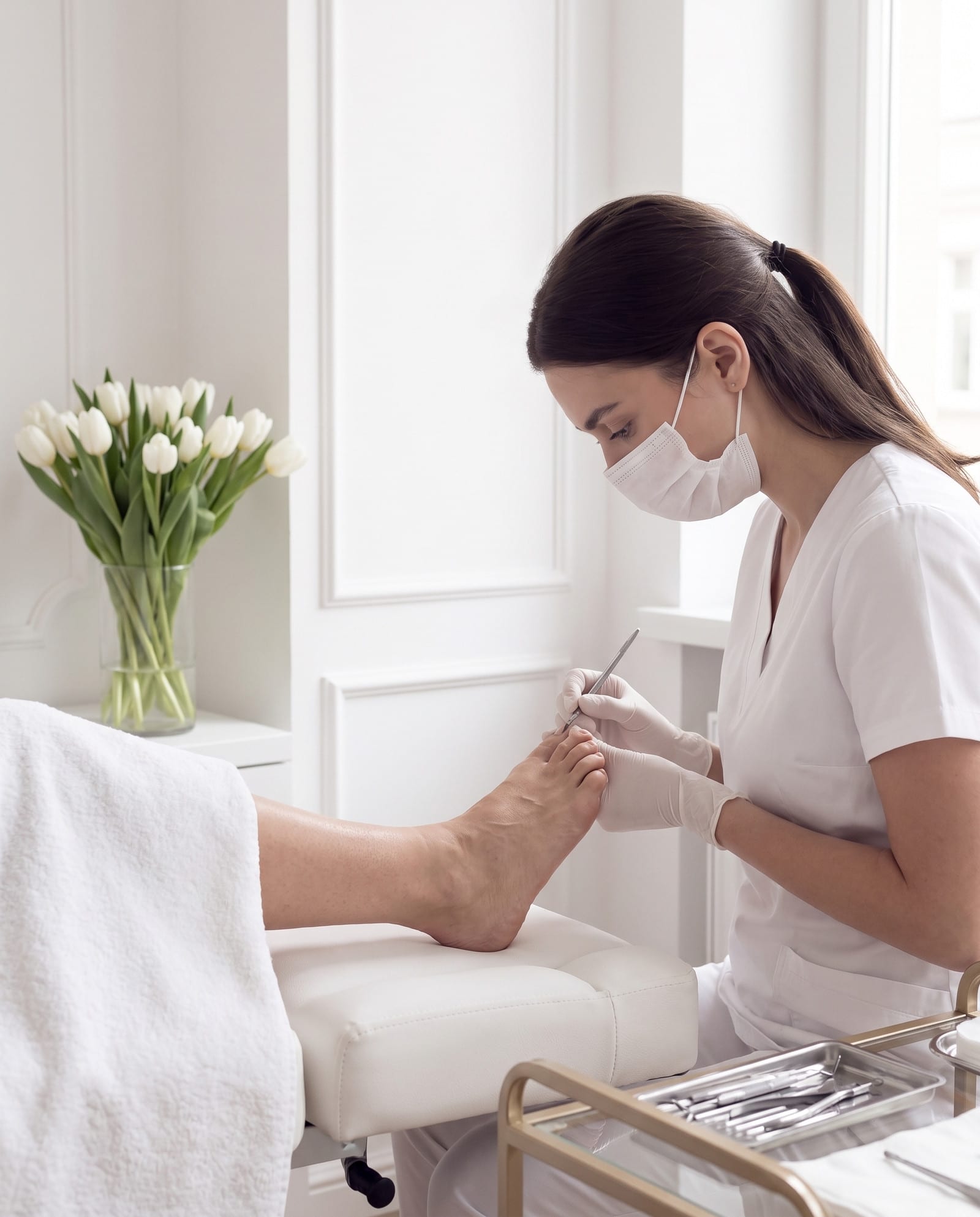
Opinions about pain must be read through the type of problem
One person comes with a superficial callus, another with a painful inflammatory state. Their comfort ratings are not comparable. Lack of pain during the first visit does not promise the same for a different problem, and discomfort does not automatically prove poor technique. What counts is whether the specialist reacted, explained and did not exceed safe boundaries.
Pay attention to the language. The description "I felt a short stinging, the specialist stopped and checked the place" conveys more than "it hurt terribly". Similarly, the sentence "everything was removed painlessly" requires context: what exactly was treated and in what state the tissue was.
Podiatry is not an endurance contest. If a clinic boasts about aggressive action or presents pain as necessary proof of effectiveness, treat it as a warning signal. The goal is safe help and foot function, not a spectacular amount of removed tissue.
A review of an aesthetic service does not describe a podiatric visit
The same profile of a place may collect opinions about pedicures, nail styling and care for a foot problem. Pleasant service during nail painting does not say how the qualification proceeds for an ingrown nail, a crack or a suspected infection. Before drawing conclusions, check which service the comment concerns.
The words "medical pedicure" are sometimes used colloquially, but they do not automatically define the scope or competence. What counts is the description of what is to be assessed and performed. When booking, name the symptom: pain in the nail fold, recurring corn, heel crack, change in plate colour. Thanks to this, the reception can refer you to the right type of visit.
If reviews mix different services, filter them by words related to your problem. Do not be guided solely by the average rating. A clinic may have hundreds of manicure reviews and only a few concerning podiatry; the number of stars will not show this proportion.
A good review describes recommendations possible to perform at home
A general message "please take care of your feet" is not a plan. A useful account mentions that the client learned where to apply a preparation, how often, what not to cut and when to return for a follow-up. Even better if the recommendations took into account standing work, sport, footwear and the ability to reach the feet independently.
Not every extensive list is good. A plan consisting of many products and activities may be unrealistic. Quality is recognised by priorities: what is most important, what effect we observe and what we do when care causes irritation. A review that the specialist simplified the routine may be more valuable than enthusiasm about the number of recommended cosmetics.
A recommendation should have boundaries. Cutting at home, piercing, aggressive acids and borrowed medications do not become safe because the client wants to speed up the result. If a review praises instructions for performing an invasive activity independently without risk assessment, do not treat it as proof of professionalism.
A phone call before the visit verifies more than another hour of reading
Prepare a short description: how long the problem has lasted, whether it hurts, whether there is a wound or discharge, what illnesses and medications may be relevant and whether there was a previous diagnosis. Do not send photos through random channels without information on how the clinic protects data. Ask whether a photograph is needed to choose the type of visit and where to safely send it.
Assess the quality of feedback questions. If, in the case of a wound or severe inflammation, the only answer is an available appointment, an important stage is missing. The reception does not have to diagnose, but it should be able to pass the report to a competent person and inform when the client should seek medical help.
A conversation does not guarantee a result, but it shows whether the process starts before the chair. This is especially important in diabetes, circulatory disorders, reduced sensation and treatment affecting healing. One factual call can reveal more than an anonymous ranking.
Warsaw: check the location and scope before you compare ratings.
You can find a description of our services on the podology in Warsaw page. J’ADORE Instytut operates at Żelazna 59 (Mon–Sat 8–21, Sun 11–19) and Mińska 29A (Mon–Sat 9–21). When booking, please confirm which location offers the service you need and describe your specific issue. The term "pedicure" alone may not reflect the nature of your visit.
The best question to ask a salon concerns the limits of their practice.
You may also ask about post-treatment support. Is there a specific channel for reporting pain, redness or issues with offloading? Does the salon explain which symptoms are normal and which require a faster assessment? Care does not end with a photo of a smooth foot taken by the chair.
Ask: "In what situation would you decline a treatment and refer me elsewhere?". A concrete answer is more valuable than dozens of sentences about a pleasant atmosphere. Professionalism in podology is also measured by what a specialist consciously chooses not to do.
Read reviews as a record of someone else’s visit, not as a promise of your own result. Look for information regarding the medical history, hygiene, explanations of recurrences and follow-ups. Everything else must be determined by an examination of the foot and a qualification on-site.
If you are still unsure after reading whether a place handles your type of problem, do not guess based on photos. Call and name the symptom. A precise answer about the scope of a service is better than booking under the wrong category and being disappointed that a safe procedure cannot be performed that day.
The most reliable decision combines three sources: reviews of the process, a clear answer from the salon and an on-site qualification. None of these is sufficient on its own. Stars help create a shortlist, but only a conversation shows whether a place understands the boundaries of podology and can tailor further steps to the actual condition of your foot.