Why nails ingrow — the mechanism explained
A nail grows from the matrix — specialised tissue at the base that produces keratin and pushes the plate forward. In a healthy state, the nail grows straight along the grooves on either side of the toe, and its edges stay above the skin of the nail fold. The problem starts when that balance is disrupted and the edge of the nail begins to dig into the surrounding soft tissue — instead of gliding above it.
This digging-in isn't a single event. It's a slow process that unfolds over weeks and months. The nail presses on the tissue, the tissue responds with inflammation and swelling, and the swelling pushes it further under the nail's edge. A vicious cycle forms: the more it hurts, the more the tissue swells and tightens around the plate — which makes it dig in deeper. That's why a problem that started as mild discomfort can become genuinely serious within weeks.
- Incorrect nail cutting — the most common cause. Cutting nails too short, rounding the corners, or trimming so-called loops causes the side edge to bend and grow into the tissue at the next regrowth.
- Unsuitable footwear — shoes too tight, too narrow at the toe, sports shoes worn for too long. Constant side pressure essentially "pushes" the nail's edge into the fold.
- Nail shape and toe anatomy — a concave or overly arched nail plate, a wide lateral fold, flat feet and an abnormal gait are predispositions that can cause recurrence even with impeccable care.
- Injuries — dropping something heavy on the toe, a knock, a stumble. A sudden injury can change the nail's growth trajectory.
- Nail fungus — a thick, deformed nail plate is more likely to bend incorrectly and grow into the fold.
Four stages of ingrowth — the scale that determines treatment
Podologists and surgeons often use different classifications, but broadly speaking, an ingrown toenail can be described in four stages of progression. Which stage you're at determines the treatment path more than any other factor. That's why an honest assessment of the nail's condition — not guesswork self-treatment — is the starting point for effective help.
- 01
Early stage — discomfort and mild swelling
The nail's edge begins to press on the lateral fold. The skin is slightly red and sensitive. There's no infection, no discharge. Walking is still possible, though certain shoes feel uncomfortable. At this stage, podology treatment is usually entirely sufficient.
- 02
Moderate stage — inflammation without infection
The tissue around the nail's edge is clearly swollen and red. Pain is noticeable under pressure and while walking. There's no pus and no granulation tissue yet. A podologist can usually manage this, though a medical consultation is sometimes advisable.
- 03
Advanced stage — infection and granuloma
Purulent discharge appears, or granulation tissue — overgrown tissue that forms a painful "bump" at the nail's edge. This is often the point where medical intervention is needed — antibiotics, and frequently a surgical procedure.
- 04
Chronic stage — recurring, with deformity
The problem recurs despite treatment. The nail plate is deformed, and the lateral fold is permanently overgrown. Here, the usual effective solution is surgery with partial matricectomy — removing the section of the matrix responsible for producing the problematic edge.
What a podologist does — and why it's worth starting there
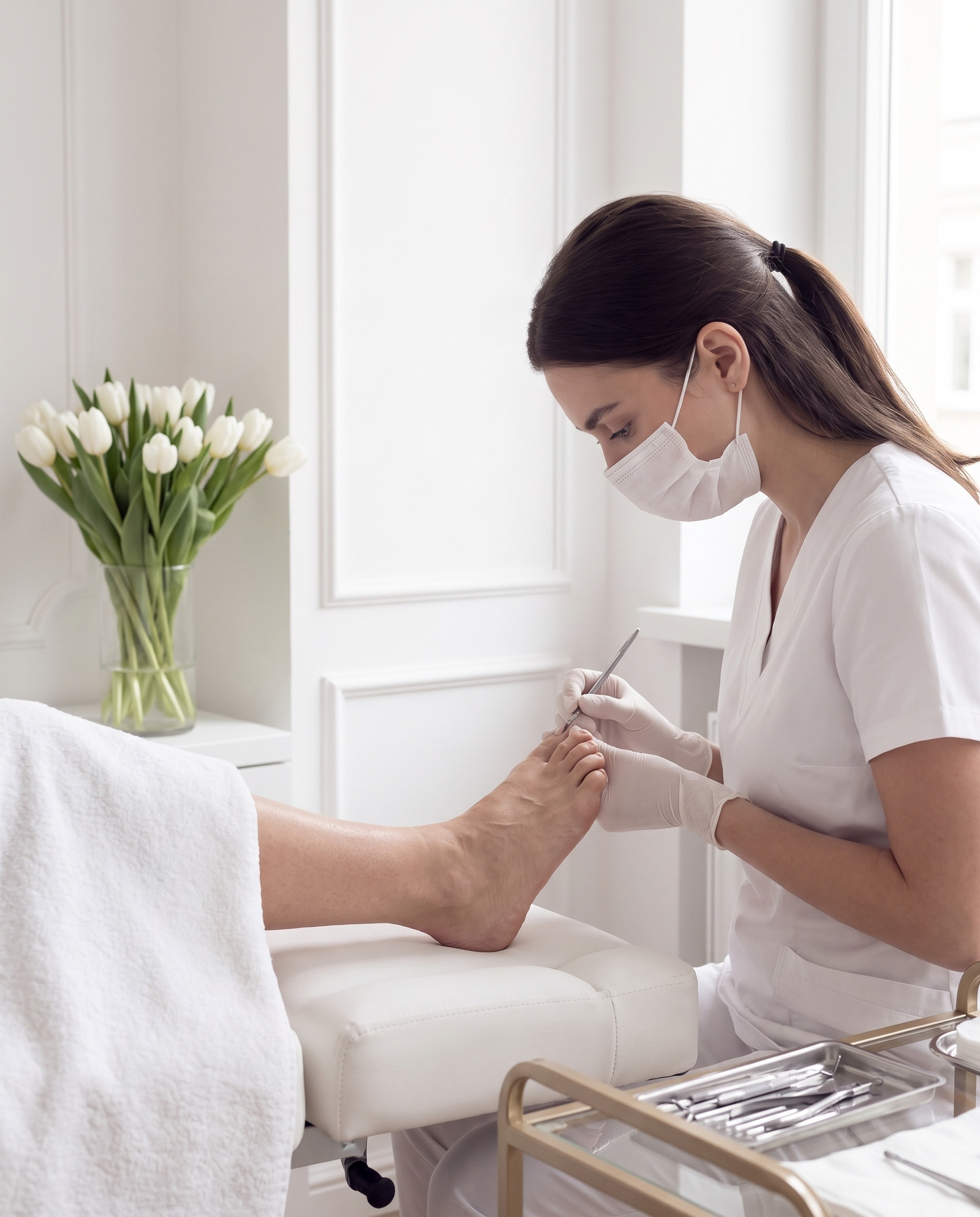
A podologist specialises in feet — including nails, their conditions, and growth disorders. For the first and often second stage of an ingrown toenail, this is the right first point of contact, not a surgical clinic. Podologists work without a scalpel or anaesthesia — and that's their advantage in uncomplicated cases.
- Trimming and edge correction — gently freeing the trapped nail edge using a specialised technique that minimises the risk of recurrence. This isn't the same as cutting the nail "down to the quick" — a podologist works with precision, usually with specialist instruments.
- Corrective brace (nail orthotics) — a thin brace glued onto or clipped around the nail plate that gradually reshapes its curvature and guides the edges outward. A non-invasive method, often highly effective for recurring ingrowth without infection.
- Packing — placing a small roll or dressing under the nail's edge, which separates it from the fold and gives the tissue time to recover. Simple, but surprisingly effective in early stages.
- Care education — learning correct cutting technique, sock choice, footwear assessment. Without this layer, recurrence is almost certain, regardless of treatment method.
When surgical intervention becomes necessary
A surgeon steps in when the problem has moved beyond what a podologist can manage without medical tools. This isn't a sign of failure or neglect — some conditions simply require anaesthesia, a sterile surgical field, and the ability to prescribe antibiotics. Recognising when this threshold has been crossed often helps avoid complications.
Podologist
early and moderate stages
- Discomfort without pus
- Swelling and redness without discharge
- Recurring ingrowth without plate deformity
- Correcting nail curvature (brace)
- Prevention and care education
Surgeon
advanced and chronic stages
- Suppurating infection requiring antibiotics
- Overgrown, bleeding granulation tissue
- Recurrence despite conservative treatment
- Matricectomy — permanent removal of a section of the nail matrix
- Diabetes or other vascular conditions affecting the toe
Surgery for an ingrown toenail is usually performed under local anaesthesia — a toe block, which effectively removes pain. The standard procedure is partial removal of the nail plate (lateral avulsion) with matricectomy — destroying or removing the section of the matrix responsible for producing the problematic edge. Without matricectomy, recurrence is very common, because the matrix simply regrows the same edge.
Preventing recurrence — care and lifestyle
Ingrown toenails tend to recur — particularly in people with an anatomical predisposition (concave plate, wide fold, flat feet) or those who slip back into old habits after treatment. The good news is that with the right home care and a few simple rules, many recurrences can be effectively prevented.
- Cut nails straight across — don't round the corners, don't trim the side edges deeply. The plate should end level with the fingertip, and its side corners should be visible above the skin of the fold.
- Don't cut too short — a nail cut too short digs into the fold at the next regrowth instead of gliding above it.
- Choose footwear with a wider toe box — particularly for long walks, sports, or standing work. Lateral pressure is one of the key factors in recurrence.
- Foot hygiene — regular washing, thorough drying (especially between the toes), changing socks. Moisture encourages fungal infections, which alter nail quality and encourage ingrowth.
- Regular podology visits — particularly after a past episode of ingrowth or with an anatomical predisposition. A podologist will assess the nails' condition and act, if needed, before the problem develops.
Podology visit + corrective brace
For recurring ingrowth without infection — a podologist frees the edge and fits a brace that gradually corrects the plate's curvature over several weeks.
Surgery + podology follow-up care
After surgery, the foot needs care — proper dressing, guidance on aftercare, and an assessment of the nail at first regrowth are good practice following matricectomy.
Therapeutic podology + fungal nail care
When ingrowth occurs alongside nail fungus, both problems need treating in parallel — otherwise the thickened, deformed plate will keep returning to poor growth.