A treatment room at J'adore
LASER THERAPY / HIGH-TECH / REMOVAL
"Heavy", drooping upper eyelids, excess skin that hides the crease and makes you look tired even after a good night's sleep — this is one of the first areas where the passage of time becomes visible. The classic solution is surgical blepharoplasty, i.e. removal of excess skin with a scalpel. Plasma IQ is a non-surgical alternative: instead of cutting, it uses a controlled plasma arc that precisely tightens the skin and lifts the eyelid.
The effect can be comparable to surgery with moderate excess skin — without an operating theatre, without stitches. However, it is an invasive procedure with a real healing period: for several to a dozen or so days there is visible swelling and small scabs, and you need to take this into account. At J'adore Instytut the procedure is performed by a doctor or an experienced cosmetologist. Below you will find everything worth knowing before you decide on it.
usually 1 session per area; with a larger excess of skin — a repeat treatment or a short series
How it works
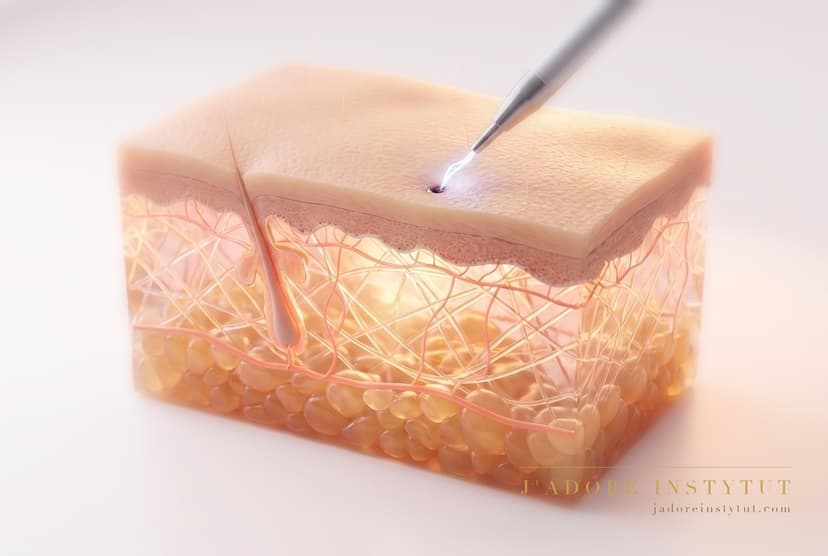
Plasma IQ is a device known as a plasma pen. Its tip never touches the skin — a microscopic plasma arc (air ionisation) forms between the electrode and the epidermis. At the point of contact, the epidermis undergoes instant sublimation — it vaporises, leaving a tiny "dot": a small, controlled scab.
The real work happens underneath, though: beneath each point, the skin contracts, and the surrounding tissue tightens like fabric being pulled taut. On top of that comes fibroblast stimulation — the cells that produce collagen — so the result keeps building for weeks after the treatment. On the eyelids, this gives a lift and tightening similar to surgical removal of excess skin, but without an incision or stitches.
The number of "dots" and their placement isn't a template from the internet — a specialist designs them individually for your anatomy and the amount of excess skin. That's why qualification is essential here.
Ideal for
Every skin lesion must be assessed before removal — if its nature raises any doubt, we refer you for diagnostics first rather than removing it blindly.
The female zone and the male zone
For women, the most common reason for a visit is drooping upper eyelids hiding make-up, along with fine lines around the eyes and above the lip. The goal is a more open gaze and smoother skin, while keeping the eye's natural shape. This is the classic Plasma IQ for women.
What we work with
For men, the dominant concern is a drooping, "heavy" upper eyelid that creates a tired, harsh look — often genetically determined. The goal: a discreet lift without changing the character of the face and without a "done" look. This is Plasma IQ for men.
What we work with
Fun fact: "plasma" isn't a laser or a current passing through the skin — it's the fourth state of matter. The device tip never touches the skin at all: a microscopic arc works through the air, and the entire process happens in microseconds, right at the surface.
Safety
Plasma IQ works thermally and leaves micro-injuries on the skin — which is why three things determine the result and safety, and are worth asking about at any salon:
At J'adore, the treatment is performed by a doctor or experienced cosmetologist, and a doctor assesses the nature of any skin lesions if there's any doubt. The specialist selects the intensity and pattern of points for your skin and phototype.
Darker skin prone to hyperpigmentation needs extra care and strict sun protection — a poorly performed treatment or sun exposure during healing risks permanent hyperpigmentation.
A good specialist will say plainly when excess skin is too great and surgery would be the better choice — rather than promising a result plasma can't deliver.
Warning sign: "plasma lift in half an hour, no healing required" · Plasma IQ always involves several days of healing — swelling and scabs. If someone promises a result with no healing period, "ready straight away for a party", or does not assess your skin phototype and the nature of your skin lesions — that is a warning sign. You have the right to ask who performs the treatment and what the healing will look like. A reliable clinic will answer without hesitation.
Contraindications
Some contraindications are permanent, others temporary — in which case we simply postpone the treatment until the situation resolves. This is a thermal treatment that breaks the epidermis, so the list is similar to that for ablative lasers.
From the specialist's chair
The thing most often underestimated: tanning and sun. Clients ask "can I come straight from holiday?" No — we won't treat freshly tanned skin, and afterwards we protect it from the sun for weeks. It's not a fussy rule — it's the difference between a beautiful result and hyperpigmentation.
This isn't a complete list — we'll go through your medications, health conditions, phototype and previous treatments individually at consultation.

Freshly healed skin is highly prone to hyperpigmentation. SPF 50+ is an absolute requirement for many weeks after the treatment — without it, even perfectly performed work can end up with a dark patch. It's the simplest way to protect the result we've just achieved.
The visit

Consultation & qualification
assessing the amount of excess skin, your phototype, the nature of any lesions and your expectations, plus ruling out contraindications. This is also where we honestly decide whether plasma will be enough.

Local anaesthesia
we apply numbing cream well ahead of time, so the treatment is comfortable.

Eye protection
when working on the eyelids, we use shields to protect the eyeball.

Plasma treatment
the specialist applies a series of precise points in the designated area; you'll feel warmth and small pinpricks.

Cooling and aftercare dressing
applied immediately after the treatment, along with a soothing product and healing instructions.
What to expect
Most importantly: there is a real healing period here and it needs to be planned for. Immediately after the procedure, swelling appears (around the eyelids it can be pronounced), and small scabs form at the puncture sites, which must fall off on their own. The final lifting effect is only revealed once the swelling has subsided and healing is complete, and it continues to improve for weeks as collagen rebuilds.
The most common mistake after treatment is picking at scabs "because they look bad". Every scab you pick off risks a scar or hyperpigmentation — exactly what we're trying to avoid. Golden rule: don't touch, don't scratch, let them fall off on their own. Aftercare heals; patience protects the result.
Duration depends on the size and number of areas — from a short, targeted treatment (single lesions) to a longer session covering both eyelids. We confirm the exact plan at consultation.
Portfolio
A record of the work in our salons — the place where we publish treatment frames and, after photo sessions, results.
A record of results — in preparation. We publish photographs of our clients only with their consent.
Once fully healed, the result usually lasts from a year to several years. Skin naturally continues to age over time, so some people choose to repeat the treatment after a while.
Plasma IQ and your lifestyle
The questions here aren't about the treatment itself, but about the healing period: make-up, sun, pools, sport. There's one rule — while the skin is healing, we protect it from sun, moisture, sweat and mechanical irritation, to avoid scarring and hyperpigmentation.
This is absolutely the most important point: healing skin exposed to sun = risk of permanent hyperpigmentation. Avoid sun and sunbeds while healing, and afterwards use SPF 50+ without exception — for many weeks.
We don't apply make-up or pore-clogging products over an area with scabs. You return to it only once the skin has healed — your specialist will tell you exactly when.
Chlorine, high temperatures, steam and sweat soften scabs and irritate the healing skin. Pools, saunas and hot baths — only once fully healed.
Heavy sweating and increased blood flow can cause irritation and slow healing. Save intense exercise for after the scabs have gone.
Gentle cleansing and your prescribed regenerating cream are your allies — use them exactly as your specialist recommends. No acids, retinol or peels until fully healed.
You'll be able to return to most jobs while accepting visible scabs for a few to around two weeks. It's best to schedule important events and photoshoots after healing.
Plasma (Plasma IQ — plasma pen)
Plasma, lasers and surgical blepharoplasty are often confused, but they do different things and suit different degrees of the problem:
tightens and lifts excess skin
it will not replace surgery in cases of significant excess skin; it involves a real healing period (swelling + scabs)
improve skin quality and firmness
won't remove excess drooping eyelid skin the way plasma or surgery can
excises excess skin with a scalpel
requires an operation, stitches and a longer recovery — a different weight of decision than plasma
Combine with
Plasma IQ solves a specific problem — excess/lax eyelid skin and small lesions. We complete the picture (skin quality, contour firmness, expression lines) with other treatments. A specialist decides on order and timing at consultation, but the logic stays the same: the skin must fully heal first.
A simple pointer from consultations: small to moderate excess skin → Plasma IQ is a great, less demanding choice. Significant excess skin → I'll honestly refer you to a surgeon, because plasma won't tighten enough. And if the issue is really skin condition and mild laxity rather than excess skin — it's often better to start with a laser or thermolifting.
Technology and treatment areas
Plasma IQ is one technology — the plasma pen, meaning epidermal sublimation with a plasma arc. What changes between treatments is the area and the goal: points are designed differently for a drooping eyelid than for a single fibroma, and differently again for lines above the lip.
Targeted sublimation and tightening of the skin above the eyelid; surrounding tissue tightens and lifts.
Dla kogoDrooping upper eyelids and lower eyelid laxity with moderate excess skin.
A denser grid of micro-points on fine lines — contraction plus collagen stimulation.
Dla kogoCrow's feet and vertical lines above the upper lip ("smoker's lines").
Precise sublimation of the lesion itself without affecting the skin around it; no cutting, no stitches.
Dla kogoSeborrhoeic warts, skin tags, milia — following an assessment of the lesion's nature.
Fact: Where do price differences come from? From the size and number of areas (upper eyelid alone vs. upper + lower + eye area), from the number of lesions removed, and from whether a repeat treatment will be needed for a larger excess of skin. That's why we always confirm pricing and any series at consultation — never from an online price list.
Price list
Checking free hours…
From the magazine
Editorial pieces on how this treatment works in practice — what happens during the session, how to prepare, where the limits are and what the first days after look like.
See also
The result lastsusually 1–3 yearsJ’adore Instytut
Medical information. Plasma IQ is a treatment using a plasma pen device (plasma arc / epidermal sublimation); it is an invasive treatment with a healing period. This text is for information only and does not constitute medical advice. Indications, qualification, area selection and contraindications are decided by a specialist during an individual consultation; for medical indications (e.g. assessing the nature of a skin lesion), a doctor's qualification is required.
Home care
Cosmetics matched to what your skin needs after a treatment — so the clinic effect lasts longer.
 eye areaMesoesteticAge Element Eye & Lip Contour Cream 20mlView in the shop(opens in a new tab)
 eye areaSelvert Thermal+ Pure Vitamin C Vitalizing Eye Contour CreamView in the shop(opens in a new tab)
 eye areaDiego Dalla PalmaSENSITIVE Soothing Eye Cream 15 mlView in the shop(opens in a new tab)
 eye areaMedik8Advanced Night Eye™ – Nourishing Night Cream for EyesView in the shop(opens in a new tab)
 eye areaMedik8Eyelift™ PeptidesView in the shop(opens in a new tab)
 eye areaSkeyndorCorrective Eye Contour Wrinkle FillerView in the shop(opens in a new tab)
 eye areaSkeyndorRedensifying Eye Contour Cream - EternalView in the shop(opens in a new tab)
 eye areaSelvert ThermalL'Esprit Derma Eye Bags & Dark Circles BalmView in the shop(opens in a new tab)