Why does a beard turn grey faster than the hair on your head?
It's one of those questions people answer with "that's just how it is". But science has a specific answer.
Melanocytes — the cells responsible for hair pigment — have different lifespans in different parts of the body. Melanocytes in the beard's hair follicles are less resistant to oxidative stress than those on the scalp. Research published in the Journal of Investigative Dermatology found that melanocyte stem cells in the beard area become depleted 5–10 years earlier, on average, than those in the scalp.
The result: a man can have thick, dark hair on his head and a beard like Gandalf's at the same time. This isn't an anomaly — it's biology. The life cycle of melanocytes in the beard is simply shorter.
There's an additional factor: oxidative stress. The face is exposed to UV, pollution and shaving (micro-injuries). All of this speeds up melanocyte degradation in the beard area. That's why the beard and moustache grey first — not the hair on the head, not body hair, but the face.
Pale lashes — "you look tired"
Few people talk about this, but losing pigment in the lashes has a huge effect on how a face looks. Lashes create a natural "frame" for the eye — they define the iris, add depth to your gaze, build contrast.
As lashes lighten — gradually, so you don't notice it happening — eyes start to look smaller, flatter, less defined. People around you won't say "your lashes have gone pale". They'll say "you look tired" or "did you sleep badly?" Because subconsciously, they read a lack of contrast as a lack of vitality.
The same applies to brows. Brows are the most important element of facial expression — they communicate emotion before you even open your mouth. Fading brows aren't just an aesthetic issue. They're a matter of how readable your face is. When brows lose colour, your face loses its "expression". You look neutral even when you're full of energy.
Brow tinting — 10 minutes that change your week
Let's start with what's simplest and gives the fastest result.
What does it involve? The cosmetologist selects a dye or henna shade to match your natural brow colour — not black, not graphite, but the exact shade you had before your brows started to fade. She applies the product, leaves it for 10–15 minutes, then removes it. That's it.
Result: Your brows look like yours — just a few years younger. Darker, better defined, more visible. Your face instantly looks more expressive. Not "dyed" — expressive. That's the key difference.
Results last: 3–4 weeks. The colour fades gradually, so there's no "here today, gone tomorrow" effect.
Lash tinting — subtle, but HUGE
This is a treatment after which men say: "I should have done this sooner."
What does it involve? Protective pads go under the lower lashes. The cosmetologist applies dye to the upper and lower lashes. 10–15 minutes, then it's removed. Done.
Result: Eyes look clearer. The gaze looks deeper. The iris looks more intense. This isn't makeup — it's restoring the natural contrast that time has taken away.
The effect is subtle — and that's the point. No one will think "he's dyed his lashes". People will think "he looks good" or "well rested". Because we subconsciously read dark lashes as a sign of health and vitality.
Results last: 3–4 weeks.
Brows + lashes = a combo for about a hundred zloty
For comparison:
Grey beard — Just for Men vs. the salon
This is where it gets interesting. A grey beard is one of those topics where men most often try to handle things themselves — and most often make mistakes.
Just for Men and drugstore products
The downsides — and it's a long list:
- Shade. Home beard dyes come in a limited palette. "Dark Brown" on the box and "Dark Brown" on your face are two different colours. The result can look unnatural — too flat, too intense, too warm.
- An orange tint. This is the plague of home dyeing. Grey hair has a specific structure (no melanin, different porosity) and absorbs pigment unevenly. The result: instead of natural brown, you get a rust-coloured tint.
- The "block" effect. Professional beard colouring isn't about "everything one colour". It's about blending shades, leaving a few grey hairs in place, creating a natural gradient. Home dye gives a uniform block effect — and a uniform block looks artificial.
- Irritation. The skin on the face is sensitive. PPD (paraphenylenediamine), found in many dyes, can cause contact dermatitis — especially on the beard, where shaving weakens the skin barrier.
Beard tinting at the salon
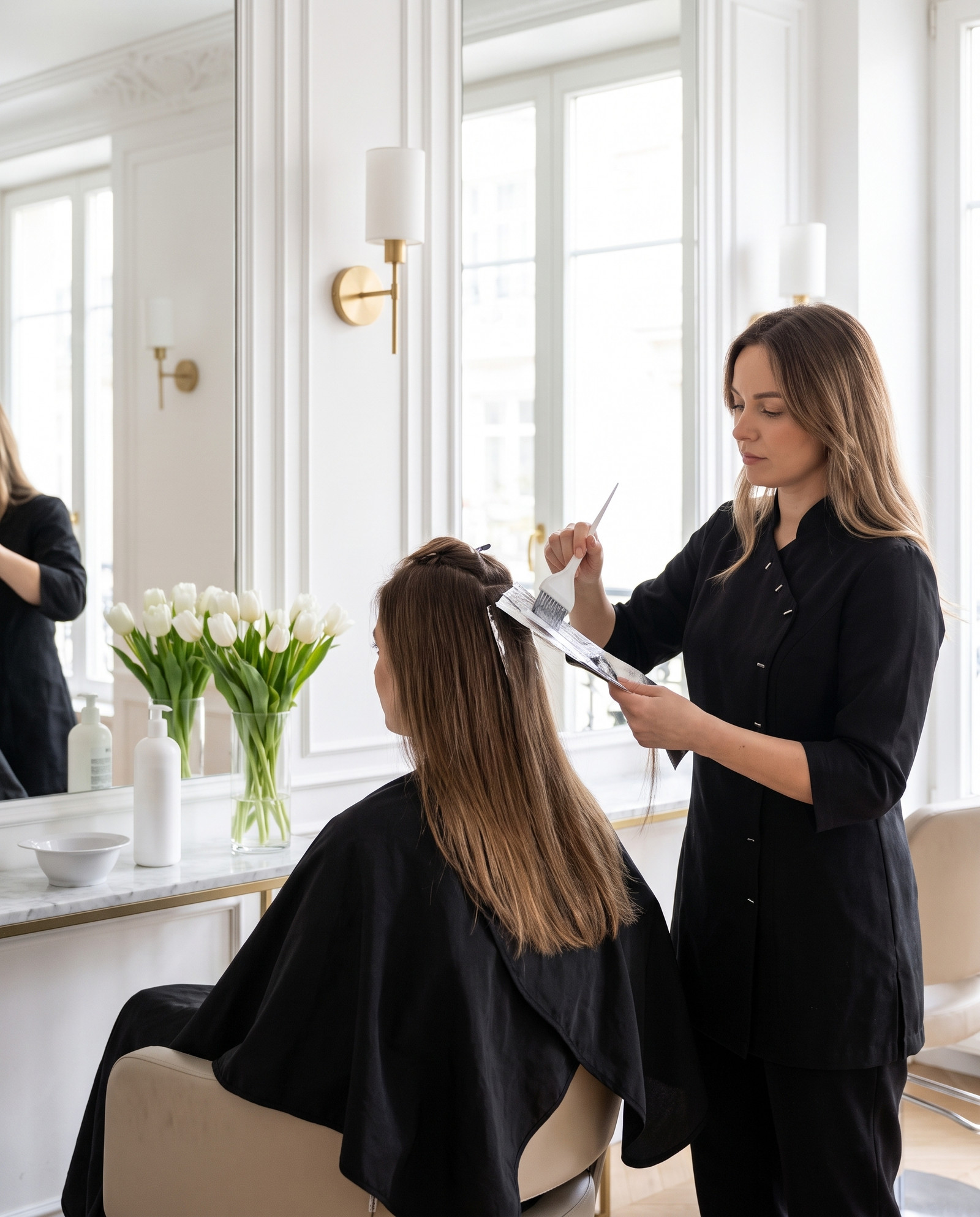
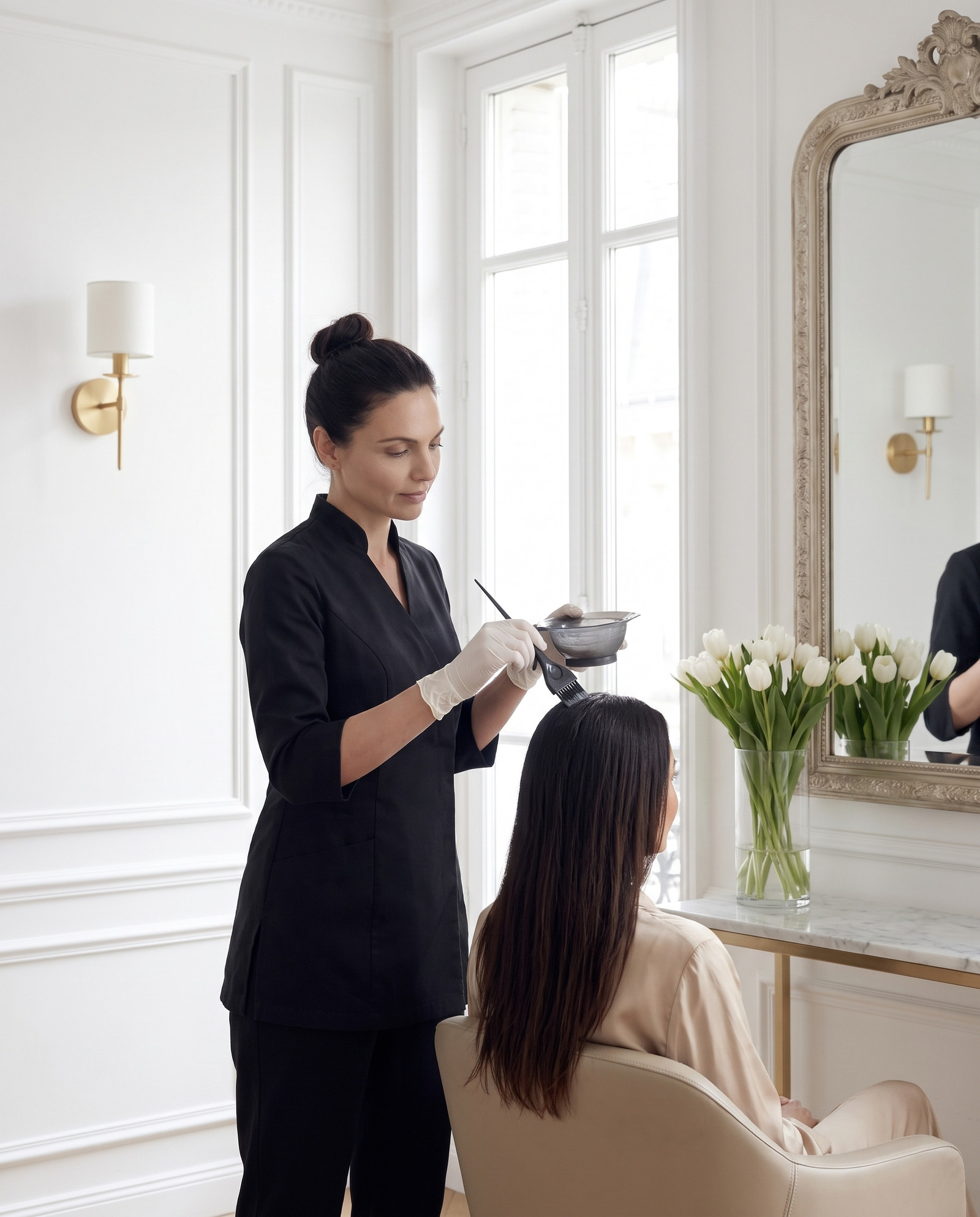
An experienced cosmetologist or barber does something you can't do at home: matches the shade to your natural colour and degree of greying.
This isn't "cover everything with dark brown". It's:
- Analysing your natural shade (warm brown? cool? with a hint of red?)
- Assessing the percentage of grey (10%? 50%? 80%?)
- Choosing the technique — full coverage or toning (darkening while keeping a few light hairs)?
- Precise application — dye where it's needed, not where it isn't
Result: your beard looks natural. As if you simply had fewer grey hairs. Not "dyed" — just yours.
"I don't want to look like I've dyed it"
This is the sentence we hear most often. And it captures the whole truth about what men expect from beauty treatments: naturalness. No dramatic changes. No revolutions. You want to look like yourself — just better.
The good news: professional tinting is designed exactly for this. A cosmetologist at the salon won't give you black brows if your natural colour was dark blond. She won't give you a flat, uniform chestnut beard if yours was always naturally varied. She'll choose a tone that suits your complexion, your eye colour and — yes — your age.
Because the point is to look like the best version of yourself. Not someone else. Not younger. Yourself.
And no one will know. Really. Because well-done tinting is invisible. Only the result shows — a clearer gaze, defined brows, a well-groomed beard. People can't pinpoint what's changed. They just see that something looks better.
Your first visit — what to expect
You don't need to call and ask "do you take men?" (yes, we do, and more every day). You don't need to know what you want. You don't need to know anything about shades.
A standard first visit:
- A short conversation — what bothers you, what you're hoping for, what you're worried about.
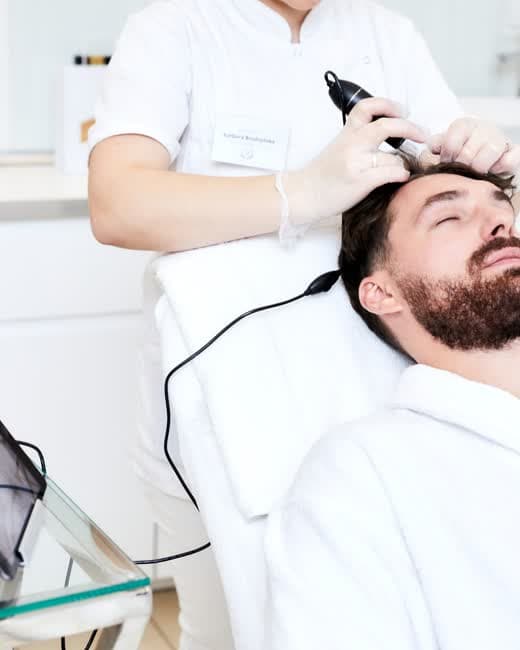
- Assessment — the cosmetologist evaluates your natural colouring, skin type and degree of depigmentation.
- A proposal — "I'd suggest tinting your brows in shade X, your lashes in shade Y, and for the beard we'll leave it as it is, or do some toning."
- The treatment — 20–30 minutes for everything. You sit, scroll through your phone, and it's done.
- You leave — and the only thing that's changed is that the mirror now shows you a version of yourself from a few years ago.
This isn't surgery. It isn't a commitment. It isn't even especially exciting — and that's exactly the point. It's a simple, quick, inexpensive grooming routine that makes a disproportionately big difference.
Men at J'ADORE — perfectly normal
J'ADORE INSTYTUT isn't "a salon for women that men can also visit". We have men on the schedule every day — brow and lash tinting, brow shaping, facial treatments. This isn't a niche service. It's a normal part of taking care of yourself.
We look forward to welcoming you at our salons in Warsaw (Żelazna 59, Mińska 29A) and Krakow (Karmelicka 45). Book online — and discover that the best investment in how you look is the one no one else notices.