
WarszawaŻelazna 59WarszawaMińska 29AKrakówKarmelicka 45Warszawa · Kraków

Careers

ENPL

Full perspective

Programme for sensitive skin / vascular skin for men

Redness and capillaries in men — it doesn't have to be "just how it is"
In men, skin is thicker, but we add a daily irritant — shaving, meaning micro-trauma every 1–3 days — plus a habit of skipping SPF. Result: chronic redness on the cheeks and nose, capillaries, flushing after exercise and alcohol, and sometimes rosacea (in men more often with overgrowth on the nose). This is a typical sensitive skin programme for men.
Czas
single visit — usually from several dozen minutes to around an hour
Efekt
result maintained with home care + follow-up sessions
Regeneracja
zero downtime — skin may be slightly flushed for a few hours at most
Seria
a programme spanning several weeks: series usually 4–6 sessions, every 1–2 weeks
Wykonuje
experienced cosmetologist
ListenProgramme for sensitive skin / vascular skin — this whole page read aloud

When it's worth it — indications

  • Reactive skin — stinging, tingling or redness after "ordinary" cosmetics that don't affect other people at all.
  • Vascular skin — visible capillaries (telangiectasia) on the cheeks and around the nose.
  • Tendency to flush — sudden redness after heat, cold, alcohol, spicy food or stress.
  • Rosacea — persistent redness and capillaries; we work gently, in coordination with a dermatologist.
  • Very thin, "see-through" skin — with visible blood vessels and low tolerance for triggers.
  • Dry, tight skin with a weakened barrier — a feeling of tightness, roughness, dehydration.
  • Intolerance to ingredients — fragrances, alcohol, SLS, strong acids.
  • Skin after summer sun/laser treatments, or during dermatological treatment (retinoids, antibiotics) — in need of regeneration.
  • Atopic dermatitis — as supportive care, after consultation and outside flare-up periods.

The areas we work on

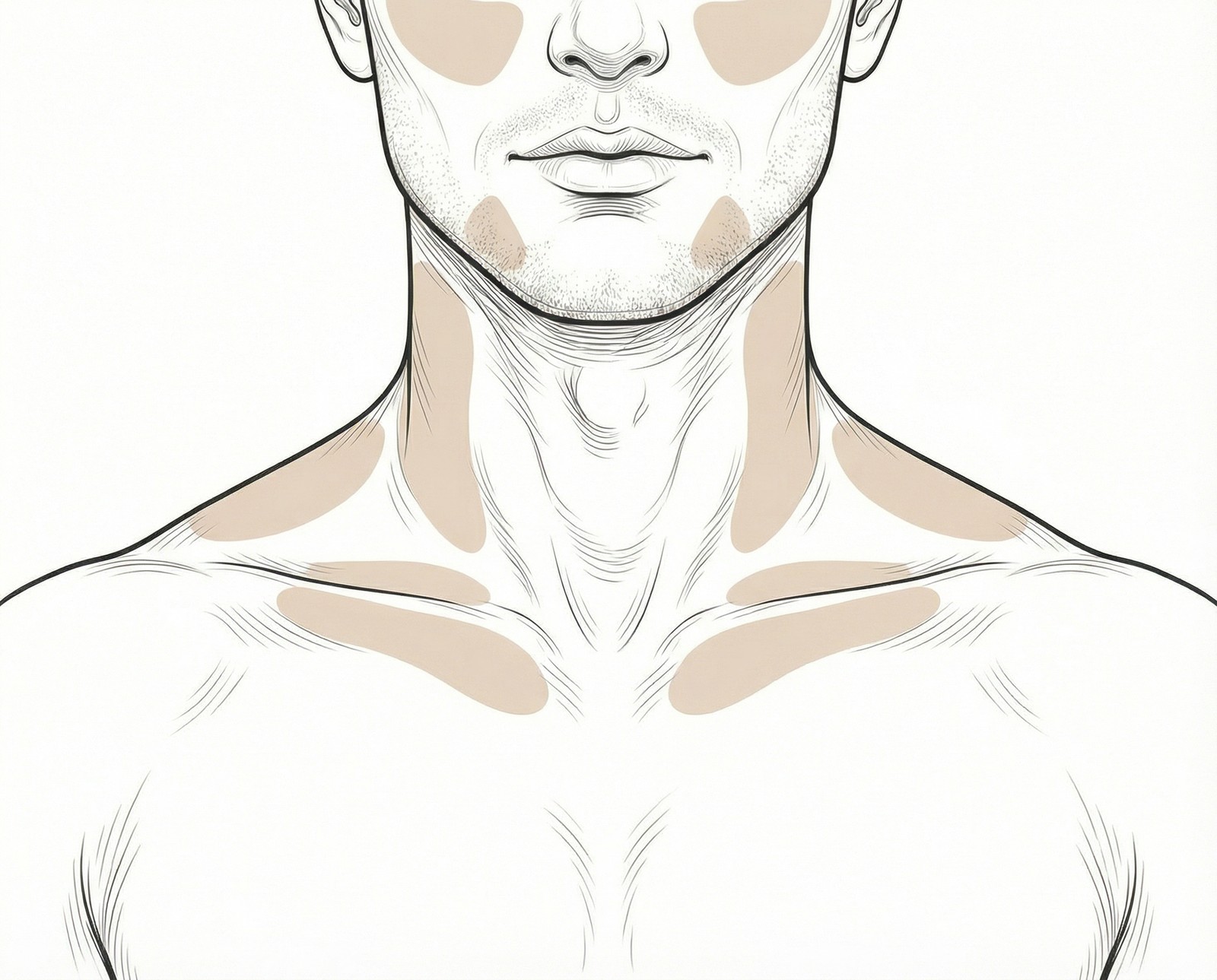
  1. persistent redness after shaving that lasts for hours;
  2. capillaries on the sides of the nose and cheeks (telangiectasia);
  3. flushing after training, sauna, spicy food and alcohol;
  4. goal: calmer, less red skin — no elaborate ritual, just a simple routine.
Rysunek stref zabiegowych — twarz i szyja, sylwetka męskaForehead and templesPoliczkiJawlineSzyja
Indicative map of the areas

Redness and capillaries in men — it doesn't have to be "just how it is"

Persistent redness on the cheeks and nose, capillaries visible around the nose, hours of a red face after training or an evening whisky — and shaving that, instead of leaving skin looking neat, leaves it burning and almost scalded for half the day. In men, sensitive and vascular skin looks different from in women, and appears in a different daily context — but the mechanism is the same: a weakened hydrolipid barrier and overreactive blood vessels that respond too strongly to triggers others don't feel at all.
The good news is that this can be effectively managed. Building a stronger barrier and reducing vascular reactivity takes a few weeks of work — without giving up shaving, coffee or the gym. The goal is simple: calmer skin, a less red face, less visible capillaries — and a home routine that takes no more than three minutes.

What makes men's skin particularly vulnerable

Men's facial skin is anatomically thicker, with higher sebum production — but that doesn't protect against vascular sensitivity. On top of that comes one constant, daily irritant that women don't have: shaving. A razor — especially "dry", on already irritated skin — causes micro-trauma to the epidermis every one to three days. Every pass of the blade disrupts the top layer of skin cells and temporarily weakens the barrier. On reactive skin, that's enough to trigger a cascade: redness, a stinging feeling, an episode of flushing that lasts for hours.
On top of this come typically male flushing triggers: intense training (raising core body temperature), sauna, alcohol (especially red wine and stronger spirits), spicy food. In men with a vascular predisposition, each of these triggers can cause noticeable redness that — with years of exposure and no barrier protection or SPF — gradually settles into persistent redness and visible capillaries.
Finally: rhinophyma — overgrowth of glands and fibrous tissue that in men mainly affects the nose — is a rarer condition, but exclusively male. We don't treat rhinophyma in a cosmetology salon — that's the domain of surgery or advanced aesthetic medicine — but we run treatments that calm redness and capillaries as part of a broader plan, in coordination with a dermatologist or doctor.

The programme — what we do, and in what order

The sensitive and vascular skin programme for men progresses in stages — because trying to "fix capillaries in one visit" on irritated, reactive skin is the fastest way to make things worse.
The first stage is strengthening the barrier and calming skin: bioengineered EstGen colostrum (growth factors EGF, IGF, TGF-β, immunoglobulins) rebuilds the barrier without acids or heat. A medical LED lamp in the red spectrum (around 630–670 nm) has an anti-inflammatory effect and stimulates fibroblasts — no chemicals, no risk of allergic reaction, zero downtime. Soothing treatments from the Skeyndor Hydrasensitiv line complete this stage. Result after two to three sessions: less stinging, less burning after shaving, skin reacting less to heat and exercise.
Once the barrier has calmed, we move into the deep hydration and resilience-building stage. Intensive hydration using professional cosmetology lines, and for some clients (in coordination with a doctor) Profhilo bioremodelling — hyaluronic acid that rebuilds the skin matrix and increases its resilience to external triggers. After this stage, skin is thicker, more resilient — and less red day-to-day.
The vascular stage — selective light closing dilated capillaries and reducing persistent redness — is planned only once skin is calm and prepared. Never during an active flare-up, never on a barrier freshly irritated by shaving.

Shaving and daily habits — what actually changes the result

Good news: you don't have to stop shaving. You need to change how you do it.
For the duration of the programme, we recommend switching to electric shaving or a trimmer instead of a multi-blade razor — less mechanical trauma to the barrier. If you keep the razor — use a hydrating gel instead of alcohol-based foam, a sharp single blade (a blunt blade tears the epidermis), and shave in the direction of hair growth. After shaving: an alcohol- and menthol-free balm — the standard "aftershave" product paradoxically often makes redness worse in men with reactive skin. After the vascular stage, we postpone shaving for a few days.
Mineral SPF 50+ (zinc oxide) — yes, for men too, and yes, every day. UV is one of the strongest triggers for capillaries returning; without SPF, the programme's results last noticeably shorter. Modern mineral formulas are matte and comfortable — nothing like the face cream of a decade ago.
Sauna, hot baths, very intense training in the heat — these are the strongest triggers for vascular dilation. During the programme, it's worth limiting or spacing them out; in the longer term, the goal is control, not elimination, since everyone's threshold differs.

Frequently asked questions

I've had red cheeks for years and thought it was just my skin type — can this actually be changed?
Persistent redness on the cheeks and nose is usually a combination of a weakened barrier and overreactive blood vessels — and yes, this can be effectively reduced. The programme builds the barrier (less reactivity), and the vascular stage reduces visible capillaries. Result after the full series: noticeably calmer skin tone day-to-day. It won't disappear completely in one visit — but after a few weeks, the difference will be visible.
Will I have to stop shaving during the programme?
No. We recommend changing your tool (electric shaving or a trimmer) and products (hydrating gel, alcohol- and menthol-free balm) — but shaving itself isn't off the table. After the vascular stage, take a break of a few days so skin can recover calmly. We'll discuss your specific routine at the consultation and adjust our recommendations.
How does the men's programme differ from the women's treatment — does it even matter?
The base protocol is the same — EstGen, LED, soothing treatments, the vascular stage at the right time. But the context differs: shaving as a constant irritant, typically male triggers (training, sauna, alcohol), thicker skin with higher sebum production, and sometimes rhinophyma affecting the nose. We adapt our recommendations and home routine to your reality — not to a protocol written with women's skincare in mind.
I have capillaries on my nose — can they be removed without laser treatment?
We close capillaries on the nose (telangiectasia) using selective light absorbed by haemoglobin — this isn't an ablative laser, it doesn't damage the epidermis, and it doesn't leave wounds. The treatment can feel like brief "snaps", but on properly prepared skin (after the calming stage) it's well tolerated. A series of sessions reduces the visibility of capillaries; with exposure to triggers (sun, heat), new ones can appear over time — hence we plan touch-ups.
I train regularly — do I need to give that up during the programme?
No. Intense exercise raises core body temperature and temporarily dilates blood vessels — this is a redness trigger, but not necessarily a trigger for lasting damage. After a session, give your skin one day without intense training. In the longer term, training is fine, but it's worth skipping the sauna straight after a workout — that's a double trigger. And apply SPF before heading out to train outdoors, since UV combined with high temperature is the worst combination for vascular skin.

Where we offer it

Programme for sensitive skin / vascular skin for men — we perform it in three J'ADORE INSTYTUT salons: two in Warsaw and one in Krakow.

  • WarszawaŻelazna 59 · Wola · Mirów
  • WarszawaMińska 29A · Praga-Południe · Kamionek
  • KrakówKarmelicka 45 · Stare Miasto · Piasek

Price list

    Book a visit

    Prices come from the salon price lists. The choice of cocktail and the number of sessions is decided by your specialist at the consultation.