WarszawaŻelazna 59WarszawaMińska 29AKrakówKarmelicka 45Warszawa · Kraków

Careers

ENPL

Full perspective

Scalp PRP for men

Male pattern baldness — what it means and when PRP makes sense
In men, classic male pattern baldness dominates: a receding hairline, crown thinning, a characteristic pattern. This is scalp PRP for men — most effective when follicles are still active rather than fully dormant. We often combine it with general treatment (a doctor decides this), because the treatment alone rarely "catches up with" a strong hormonal component.
Czas
a short visit — blood draw, plasma preparation and micro-injections
Efekt
results build over weeks and need maintenance
Regeneracja
minimal — mild scalp redness for a few to several hours
Seria
a series of several sessions at intervals + maintenance sessions
Wykonuje
trichologist or experienced cosmetologist
ListenScalp PRP — this whole page read aloud

When it's worth it — indications

  • Female or male pattern baldness — thinning at the crown and along the parting (in women) or a receding hairline and crown thinning (in men). This is the main indication.
  • Telogen effluvium — diffuse, intensified hair loss after stress, childbirth, illness, sudden dieting or seasonal changes.
  • Weakened, thin hair — when hair is getting finer, softer and slower to regrow, even without visible bald patches yet.
  • Support after diagnosis — when a trichologist or dermatologist has identified the cause and PRP is meant to complement a home-care plan or general treatment.
  • Prevention for those with a family history — when early baldness runs in the family and you want to act on the first signs.

The areas we work on

  1. a receding hairline and crown thinning;
  2. the early stage of pattern baldness — the best moment to start;
  3. maintaining the effects of general treatment between cycles;
  4. zero downtime — you can go about your day with no visible signs on your hair.
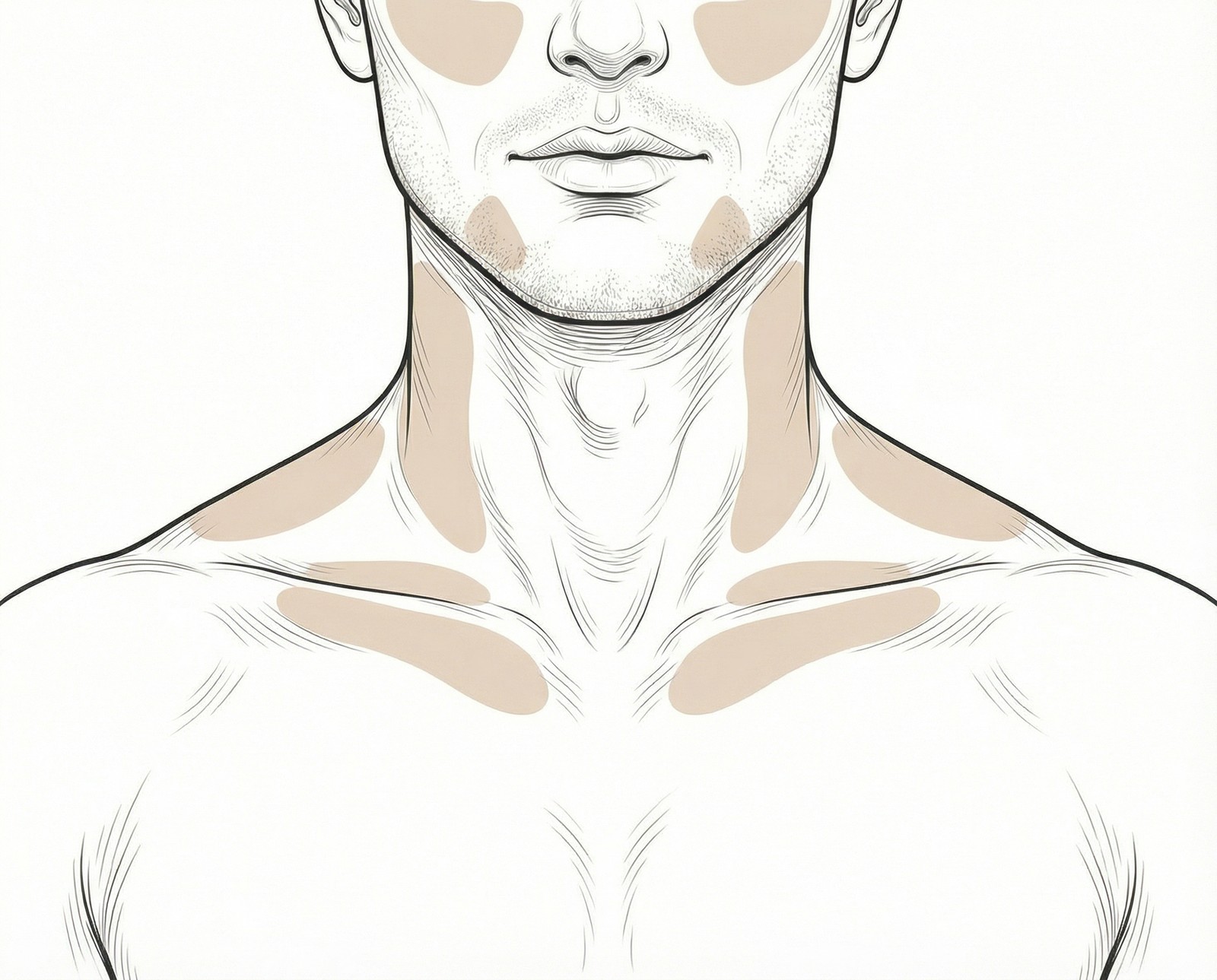
Rysunek stref zabiegowych — twarz i szyja, sylwetka męskaForehead and templesPoliczkiJawlineSzyja
Indicative map of the areas

Male pattern baldness — what it means and when PRP makes sense

If a man has a receding hairline or thinning hair at the crown, in more than nine cases out of ten, it's male pattern baldness. The mechanism is well understood: DHT (a derivative of testosterone) binds to receptors in the follicle and gradually miniaturises it — each growth cycle produces a shorter, thinner, less pigmented hair, until the follicle stops producing hair altogether. This process is only reversible at an early stage — which is exactly why the moment you act makes a huge difference.
Scalp PRP works precisely here: growth factors from your own plasma reach the follicle area directly and send a signal to work — extending the hair growth phase, reducing miniaturisation, improving scalp condition. They don't block DHT (that's the job of medication, if you opt for general treatment), but they give follicles a better environment to work in.
An honest starting point: PRP won't rebuild what's already completely gone. Smooth skin with no visible follicles doesn't respond to growth factors — there needs to be a follicle there to receive the signal. That's why the best time for PRP is the early or mid stage of baldness, when follicles are weakened but still active.

The male pattern of baldness — what you see, and where PRP targets

Male pattern baldness has a distinctive pattern: it starts at the hairline and crown, progressing according to the stages described in the Hamilton-Norwood scale. Unlike in women, where thinning is diffuse, the boundaries between zones in men are more clearly defined.
Practical uses of PRP in men:
  • a receding hairline at an early or middle stage — an area where follicles are still active;
  • thinning at the crown — the classic zone of miniaturisation in men with pattern baldness;
  • maintaining the effects of general treatment (finasteride, minoxidil) between cycles — PRP can reinforce the results of pharmacotherapy;
  • improving overall scalp condition and hair quality — when hair is thinner and weaker, but shedding isn't yet extensive;
  • prevention for men with a strong family history who want to act before the effect becomes clearly visible.

The male scalp — different conditions, different care

Men's scalps are, on average, thicker, with more intense blood supply and greater sebaceous gland activity — a result of higher androgen levels. This translates into a few practical aspects of the treatment:
Intense sebaceous gland activity often goes hand in hand with seborrhoeic scalp dermatitis and dandruff — and if left untreated, these conditions intensify hair loss. Before a PRP series, it's worth making sure your scalp is in good condition, because inflamed, oily skin is a poorer environment for growth factors. A trichologist will assess this with trichoscopy.
Men with shorter hair or a shaved head often ask about visibility after the treatment — mild scalp redness fades within a few to several hours, and it's more noticeable without hair to cover it. It's practically the only downside of a short hairstyle; if timing matters to you — before a weekend or an important meeting — plan your visit a few days in advance.

Combining PRP with general treatment — why it matters

In male pattern baldness, PRP rarely "wins" on its own against a strong hormonal component. Finasteride and dutasteride block the conversion of testosterone into DHT and act at the root of the balding mechanism. Minoxidil improves blood supply to the follicles and extends the growth phase. PRP adds growth factors from your own plasma on top of that.
We neither recommend nor administer pharmacotherapy — that's a doctor's job (a dermatologist or a medically qualified trichologist). However, combining PRP with well-chosen general treatment is an option many people choose as a comprehensive plan, and it gives the most lasting results. If you'd like to discuss this, we can refer you to a doctor, or suggest a consultation that takes both levels of treatment into account.

Frequently asked questions

I've had a receding hairline for years — does PRP still make sense, or is it too late?
It depends on the condition of the follicles in the hairline area, which we assess with trichoscopy. If we see miniaturised but still active follicles, it's worth doing. If the skin in that area is already smooth and shiny, with no visible follicles, PRP won't reach anywhere it could still work. An honest answer requires assessment under magnification. It's definitely worth checking before giving up, because sometimes what looks like a "bald patch" is still miniaturisation, not complete loss.
Will PRP stop baldness permanently?
No — particularly with pattern baldness, where a persistent hormonal component drives the hair loss. PRP works for as long as you keep using it (series plus maintenance sessions). Without maintenance, the effect fades over time, because the miniaturisation mechanism remains active throughout. It's similar to many other methods in aesthetics — results need maintaining. An honest plan involves an initial series followed by regular follow-up visits.
I've been taking finasteride for a year — does PRP make sense if I'm already on medication?
Yes, and it can be a good combination. Finasteride works hormonally — it limits DHT. PRP works locally — it sends a regenerative signal to the follicles. The two mechanisms aren't mutually exclusive; many men combine them precisely to maximise the effect. Tell us about your medication during the consultation — we'll factor it into planning the series and any supporting methods.
I have a shaved head — is PRP for me, and will it show after the treatment?
PRP can be performed regardless of hair length — there's no requirement for hair to be visible. Naturally, the treatment targets follicles, so if you've had complete hair loss in an area for many years, we come back to the question of whether those follicles are still active. But if you shave your head because your hair is thinning rather than because it's gone completely, that's a very sensible moment to check whether PRP can strengthen what's left. As for visibility: without hair, the redness is a little more noticeable for a few hours, but there are no bandages or marks the next day.
Can I go to the gym and sauna after the treatment?
Gym — hold off for around 24 hours after the treatment (intense exertion and sweating intensify scalp redness). Push back the sauna, swimming pool and hot baths by a few days — high temperatures and chlorine risk irritating the fresh injection sites. These are the only restrictions; the next day, you're back to your normal routine with no visible signs of the treatment.

Where we offer it

Scalp PRP for men — we perform it in three J'ADORE INSTYTUT salons: two in Warsaw and one in Krakow.

  • WarszawaŻelazna 59 · Wola · Mirów
  • WarszawaMińska 29A · Praga-Południe · Kamionek
  • KrakówKarmelicka 45 · Stare Miasto · Piasek

Price list

    Book a visit

    Prices come from the salon price lists. The choice of cocktail and the number of sessions is decided by your specialist at the consultation.