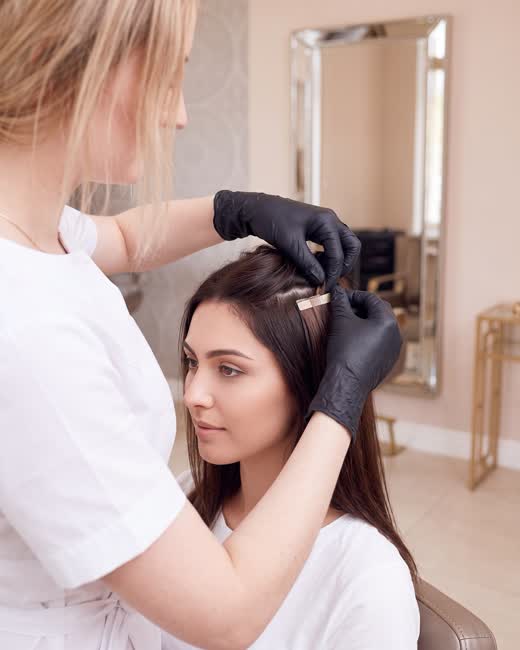
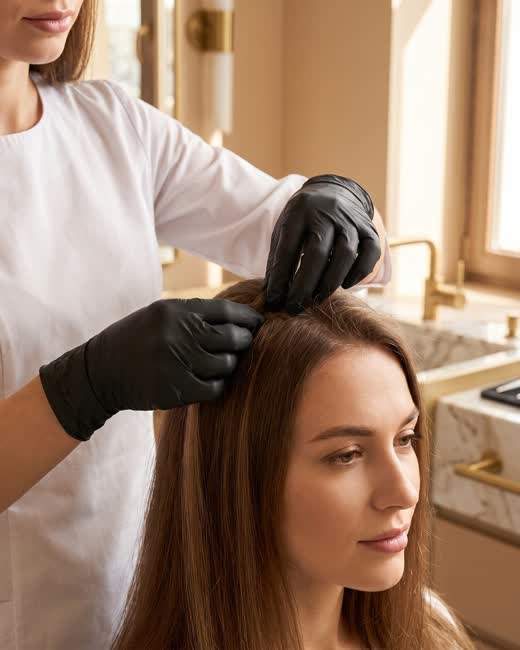
A treatment room at J'adore
SCALP & HAIR
Hair doesn't fall out "suddenly" — it weakens first. With each cycle, the follicle produces a thinner, shorter, less pigmented hair, until it eventually stops pushing it out at all.
This process — follicle miniaturisation — is behind the most common type of hair loss: male and female pattern baldness. Scalp PRP (platelet-rich plasma) is an attempt to reverse this direction using your body's own resources: from a small amount of your blood, we prepare a plasma fraction exceptionally rich in platelets — and, with them, in growth factors, natural signalling molecules that the follicle reads as a "signal to work". We deliver them through micro-injections exactly where they're needed most. This isn't a miracle cure for baldness, and we don't promise new hair where follicles have already gone dormant for good — PRP supports the ones still fighting, ideally after a proper diagnosis and as part of a series. At J'adore Instytut, the treatment is performed by a trichologist or experienced cosmetologist. Below you'll find everything worth knowing before your first visit.
a series of several sessions at intervals + maintenance sessions
How it works
PRP stands for platelet-rich plasma. We draw a small amount of your blood, then separate out a plasma fraction that's particularly concentrated in platelets. Platelets aren't only about clotting — they're a storehouse of growth factors, proteins the body uses every day to drive healing and tissue regeneration.
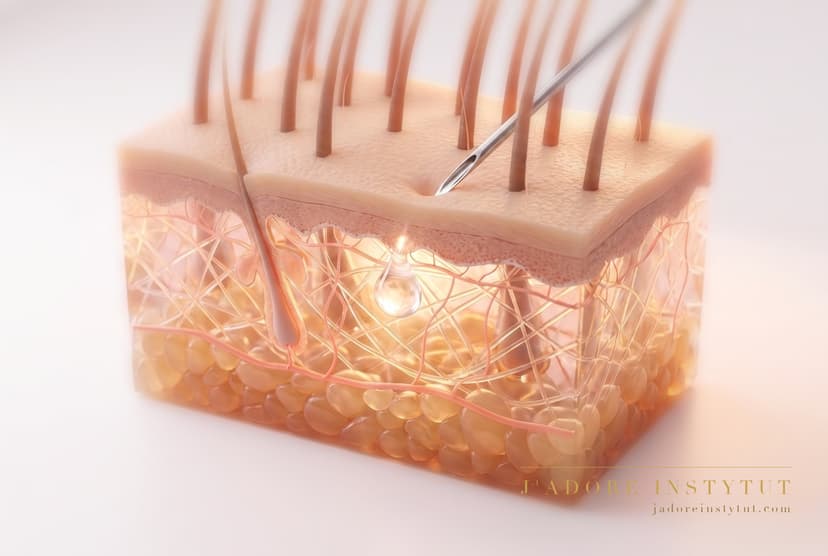
Delivered by micro-injection into the scalp, these growth factors reach the follicles directly and are read as a signal to work: they stimulate the follicle, extend the hair's growth phase (anagen) and reduce its miniaturisation — the gradual "thinning" of the hair that precedes shedding. Our first line of use for PRP is male and female pattern baldness, though it also works well for telogen effluvium (for example after stress, childbirth, or a restrictive diet).
The key point: the material comes entirely from you. We introduce no foreign substance, so there's no risk of an allergic reaction to the preparation itself. It's the same method we use on the face — if that rings a bell from skin rejuvenation, you're right; we cover it in more detail in our facial PRP treatment.
Ideal for
What PRP won't do: it won't "revive" follicles that have completely shut down (smooth, shiny skin with no visible follicles), and it won't replace a hair transplant in advanced baldness. We always establish the realistic scope of results during a consultation with trichoscopy.
Women's zone and men's zone
In women, hair loss is most often diffuse: hair thins across the whole scalp, and the parting gradually widens — distinct "bald patches" rarely appear. Telogen effluvium is also common (after childbirth, stress, dieting, or during perimenopause). Scalp PRP for women targets density and improved hair condition, ideally as a series and after ruling out general causes (deficiencies, thyroid, hormones).
What we work with
In men, classic male pattern baldness dominates: a receding hairline, crown thinning, a characteristic pattern. This is scalp PRP for men — most effective when follicles are still active rather than fully dormant. We often combine it with general treatment (a doctor decides this), because the treatment alone rarely "catches up with" a strong hormonal component.
What we work with
Interesting fact: the same growth factors that "wake up" hair follicles here are used by the body every day to heal wounds. PRP actually originated outside aesthetics — in orthopaedics and sports medicine, where plasma supports the regeneration of tendons and joints. The scalp is simply another place where this natural regenerative signal comes in useful.
Safety
PRP is safe precisely because it works with your own material — but "safe" doesn't mean "indifferent to who performs it and how". Several things determine the result and your comfort, and they're worth asking about at any salon:
Not all hair loss is equal — telogen loss after stress, pattern baldness and deficiencies all call for a different approach. That's why we start with trichoscopy and a consultation, not a needle. Without it, we'd be guessing.
Blood and plasma are biological material — full sterility and single-use equipment are an absolute must.
A good specialist is more likely to say "this is support, not a miracle" and refer you to a dermatologist than to promise miraculous regrowth. If you hear a guarantee of "getting your hair back", treat it as a warning sign.
Red flag: "guaranteed hair regrowth" · No honest treatment can guarantee "full hair recovery" — especially once follicles have gone dormant. A promise made without prior trichoscopy, pressure to buy an expensive package "upfront", or dismissing sudden, severe hair loss (which can be a symptom of illness) are all reasons to pause and seek a proper diagnosis. You have the right to ask about the realistic scope of results in your case — a good salon will answer honestly, even when the answer is "PRP alone won't be enough here".
SCALP & HAIR
Contraindications
Because PRP breaks the skin (blood draw and micro-injections), some contraindications are permanent, while others are temporary — in that case, we simply postpone the treatment until the situation passes.
From the trichologist's chair
The most commonly dismissed issue is a cold sore — "I've only got one on my lip, and the treatment's on my scalp, so it shouldn't matter." It matters: an active virus is a risk regardless of location, so it's better to postpone by a few days. Another point: if hair loss appeared suddenly and severely, we look for the cause with a doctor first — PRP isn't the answer to every type of hair loss.
This isn't a full list — we'll go through your medication, health conditions, test results and previous treatments individually during a consultation with trichoscopy.

What to expect
Most importantly: you won't see results "after just one session". Growth factors act on the follicle slowly, and hair grows over months — this is a marathon, not a sprint. The first thing that usually changes is less hair shedding (on the brush, in the drain, on the pillow), with density subtly increasing only later.
The most common disappointment comes from expecting "hair after a month". I explain it like this: we don't plant new hair — we hold back the queue of hair about to fall out and strengthen those that remain. So the first real proof it's working is less hair on the comb, not a new hairstyle. Patience and sticking to the series do half the work here.
PRP supports, but it doesn't stop the underlying cause — if a strong hormonal component drives the hair loss (pattern baldness), the effect lasts only as long as we keep up maintenance, and it often works best combined with general treatment overseen by a doctor.
Portfolio
A record of the work in our salons — the place where we publish treatment frames and, after photo sessions, results.
A record of results — in preparation. We publish photographs of our clients only with their consent.
PRP and your lifestyle
After the treatment, it's all about one thing: not irritating the freshly treated scalp, and not intensifying redness on the first day. The rules are simple and short-lived.
Don't wash your hair the same day — let the skin heal over. From the next day, wash gently with lukewarm water, without vigorous massaging or scrubbing with your nails.
Intense exertion and heavy sweating right after the treatment irritate the skin and intensify redness. Ease back into the gym after a day.
High temperatures, chlorine and communal bathing risk irritating and infecting fresh injection sites. We hold off on the sauna, pool and hammam for a few days.
Protect freshly treated partings and exposed areas from strong sun — a hat or SPF on the scalp for the first few days.
Colouring, perming or strong styling products on freshly treated skin is an unnecessary risk. Plan them in advance, or a few days after the treatment.
Discuss anticoagulant medication during consultation (it encourages bruising and affects the treatment). Avoid alcohol the day before and after — it dilates blood vessels and intensifies bruising.
Scalp PRP
There are now several "injection-based" methods for the scalp, and it's easy to confuse them. They all do a lot of good, but through different mechanisms — and they often work best together, as part of a considered plan:
a regenerative signal from your own blood
doesn't "deliver" ready-made vitamins or hyaluronic acid — it works through signalling, not nourishment
a nourishing cocktail delivered straight into the skin
this is a substance from outside, not a signal from your blood — a different mechanism from PRP
the latest generation of signalling
this is a ready-made preparation, not autologous material — it works through signalling, but from outside your body
Combine with
PRP rarely works alone. The choice, order and intervals are decided by the trichologist during consultation, but the general logic stays the same — diagnosis first, then the series, with supporting elements built around it:
People ask, "which is better — PRP or mesotherapy?" The most honest answer: they're not competitors, they're different tools. PRP is a signal from your own blood, mesotherapy is a nourishing cocktail, and exosomes carry the strongest regenerative "message". After trichoscopy, we choose one or combine them — depending on what your scalp needs at that stage.
Products included
You don't "choose a product off the shelf" — with PRP, the material is your own blood. Differences come instead from the treatment plan and what we add around the plasma. After trichoscopy, the trichologist chooses the intensity and frequency of the series, along with any supporting methods.
Classic platelet-rich plasma, prepared from a blood draw and delivered by micro-injection.
Dla kogoStarting the series, supporting condition, checking your skin's response.
Several sessions at intervals plus maintenance visits — this is how the method works best.
Dla kogoMale and female pattern baldness and telogen effluvium, when the goal is a lasting effect.
Combining plasma with a nourishing cocktail, exosomes, or gentle LED therapy between sessions.
Dla kogoA scalp that needs stronger, multi-directional support.
Fact: We always decide the exact structure of the series and any combinations individually — they depend on your type and stage of hair loss, and how you respond to the first sessions.
Price list
Checking free hours…
From the magazine
Editorial pieces on how this treatment works in practice — what happens during the session, how to prepare, where the limits are and what the first days after look like.
See also
The result lastsresults build over weeks and need maintenanceJ’adore Instytut
Note. Scalp PRP (platelet-rich plasma) is a trichology and cosmetology treatment that supports scalp and hair condition. It is not a treatment for baldness and not a medical procedure, and it does not replace dermatological or endocrinological diagnostics. If you experience severe or sudden hair loss, consult a dermatologist or trichologist. This text is provided for information only. Indications and contraindications are determined by a trichologist or experienced cosmetologist during a consultation with trichoscopy.
Home care
Cosmetics matched to what your skin needs after a treatment — so the clinic effect lasts longer.
 hair lossDSD de LuxeVasogrotene GF Activator 011 50mlView in the shop(opens in a new tab)
 scalpSesdermaSEBOVALIS Medicinal Shampoo 200 mlView in the shop(opens in a new tab)
 hair lossDermoMedicaGrowth Hair Serum 60mlView in the shop(opens in a new tab)
 scalpestGenBalancing ShampooView in the shop(opens in a new tab)
 hair lossDSD de LuxeCrexepil Lotion Forte 3.4.1 100mlView in the shop(opens in a new tab)
 scalpKV-13.2 Oily Dandruff Lotion 100ml – Anti-Dandruff BalmView in the shop(opens in a new tab)
 hair lossDermoMedicaGrowth Factor Scalp Mask 200mlView in the shop(opens in a new tab)
 hair lossMesoesteticTricology ShampooView in the shop(opens in a new tab)