
WarszawaŻelazna 59WarszawaMińska 29AKrakówKarmelicka 45Warszawa · Kraków

Careers

ENPL

Full perspective

Hyperpigmentation removal (DYE-VL) for men

Hyperpigmentation in men — the result of years without protection, not an aesthetic whim
For men, hyperpigmentation is most often the result of years without sunscreen — outdoor work, outdoor sport, no habit of sun protection. Skin is thicker, and spots tend to be widespread. This is hyperpigmentation removal for men.
Czas
short "lunch break" treatment
Efekt
lasting, as long as you protect your skin from the sun
Regeneracja
usually no downtime (redness for 1–2 days)
Seria
series of several sessions, a few weeks apart
Wykonuje
doctor or experienced cosmetologist
ListenHyperpigmentation removal (DYE-VL) — this whole page read aloud

When it's worth it — indications

  • Sun spots (lentigo solaris) — brown spots on the cheeks, temples and forehead, typical after years in the sun.
  • Freckles — when they bother you and you want them lightened (some people like them — it's a choice, not a necessity).
  • Hyperpigmentation on the hands and décolletage — classic "age spots", one of the areas that gives away age most readily.
  • Uneven, grey and tired skin tone — when skin has lost its uniformity and glow due to photoageing.
  • Remnants of post-inflammatory hyperpigmentation — such as marks left by long-healed acne (following specialist assessment).
  • Skin generally affected by sun damage — light treatments also improve texture and tone (photorejuvenation) as a bonus.

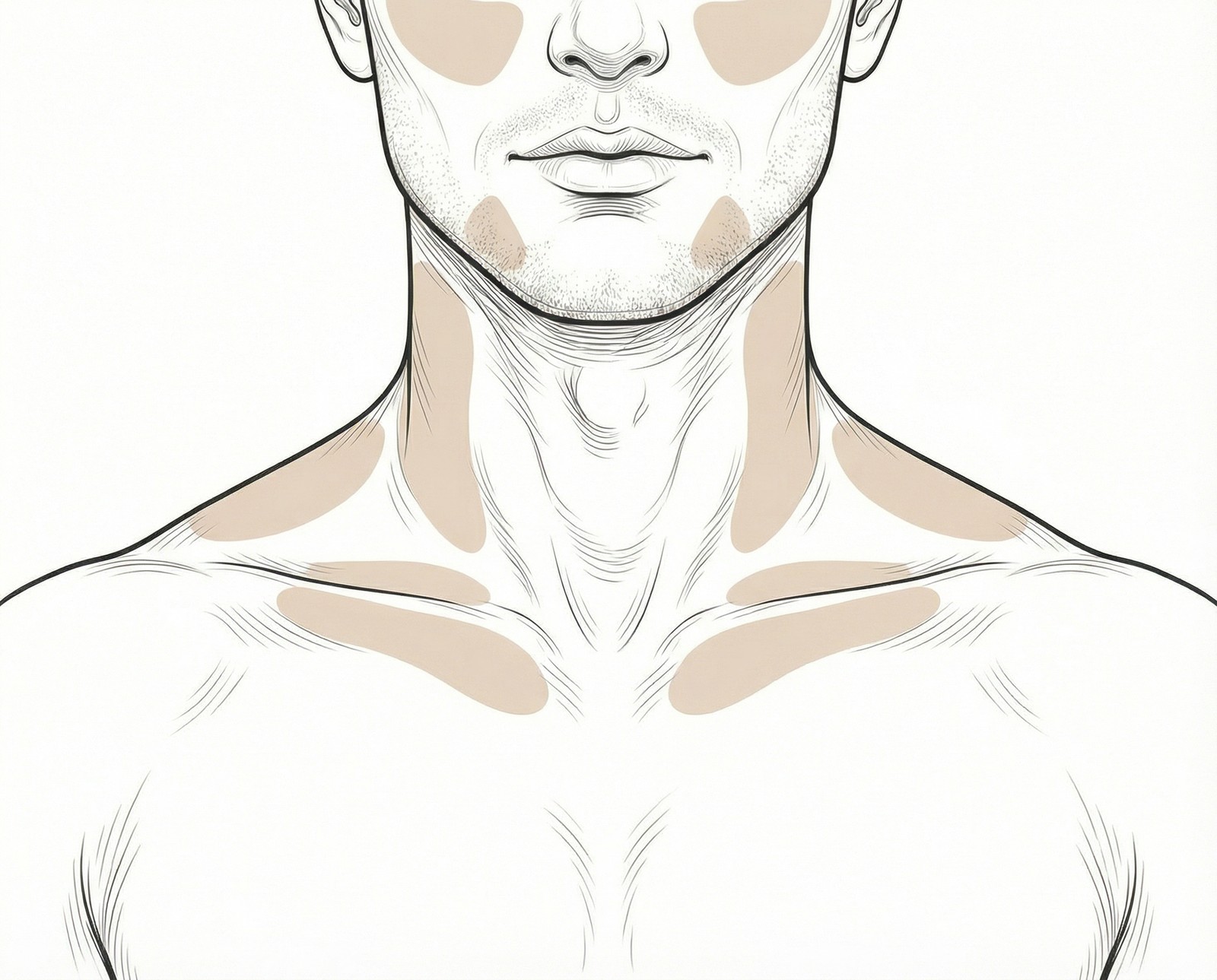
The areas we work on

  1. sun spots on the face, forehead and — for men with a receding hairline — on the crown and bald scalp;
  2. hyperpigmentation on the backs of the hands and forearms (drivers, cyclists, sailors);
  3. general photoageing from decades of sun exposure;
  4. zero downtime with gentle treatments — you can return to your routine the same day.
Rysunek stref zabiegowych — twarz i szyja, sylwetka męskaForehead and templesPoliczkiJawlineSzyja
Indicative map of the areas

Hyperpigmentation in men — the result of years without protection, not an aesthetic whim

Men's skin is thicker and produces more sebum — which makes it seem resistant to sun damage for years. The problem shows up after age 35, often after 40: accumulated pigment starts appearing as brown spots on the forehead, nose, temples and backs of the hands. There's no hormonal factor here, and no skincare masking it — it's simply a history of UV exposure without protection, often intensified by outdoor work, sport, or just years without a sun-protection habit.
There's an additional factor rarely discussed with men, but it matters: skin exposed to years of razor shaving is prone to post-inflammatory hyperpigmentation — small inflammatory reactions in the beard and neck area can leave dark marks that build up over time.

Where hyperpigmentation tends to collect most in men

Men's hyperpigmentation patterns differ from women's — and this determines which areas we typically address:
  • Face — forehead, nose, cheeks — classic signs of photoageing after years without sunscreen. Often widespread and evenly distributed, which sets them apart from the distinct, individual spots seen in women.
  • Scalp and crown — one of the most common and most requested areas for men with receding hairlines or baldness. Scalp skin exposed to sun without protection accumulates pigment particularly quickly.
  • Backs of the hands and forearms — visible with every handshake; drivers, cyclists, sailors and anyone who spends time behind the wheel or outdoors know this issue firsthand.
  • Neck and shaving area — post-inflammatory hyperpigmentation from mechanical skin irritation. This requires a slightly different approach than actinic (sun-related) spots.

Diagnostics before starting a series — why it matters

Not all hyperpigmentation sits at the same depth. Some spots are superficial and respond excellently to light treatments after just 1–3 sessions. Others go deeper and require a different tool — or a longer protocol. Wood's lamp diagnostics, which we use before treatment, lets us assess pigment depth invisible to the naked eye — this is the basis for choosing the right method and avoiding a situation where the chosen technology misses the target.
We match the treatment to your skin, not the other way round. If sun spots on the face and deep hyperpigmentation on the hands call for different approaches — we use different approaches. There's no one-size-fits-all protocol here.

Shaving, training, work — a treatment built around your lifestyle

The men we talk to usually share one expectation: no downtime is acceptable. And for most hyperpigmentation treatments — that's entirely possible. Gentle light treatments (DYE-VL, ClearLift) usually involve a few days of mild redness and darkening spots — you're back to work the same day or the next.
Shaving can continue — just be gentler in the first 24 hours, without rubbing the treated area. It's worth postponing intensive strength training for 24 hours, so swelling doesn't increase right after the treatment. The rest of your routine stays unchanged.
After fractional laser — used for resistant hyperpigmentation or when improving skin texture at the same time — recovery takes longer (several days of redness and flaking). We'll explain this in detail before the treatment, so you can plan your schedule.

Frequently asked questions

Will anyone at work notice I've had a treatment?
With gentle treatments — usually not. For a few days, the hyperpigmentation darkens and starts shedding along with the flaking epidermis, but this change is subtle and won't stand out in professional settings. The final result is more even, healthier-looking skin — people notice you look better, not that you had a treatment. With stronger fractional laser, a few days are more noticeable — it's worth scheduling around a quieter week.
I train intensively at the gym — will that shorten the results or cause harm?
Training itself doesn't cancel out the treatment's effect. In people with a very fast metabolism and quick circulation, the treatment's effect may fade slightly sooner — your specialist takes this into account when planning the series. The only restriction is a break of around 24 hours from intense exercise right after the treatment, to avoid increasing swelling and redness immediately afterwards.
I shave with a razor — should I skip the beard area before the treatment?
You don't need to skip shaving. For facial treatments, shaving the beard and neck area isn't contraindicated. The only recommendation is a gentler touch in the first 24 hours after the treatment — no hard rubbing and no aggressive aftershave products with a high alcohol content. From the next day, your routine goes back to normal.
I have hyperpigmentation on my bald scalp — does this treatment work there too?
Yes — scalp skin responds to light treatments in the same way as facial skin. Sun spots on a bald scalp or receding hairline are one of the most common reasons men book this treatment, and one of the areas where results can be very noticeable. Preparation is the same as for the face — skin must be untanned, with no recent sun exposure.
Can I combine hyperpigmentation removal with other treatments for men?
This often makes sense — hyperpigmentation and broken capillary treatments are sometimes performed with the same device, just with different settings. Photorejuvenation, as a broader treatment, naturally complements spot removal. For deeper hyperpigmentation combined with poorer skin texture, fractional laser works on both issues at once. The order and spacing of different treatments is set by your specialist after examining your skin at the consultation.

Where we offer it

Hyperpigmentation removal (DYE-VL) for men — we perform it in three J'ADORE INSTYTUT salons: two in Warsaw and one in Krakow.

  • WarszawaŻelazna 59 · Wola · Mirów
  • WarszawaMińska 29A · Praga-Południe · Kamionek
  • KrakówKarmelicka 45 · Stare Miasto · Piasek

Price list

Górna warga

od 210 zł

  • Żelazna250 zł
  • Mińska210 zł
  • Karmelicka210 zł
Book a visit

Prices come from the salon price lists. The choice of cocktail and the number of sessions is decided by your specialist at the consultation.