Why shaving your back and neck is a never-ending loop
Shaving gives the fastest immediate result and the worst long-term outcome. On the neck, regrowth shows within days — and not soft regrowth, but hard, often ingrown stubble that causes redness and bumps. On the back, the problem is more fundamental: without someone else's help, it's almost impossible to do — missed patches, nicks, uneven results.
Waxing and chemical hair removal creams take the hair out a little deeper, but they don't solve the underlying problem: within a few weeks you're back to square one. Some men simply give up and live with the discomfort. Others fall into a cycle of regular barber visits every two weeks — which, over a year, becomes surprisingly costly and time-consuming. Laser treatment works on a different principle: instead of managing the hair, you eliminate it at the source.
How laser treatment handles male hair growth
Thick, dark hair on the back and neck — typical in men — is an ideal target for laser treatment. Light energy is absorbed by melanin (pigment) in the hair follicle. The darker and thicker the hair, the more energy it absorbs, and the more effectively the follicle is damaged. That's why results in men with dark, thick hair are often better than in women with fine, light hair.
Neck
small area, big visual impact
- often just a few sessions bring visible reduction
- visible results from the first sessions
- eliminates bumps and ingrown hairs at the root
Back
large area, comprehensive change
- complete independence from shaving and from asking for help
- comfort in summer (pool, gym, beach) and in winter
- permanently smooth skin, without weekly upkeep
Laser treatment doesn't affect all hairs at once — a hair has to be in its active growth phase for the energy to reach the follicle. That's why you need several sessions spread over time: each one targets a new batch of hairs entering that phase. How many sessions? That depends on the treatment area, hair density and how your skin responds to laser — the precise plan is set during consultation, not before it.
No irritation — why that's realistic, not a marketing promise
"Irritation after laser treatment" is a myth rooted in older generations of devices, or in treatments performed without cooling and without parameters matched to skin phototype. Modern diode lasers have built-in cooling systems — the handpiece delivers energy and cools the skin at the same time, which significantly reduces discomfort during the treatment and the risk of irritation afterwards.
In practice, many men experience mild redness right after the treatment, similar to what you'd see after intense exercise — it usually fades within a few hours. There's no need to hide away, no need to take time off. A few simple rules for the 24 hours after treatment: skip the sauna and pool, keep the treated area out of direct sun, avoid harsh skincare products. That's it.
Men after laser treatment: what really changes
On the neck, the effect is doubly visible: the hairline always looks neat, there's no need to plan a barber visit every two weeks "just for the neck", and bumps and ingrown hairs simply don't come back, because there's nothing left to grow in. For many men, this solves a problem they'd lived with for years and assumed was unavoidable.
- No more shaving logistics — the back is an area that's hard to shave alone, and where the results of shaving last the shortest time.
- Ingrown hairs on the neck — for many men, the problem clears up after a few sessions and doesn't come back.
- Comfort under clothing — stubble regrowing after shaving the back can cause constant discomfort; after laser treatment, the skin stays smooth.
- Time saved — a barber visit every two weeks "just for the neck", over several years, adds up to a considerable investment of time and money.

When laser treatment won't work as expected
Diode laser treatment works best on dark, thick hair with light or olive skin. If your hair is very fair, blond or red, results may be weaker, or laser may not be the right tool at all — there simply isn't enough melanin. The same applies if you tan intensively or have a very dark skin phototype: the treatment parameters need to be adjusted, and in some cases, consultation will show that a different time is safer.
How long results last is another thing worth understanding before you start. Laser treatment doesn't guarantee 100% permanent removal of all hair — the correct term is permanent reduction. For many men, after a full course of sessions, the remaining hair is sparse and fine enough that they give up shaving entirely. Others book a single top-up session after a few years. How much hair returns, and how quickly, depends on individual biology and hormone levels (testosterone stimulates hair growth).
Preparation and aftercare — a short guide
- 01
Consultation
Assessment of skin and hair, a session plan, and a discussion of expectations and any contraindications. Free of charge, no obligation.
- 02
Shaving before the treatment
A few days before the session, shave the planned area with clippers. No waxing or hair removal creams for at least 4–6 weeks before — the follicles need to be in place.
- 03
Treatment
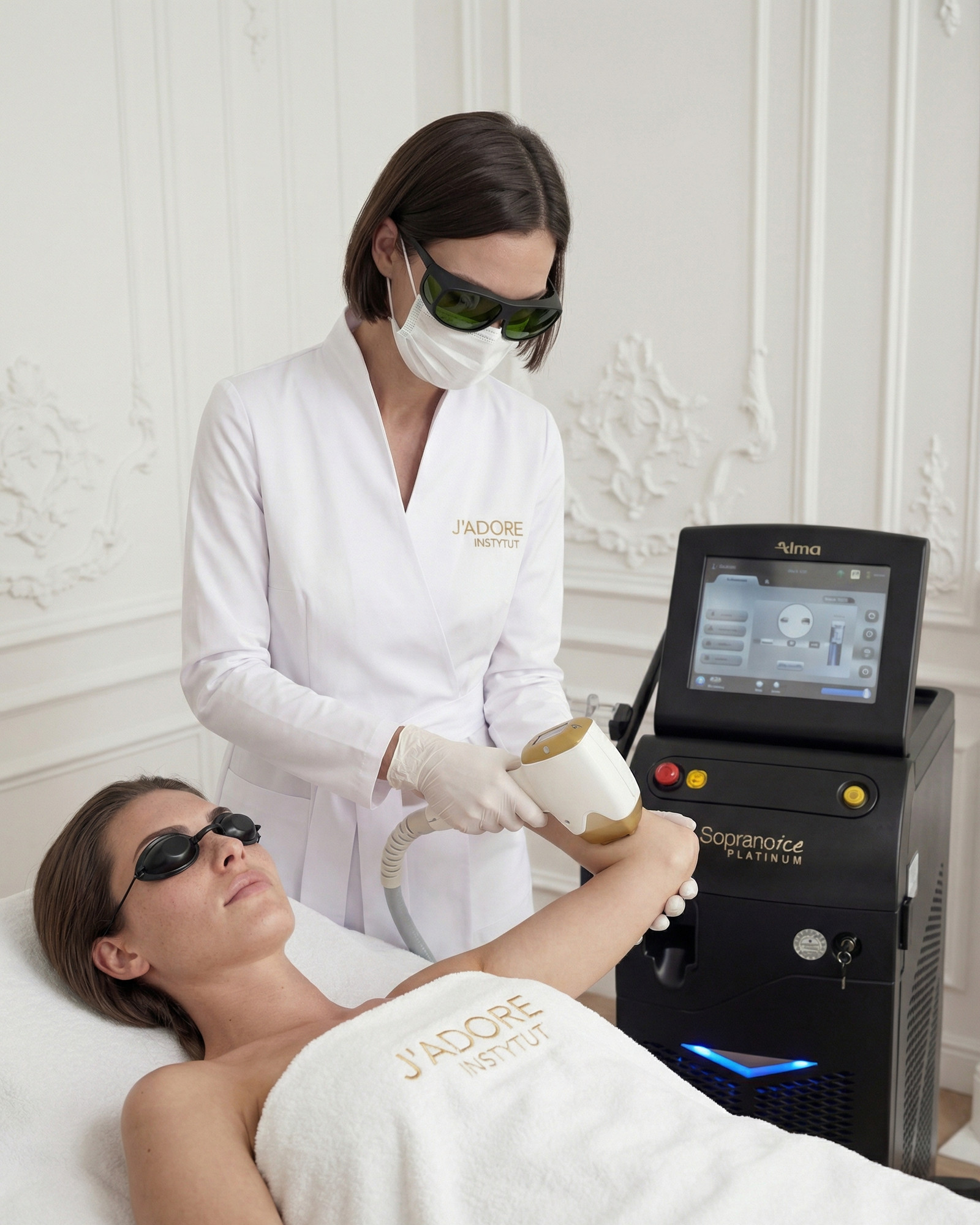
The handpiece moves across the skin, delivering pulses with simultaneous cooling. Most men describe it as warmth with a slight tingling — not pain. The back is a large area, so the treatment takes correspondingly longer than the neck.
- 04
Immediately after
Any redness fades within a few hours. For 24 hours, skip the sauna, pool, intense exercise and direct sun on the treated area.
- 05
Regrowth and the next session
For a few weeks after treatment, some hairs shed — this is normal. The next session follows a few weeks later, according to your plan. No shaving between sessions.
- 06
Assessing results
After the full course of sessions, we assess the result and whether a top-up is needed. Most men see a clear reduction well before the course ends.
Laser hair removal for underarms
A natural extension of the treatment area — the underarms are another zone where men appreciate the laser effect: less odour, less sweating, comfort after exercise.
Laser hair removal for the chest
If you're treating your back, it's often worth including the chest in the plan too — a consistent result across the whole torso, with the same treatment parameters.
Laser hair removal for the neck
The back and neck are a natural pair. The neck is a small area — adding it to a back session extends the visit only slightly, for a big visual impact.