Hair grows in phases — and that explains everything
Let's start with the one fact you really need to understand: a single hair doesn't grow continuously. It moves through a repeating three-stage cycle, and at any given moment, every hair on the body is at a different point in that cycle. That's why hair never disappears "in one go" — because it's never all in the same state at once.
- Anagen — the growth phase. The hair is actively growing, firmly connected to the papilla (the "root" that feeds it and produces it), and it holds the most pigment in the shaft. This is the only phase where the laser has something to hit and destroy. Only a hair in anagen can be effectively "switched off."
- Catagen — the transitional phase. The hair finishes growing, detaches from the papilla and starts moving towards the surface. Its connection to the "factory" is already weakening, so even if the laser heats it, there's no way to permanently damage what produces it. This phase is short — the hair is "on its way out."
- Telogen — the resting phase. The follicle rests. The old hair has either already fallen out or is about to, and the new one hasn't started yet. For the laser, this is a dead period: there's no active hair connected to the papilla, so there's nothing to destroy. The area may look "hairy," but a good portion of the follicles are dormant at this point.
And here lies the whole secret of "why not one session." At any given moment, only a portion of the hairs in a given area are in anagen — the rest are either dormant or already withdrawing, which makes them invisible or unreachable for the laser. One session can only target the portion that's actively growing at that time. The remaining follicles wait out the treatment in hiding and reappear weeks later — now in their own anagen. That's when another session is needed to catch them in the right window.
Why a series, not one "stronger" session
Since the problem is that only part of the hair is "available" at any one time, a naive solution comes to mind: why not just go stronger? One powerful session instead of several? That doesn't work — and it's a good thing it doesn't. The laser doesn't destroy hair through sheer force, but through precise targeting of the growth phase. A resting hair won't suddenly become susceptible just because we add more energy. There's simply no active target in it. The skin, on the other hand, suffers immediately — overheating the epidermis leads to burns and pigmentation changes, not a better result.
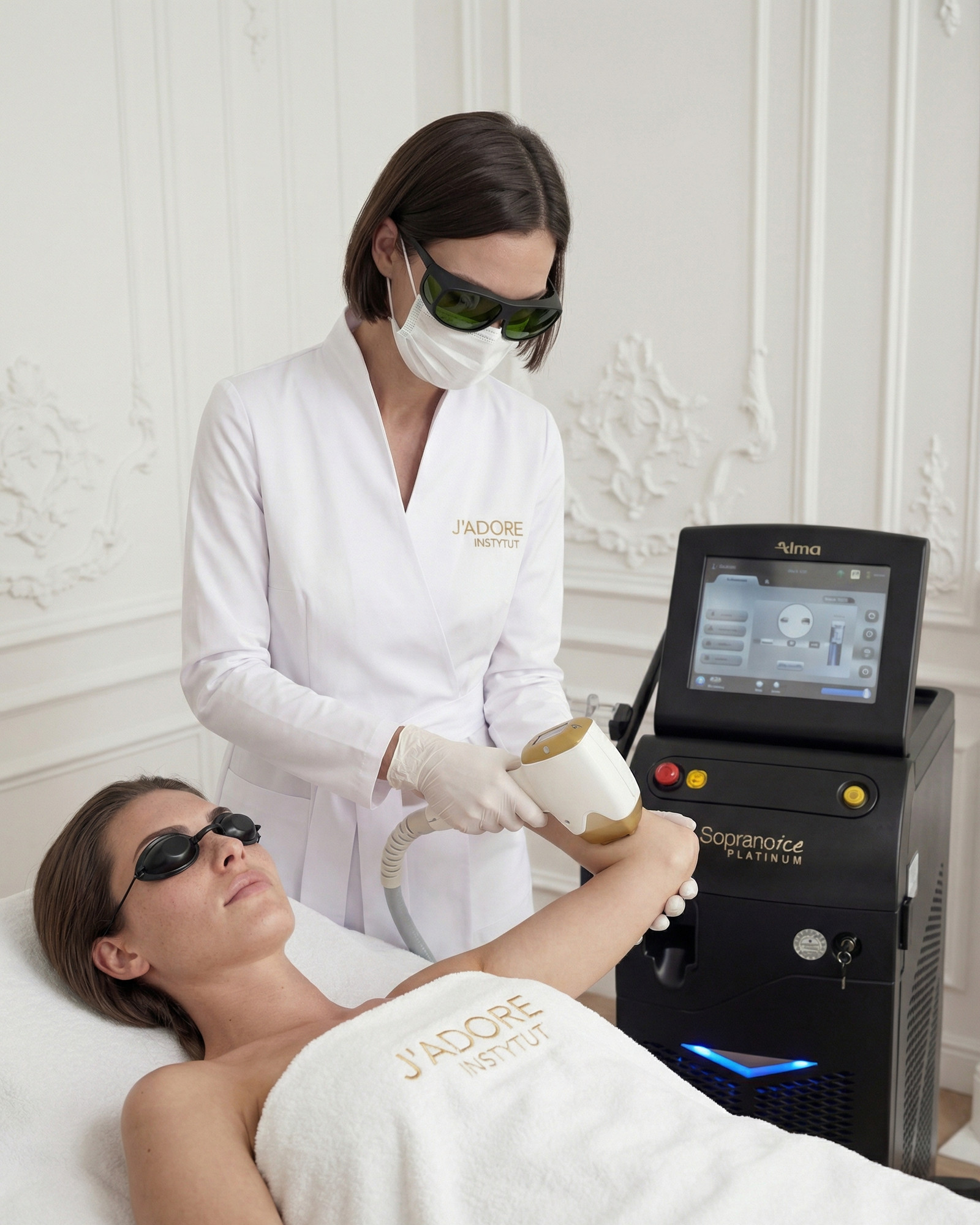
That's why modern lasers go in the opposite direction from "stronger." We work with the Soprano ICE Platinum diode laser in SHR (Super Hair Removal) mode: instead of one strong "shot," the handpiece gently and gradually heats the follicle through a series of pulses, moving across the skin. The target gets effectively heated, while the epidermis stays cooled and protected. Comfort and safety instead of brute force. Effectiveness comes from repeating sessions over time, not from the power of a single treatment.
This is where the concept of a series comes from — usually around six to eight sessions, spaced at intervals. The logic is simple: each session "clears" whichever pool of hairs happens to be in anagen at that time. The next session catches another pool once it enters the growth phase. Layer by layer, hair is reduced this way, until most follicles have been treated at the right moment. This isn't about padding out the number of visits — it's the only way this method can physically work.
Why the laser can't treat grey or fair hair
This brings us to the second big misunderstanding. Laser hair removal doesn't target "hair" as such. It targets melanin — the pigment that gives hair its colour. Melanin absorbs the laser light, converts it into heat and carries it down the shaft to the follicle. In other words: the laser sees colour, not hair. To the laser, dark, thick hair on light skin is the perfect, high-contrast target.
And that's exactly why certain hair is invisible to the laser. Grey or white hair has almost no melanin left — there's nothing for the light to absorb, the heat doesn't reach the follicle, and the follicle survives the treatment untouched. It's similar with very fair, red or downy hair: there's so little pigment that the laser either barely "senses" it or doesn't sense it at all. It's not a matter of power or a better device — it's physics. No target, no effect.
What does this mean in practice? An honest consultation starts with looking at your actual hair. Dark hair on fair skin is practically textbook material for the laser. But if grey, fair or a few resistant hairs dominate, no number of laser sessions will change that — because the problem isn't the number of treatments, it's that the laser simply can't see that hair. This is where a completely different method comes in.
When the laser isn't enough — and electrolysis takes over
There are situations where the laser, by definition, won't finish the job: grey, fair, red or downy hair, hormonal hair that returns with PCOS or menopause, and finally the odd resistant follicles left after a full laser series. In each of these cases, the problem isn't "too few sessions." The problem is a lack of melanin — a target the laser can lock onto. Adding more laser sessions here would be fighting a losing battle.
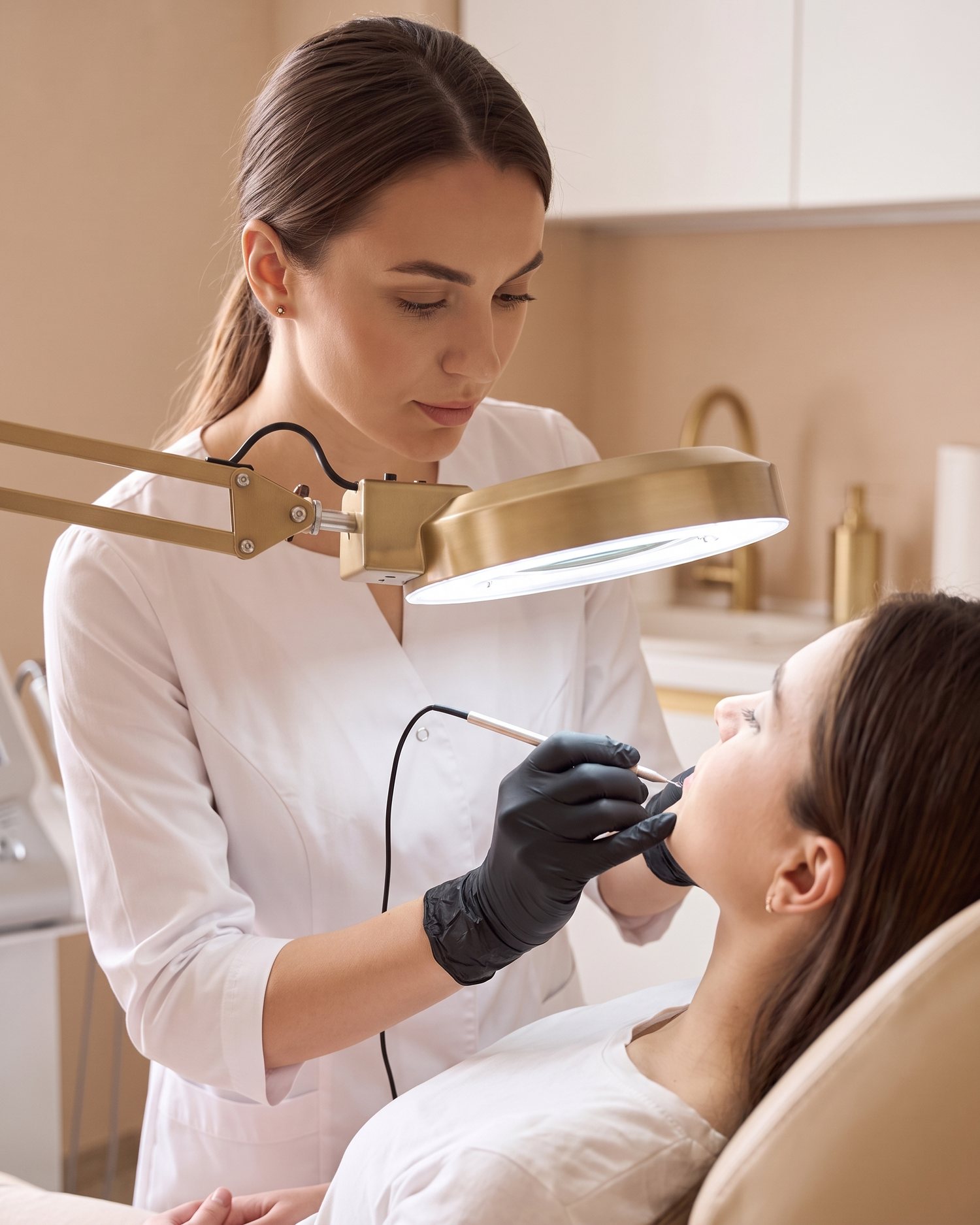
This is where electrolysis comes in — a method more than a hundred years older than the laser, and still the only one recognised for permanent hair removal regardless of hair colour. It works in a completely different way: instead of chasing pigment, it destroys the hair papilla with electric current, directly in the follicle, using a thin needle inserted along the hair. Colour stops mattering, because there's nothing to "see" here — just a follicle to treat precisely, one at a time.
Laser Hair Removal
targets melanin (colour)
- Best for dark, thick hair
- Works quickly on larger areas
- Targets the pool of hair in the growth phase
- Works as a series of sessions at intervals
Electrolysis
destroys the follicle with current (needle)
- Works on every colour — including grey and fair hair
- Follicle by follicle, with precision
- Completes what the laser couldn't reach
- Permanent reduction of the destroyed follicle
The most sensible plan often combines both methods, rather than choosing between them. If a larger area is mostly covered in dark hair, we start with a laser series — it quickly and effectively reduces most of the hair. Electrolysis then completes the result: it clears grey, fair and the odd resistant follicles the laser couldn't target. The laser does most of the work; electrolysis puts the finishing touch. These aren't competitors — they're two different tools for two different problems.
Intervals and preparation — what you shouldn't get wrong
Since effectiveness depends on hitting the growth phase, intervals between sessions aren't dragging things out — they're a condition for the method to work at all. Sessions are spaced so each one catches the next pool of follicles entering anagen. Doing treatments "one after another," just to go faster, would waste energy on hair that's still dormant. Patience isn't a virtue here — it's part of the mechanism.
There's also a preparation rule that surprises people, because it's the opposite of waxing. On the day of the treatment, the area is shaved, not waxed or plucked. The reason follows directly from the mechanism: the laser needs a hair anchored in the follicle to carry heat down to the papilla. A hair plucked beforehand leaves an empty follicle — the laser has nothing to hit, and the session is wasted. Shaving leaves the root in place, so it doesn't disrupt anything.
What about instant smoothness before the series starts delivering lasting results? This is where classic methods act as a bridge — mainly wax hair removal between stages of the plan, when you need an immediate, if temporary, result for an important occasion. This isn't a contradiction of the laser plan, just a division of roles: wax gives smoothness today, the laser builds lasting reduction over months. Just remember to switch back to shaving right before your next laser session.