Let's start with the hair — that's where it all begins
To understand why electrolysis and laser work differently, you first need to look at what both methods are trying to destroy. Hair isn't a uniform structure. It's a complex biological system, and its key component is the hair follicle — a miniature organ hidden beneath the skin's surface, responsible for the hair's growth and regeneration cycle.
The hair follicle is more than just "a hole in the skin". It contains the dermal papilla, rich in blood vessels and nerves, which nourishes the growing hair. Crucially, it also contains stem cells, capable of regeneration even after damage. This is why classic hair removal — shaving, waxing, sugaring — is never permanent. It removes the hair above the skin or pulls it from the follicle, but doesn't eliminate its ability to regrow. For a lasting result, you need to reach deeper.
Electrolysis — current in each follicle, one at a time
Electrolysis is a mechanically precise and radically direct method. A specialist inserts a thin metal needle directly into the follicle opening — not piercing the skin, but following the hair's natural channel — and delivers an electrical impulse through the needle. The energy reaches the dermal papilla directly and destroys it thermally or electrically, depending on the modality used.
- Thermolysis (diathermy): alternating current generates heat in the papilla and destroys it thermally — fast, but requires precise needle placement
- Electrolysis (galvanic): direct current triggers a chemical reaction, producing a base that destroys the papilla — slower, but very precise
- Blend method: a combination of both — the most commonly used approach today, combining the speed of thermolysis with the precision of electrolysis
The result is independent of hair colour and skin colour — electric current doesn't need any pigment as a "target". This is electrolysis's key advantage: it works equally well on blond, red, grey and white hair. If someone is trying to remove fine, light hairs above the upper lip or on the chin, electrolysis is often the only tool that can genuinely help.
Laser — light seeks darkness
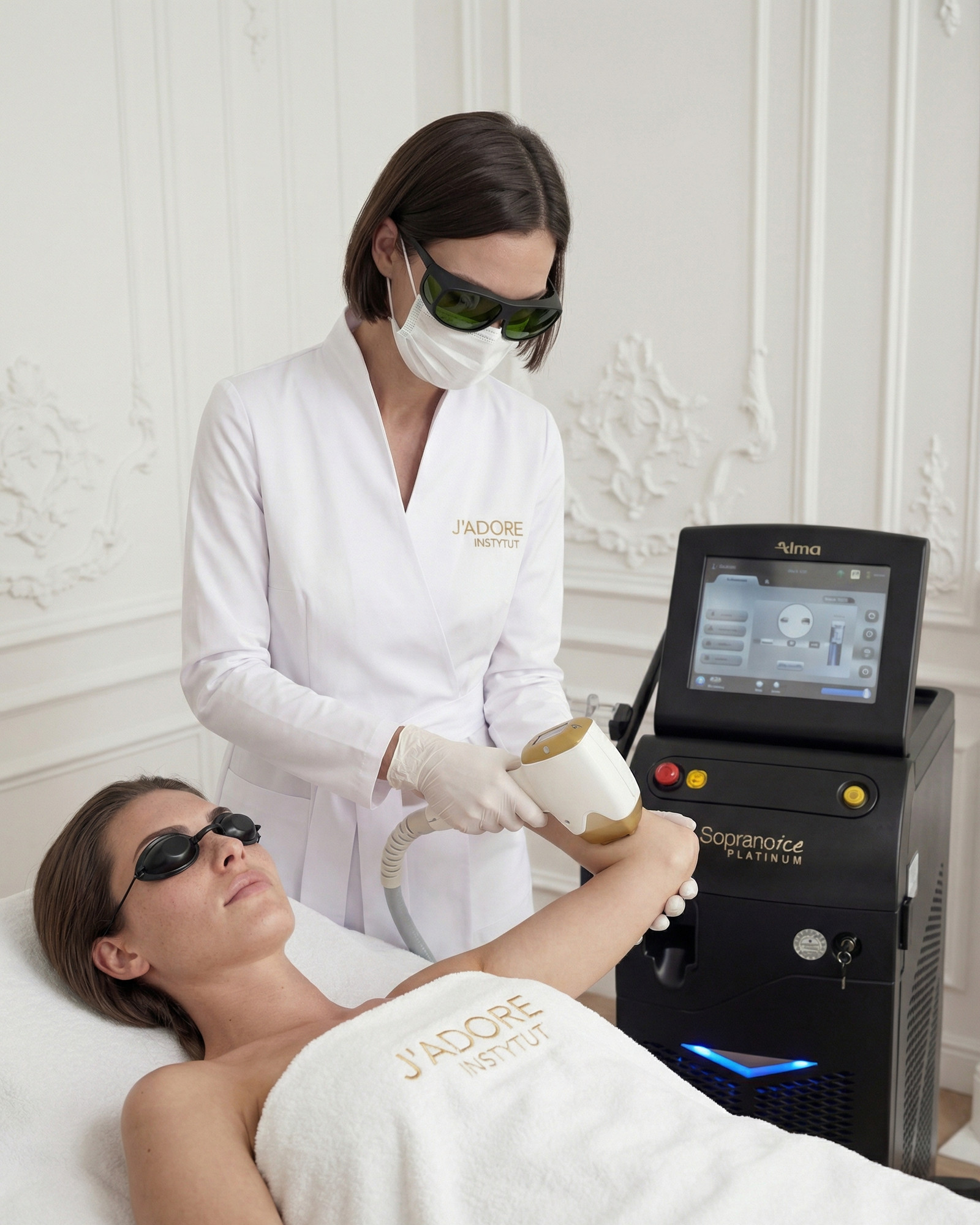
Laser works on a completely different principle — there's no needle, no physical contact with the follicle. Instead, it uses a beam of coherent light of a specific wavelength, which penetrates the skin and is absorbed by melanin — the dark pigment found in the hair follicle and in the hair itself. The absorbed energy is converted by melanin into heat, which destroys the dermal papilla.
This mechanism has its own elegance: the laser targets selectively wherever there's melanin — that is, the hair follicles — while sparing the surrounding skin, provided it has less pigment than the hair. Laser effectiveness is therefore directly tied to the contrast between hair and skin. The darker the hair and the lighter the skin, the clearer the target for the beam, and the better the results. This isn't opinion — it's physics.
Laser allows for fast treatment of large areas — the laser head covers several square centimetres of skin at once. This makes both legs, the back or the bikini area treatments where laser is a far more convenient and faster tool than needle-based work. With the right laser type matched to skin tone and hair colour, results can be very satisfying — though for many people, full results require a series of several sessions.
What really sets them apart — comparing the mechanisms
Electrolysis
electric current → follicle by follicle
- Works regardless of hair colour (blond, red, grey, white)
- Works regardless of skin colour
- The needle targets the follicle directly — mechanically precise
- Ideal for small, precise areas (brows, upper lip, chin)
- FDA-recognised as a method of permanent hair removal
- Allows correction of individual hairs
Laser
light beam → melanin in the follicle
- Fast treatment of large areas in a single session
- Best results with dark hair and light skin
- Modern lasers (Nd:YAG) suited to darker skin tones
- A convenient option for large-surface areas
- Less noticeable for the client than needle-based work
Put simply: electrolysis is a method of precision, while laser is a method of scale. The first works well wherever accuracy matters, or where hair or skin colour rules out laser. The second makes sense for large areas, with the right hair type. There's no method that's "better" in absolute terms — there's a method that's better for a given person, area and goal.
Hair and skin colour — why it matters so much
This is one of the more surprising findings for people planning hair removal: laser is a tool strongly dependent on hair biology and skin tone. Ideal conditions for laser are dark, thick hair and light skin — high contrast allows the melanin in the follicle to absorb energy precisely, with minimal absorption by the surrounding tissue.
When that contrast weakens — darker skin, light hair — laser effectiveness drops, and the risk of complications (hyperpigmentation, burns) rises if the wrong wavelength is chosen. Modern Nd:YAG lasers were designed for darker skin tones and give good results for many people, but pigment-free hair (white, grey, blond) remains beyond the reach of any laser — without pigment, there's no target for the energy to absorb.

Brows — a special case
Brows are an area with their own rules, and they deserve a separate conversation. Correcting the brow line by permanently removing unwanted hairs is a task where electrolysis is by far the more precise tool — the needle targets a specific, pointed-to hair, not an area several square centimetres wide.
Laser near the brows requires special precautions, mainly for eye safety — the laser beam and the area around the eye sockets call for protective protocols, and working on the small, irregular surface of the brow is technically more difficult than on a flat area. That's why most salons turn to electrolysis for this specific zone.
How to choose a method — questions worth asking yourself
There's no single answer for everyone. Choosing between electrolysis and laser depends on several factors at once — which is exactly why a consultation with a specialist isn't optional, it's essential. But before you get there, a few questions can help you get your bearings.
- 01
What colour is the hair you want to remove?
Dark, brown or black? Laser can be an effective option. Blond, red, grey or white? Electrolysis is probably the only method with a chance of working.
- 02
What area are we talking about?
A few hairs on the chin, a brow touch-up, the upper lip? Electrolysis. Both legs, the groin, back, arms? Laser is many times faster on large areas.
- 03
What's your skin phototype?
Light skin plus dark hair is close to ideal for laser. Dark skin needs the right laser type (Nd:YAG). Any skin tone plus light hair calls for electrolysis.
- 04
Do you care more about precision or speed?
Precision on individual hairs and difficult spots (face, brows, the hairline on the neck) — electrolysis. Large areas in a reasonable time — laser.
- 05
Consultation with a specialist
The questions above give you a general sense of direction, but they don't replace a specialist's assessment. Skin phototype, hair density, growth phase, and any contraindications (such as photosensitising medication or skin conditions) all affect the choice of method and the session plan.
In practice, the two methods often complement each other — for example, laser on the legs and electrolysis on light facial hairs is a sensible combination for someone who wants to address hair removal comprehensively across the whole body.
Brow electrolysis + shape correction
Permanently removing unwanted hairs around the brow arch, combined with a professional shape correction, gives a result that doesn't need constant work with tweezers.
Laser series + electrolysis follow-up
After a laser series is complete, a few light or laser-resistant hairs may remain. Electrolysis can precisely address them and complete the result.
Results last — what to realistically expect
The words "permanent hair removal" sound like a promise with no fine print. In reality, it's worth understanding what's really behind that term — and how electrolysis differs from laser even in terms of how long results last.
When follicles are correctly destroyed, electrolysis can give results that are permanent in the full sense of the word — a destroyed dermal papilla cannot regenerate. The US agency FDA describes electrolysis as permanent hair removal — this is not a guarantee of individual results. This does, however, require a series of treatments — each hair must be caught during the anagen phase — and a high level of precision.
Laser is officially classified as a method of permanent hair reduction — meaning that for many people, it brings very significant and long-lasting results, often with minimal regrowth after the series is complete. But not every follicle can be eliminated entirely. Some people need maintenance sessions every few years, particularly in hormonally sensitive areas (the face in women, the neck in men).