Lip blush vs classic lip PMU — what's the difference?
This isn't the same technique with nicer marketing. It's a fundamentally different approach.
- Uniform colour across the whole lip surface
- A defined outline — often darker than the fill
- Deep pigment placement (into the dermis, not the epidermis)
- Results last several years, but colour tends to shift (bluish or orange tones)
- Healing: intense, with visible scabbing for around two weeks
The problem with classic PMU? It aged badly. Iron-oxide pigments combined with deep placement migrated within the skin and changed colour. Lips that looked pink on treatment day could turn purple or orange within years.
- A gradient: a darker outline fading into a lighter centre
- New-generation pigments — colour-stable over time
- Shallow placement (at the epidermis–dermis junction)
- Gradual, natural fading
- Healing: gentler than with the classic technique
What does the treatment involve? Step by step
Treatment day — the sequence of steps:
- Cleansing and disinfecting the lips
- Applying numbing cream (lidocaine + prilocaine)
- Drawing the outline with a pencil or surgical marker — this is where you agree the shape
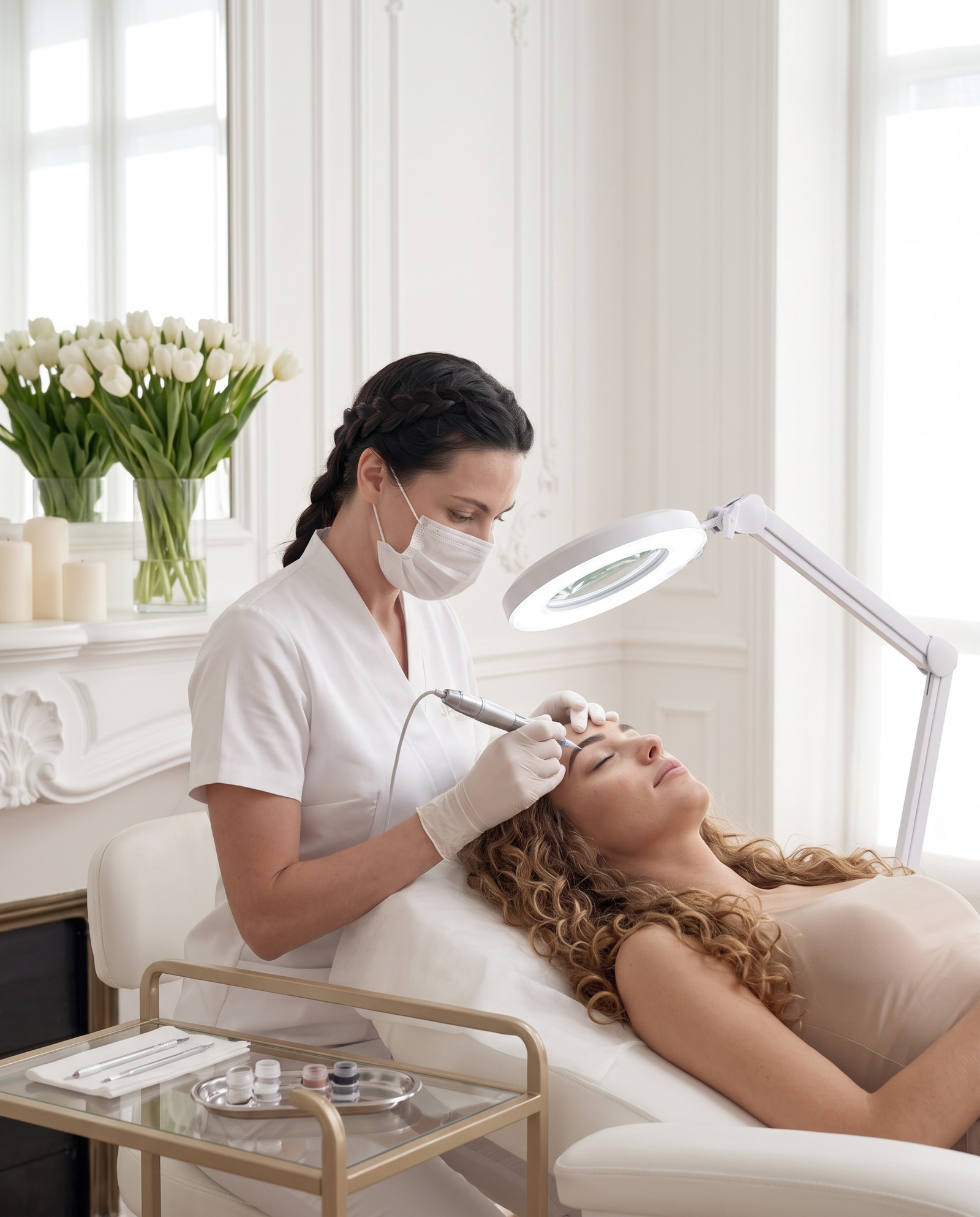
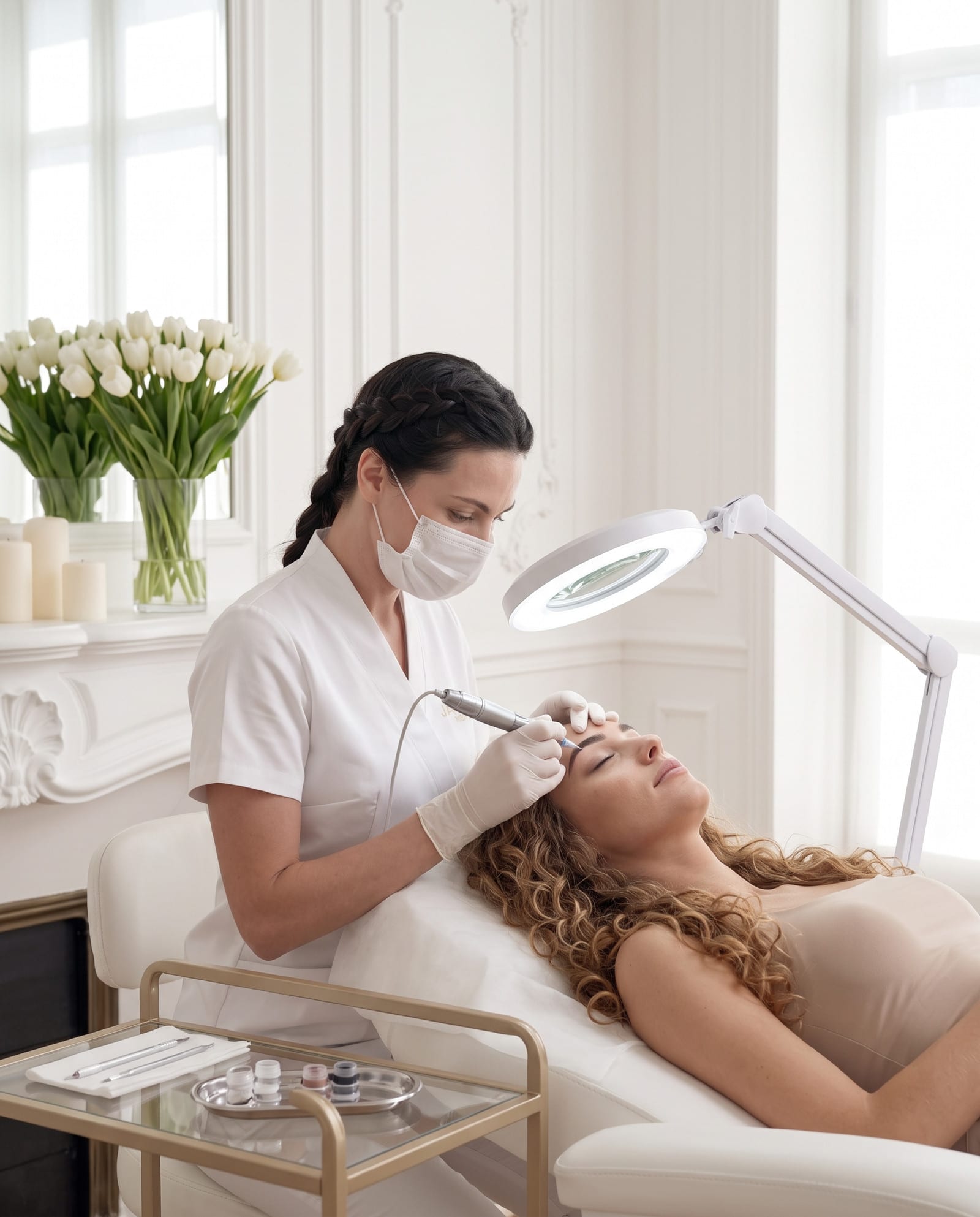
- Pigmentation using the PMU machine
- Applying further layers of numbing cream during the session — yes, that's allowed
- Straight after the treatment, the colour is 40–60% more intense than it will be once healed
Healing, day by day — what to expect
This is the part nobody shows on Instagram. It should be — because an unprepared client tends to panic on day 3.
- Day 0 (treatment day): intense, vivid colour, slight swelling — apply healing balm
- Day 1: swelling peaks, colour very intense — balm every 2–3 hours, don't lick your lips
- Day 2–3: colour darkens, lips look "painted on" — continue with balm, gently clean with a cotton pad
- Day 4–5: flaking begins — skin peels away and colour seems to vanish. Don't pick at the scabs
- Day 6–7: underneath the scabs, colour looks pale, almost invisible — keep using balm
- Day 10–14: colour starts to "come back" as the pigment settles
- Day 21–28: final colour appears — soft, natural, even. Full assessment happens at 6 weeks.
Who is a good candidate?
Ideal for:
- Women with pale, unevenly coloured lips
- Anyone who applies lipstick daily and wants to simplify their morning routine
- Clients whose lip colour has faded with age
- Anyone with asymmetry — lip blush can optically correct shape
- Athletes and swimmers — makeup that doesn't come off
Absolute contraindications:
- Pregnancy and breastfeeding
- Active cold sores (HSV-1) — the treatment can reactivate the virus
- Unstable diabetes
- Keloid scarring
- Autoimmune conditions in an active flare
- Blood-thinning medication
- Isotretinoin (Accutane) — wait at least 6 months after finishing treatment
Rotary vs coil machines — which one is in your lips?
It might seem like a minor detail, but it matters.
How do you choose a colour? (and why it's harder than you think)
The colour you see in the pigment bottle isn't the colour you'll end up with on your lips. The final result depends on:
- Your natural lip colour — the pigment blends with it optically
- Melanin levels — darker lips often "absorb" light pigments
- Blood flow to the lips — this varies from person to person
- Placement depth — deeper placement means a less vivid colour
- Skin type — oily skin can break down pigment faster
Dominant colours in 2026:
- Dusty rose — muted pink with a touch of grey. Elegant, neutral, and suits most skin tones.
- Warm nude — warm beige-pink. The "your lips, but better" effect.
- Berry tint — a raspberry flush. More striking, ideal for darker skin tones.
- Peach blush — a peachy flush. The 2026 trend — warm, youthful, fresh.
Touch-up — when and why?
- Technically, a touch-up isn't compulsory, but the vast majority of clients need one for the best result
- Without a touch-up, the result is fine. With one, it's striking.
- Often included in the price of the treatment, or priced lower than the first session
Lip blush vs your daily routine — an honest calculation
Permanent lip makeup isn't a cosmetic expense — it's an investment that saves time every morning for years. Work out how many minutes a day you spend applying lipstick, and how many products you use in a year.
7 questions to ask your PMU artist (before you decide)
Before you sign the consent form, ask about:
- Certification and experience — at minimum, a certified PMU course and at least 2 years of lip PMU practice
- Pigments and certification — look for European certification (REACH/CPNP)
- Healed results — not fresh photos. Fresh results aren't a measure of success
- Protocol for cold sore history — if the answer is "no problem" without recommending an antiviral, that's a warning sign
- Is the touch-up included in the price?
- Machine and needles — single-use needles and cartridges are standard, not a bonus
- What if I don't like the result? — a good PMU artist will be honest about the limits of the technique
Permanent lip makeup at J'ADORE INSTYTUT
At J'ADORE INSTYTUT, we perform permanent lip makeup using the lip blush technique with EU-certified pigments. Every treatment starts with an individual consultation — because lips aren't one-size-fits-all, and colour choice isn't left to chance. Want to see results? Check our Instagram — but look for HEALED photos, not fresh ones.