
First, take a moment: is this definitely a ‘treatment issue’?
Before you plan anything, one point may help clarify things: not every body ‘imperfection’ is excess fat — and not every excess of fat requires a salon treatment. What we consider ‘stubborn fat’ may sometimes be swelling, water retention, reduced skin firmness after significant weight loss, or simply a natural body shape. A treatment will not change this, nor should it.
So when are we dealing with genuine stubborn fat worth addressing? When a fold remains in one clearly defined area. You can grasp it in your hand, and it does not reduce despite a sensible diet and exercise. The rest of your body has changed noticeably, but this area has been ‘left behind’. This is not a reason to panic or starve yourself. It is a sign that it is worth moving through the next steps consciously, rather than relying on guesswork.
Why certain areas are stubborn — what is really happening
‘Stubborn fat’ is not one single issue. It involves several different mechanisms that can overlap. This matters because your plan depends on what you are actually dealing with — not the other way round. Most often, one of three scenarios is involved, and often more than one at once.
‘Storage’ fat
Physiology and hormones
- Hips, thighs, buttocks, lower abdomen, love handles
- Released last — the body treats it as a reserve
- Closely linked to hormonal balance and predisposition
Cellulite and tissue quality
Structure, not only volume
- An ‘orange peel’ effect and uneven surface texture
- Impaired microcirculation, fibrosis, stagnation
- It may be visible even in slim people
Swelling and laxity
Water and skin firmness
- Water retention and heavy, ‘puffy’ legs
- Looser skin after significant weight loss or pregnancy
- A sedentary lifestyle and poor lymphatic drainage
The difference is practical, not academic. Storage fat responds best when your overall lifestyle is in place and targeted methods ‘finish’ specific areas. Cellulite and tissue quality require work on circulation and skin structure, not simply ‘fat burning’. Swelling and laxity are a different matter again — drainage, skin firmness and regeneration can help here, rather than another restrictive diet. Confusing these three issues is the most common reason for disappointment.
Where to start — step by step
This is the heart of the article. Rather than booking the first treatment promoted by the algorithm, follow these steps in order — from the foundations to targeted methods. Most people skip the first three steps, then wonder why step four ‘did not work’.
- 01
Step 1 — An honest assessment in the mirror
First, identify what you are really dealing with. Is it a distinct fat fold that you can grasp in your hand? Or is it more of an ‘orange peel’ texture (cellulite), heaviness and swelling, or looser skin after weight loss? The ENTIRE rest of the plan depends on this answer — because these are three different directions of action.
- 02
Step 2 — Foundations: sleep, movement and nutrition
No contouring treatment can replace the basics or ‘erase’ a calorie surplus. Regular exercise (strength training plus some endurance work), sufficient protein, sleep and reducing chronic stress make a difference no device can deliver. Targeted methods only make sense ON this foundation — as a finishing touch, not a replacement.
- 03
Step 3 — Circulation and drainage
Before you start ‘targeting’ fat, support flow. Effective microcirculation and lymphatic drainage reduce swelling, improve tissue quality and help an area respond better to further action. For many people, improving drainage alone visibly ‘slims’ the legs and abdomen.
- 04
Step 4 — Consultation and tissue assessment
If the foundations are in place and the stubborn area remains, it is time to speak to a practitioner. Assessing tissue type, fold thickness, skin firmness and realistic expectations helps select a method for the issue — rather than blindly choosing a fashionable device.
- 05
Step 5 — A plan and targeted methods in a series
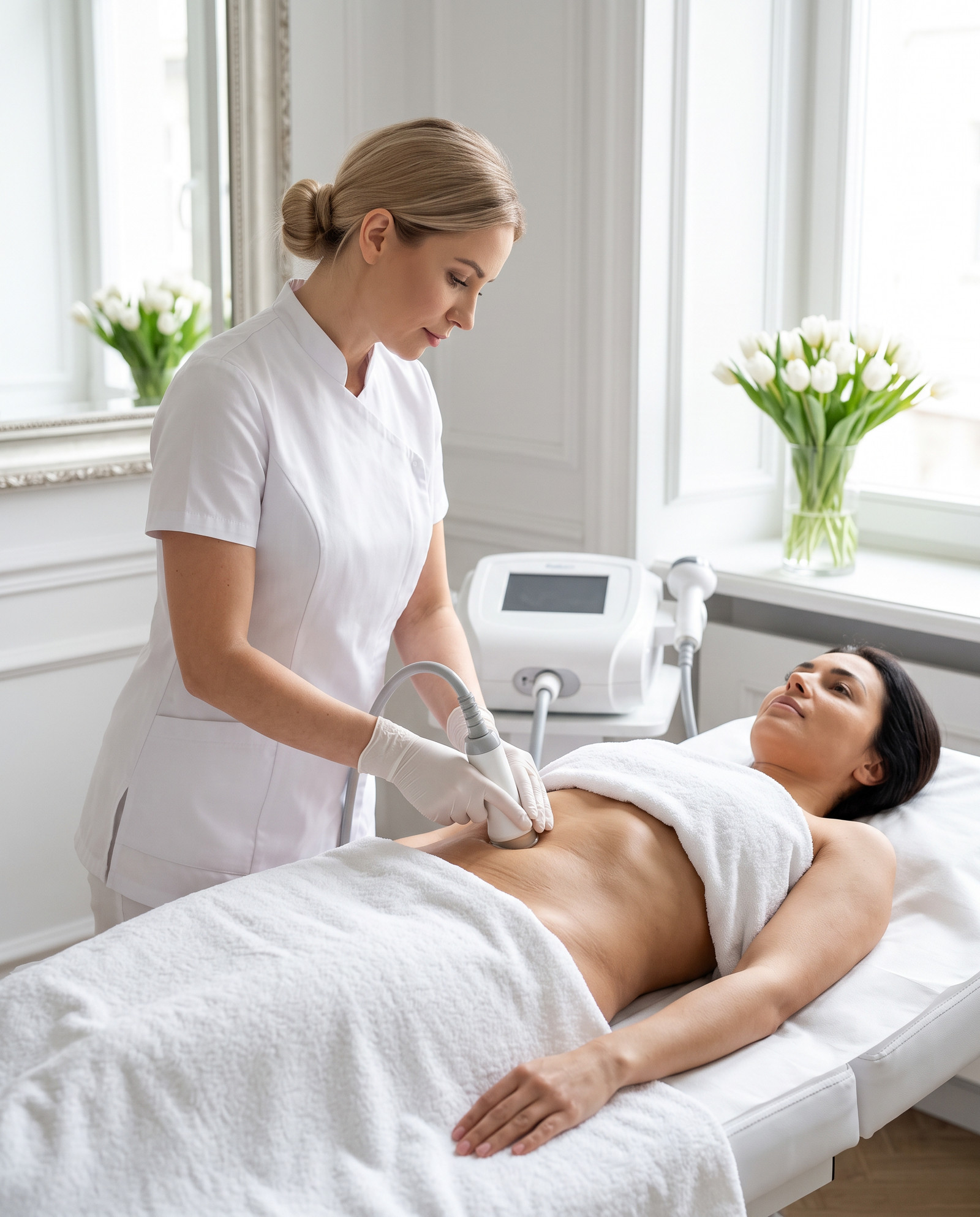
Only after this assessment can the right approach be selected: one for a fat fold, another for cellulite and laxity, and another for muscles and firmness. Body contouring is usually a SERIES, not a single appointment. Results are assessed over weeks and months, as the body needs time to clear and remodel tissue.
Pay attention to the order. Foundations come before treatments, and circulation comes before targeted methods. The best device cannot compensate for a chronic calorie surplus or neglected movement. That is why we start with the basics, rather than ‘the latest device from an advert’. Contouring supports a well-managed body; it does not replace it.
What NOT to do
Chaotic action — or taking ‘shortcuts’ — can be just as harmful as doing nothing. Before you spend your first zloty or devote your first week of motivation, read this short list of pitfalls. It can save you frustration, money and unnecessary discouragement.
In short: understand first, then act. It is worth directing your money and energy towards the foundations and a well-chosen series, rather than a random device that “helped someone” — because that person may have had a completely different concern from yours.
When to book a consultation
Not every “I do not like this area” means you need to visit a salon straight away. However, some situations are worth stopping to manage alone and simply booking an appointment. Treat this as a simple checklist.
- You have lost weight sensibly and it shows across your whole figure, but one or two areas remain stubbornly unchanged despite consistency.
- The issue is not the fat fold itself, but cellulite, laxity or swelling — and you do not know where to start.
- You want to prepare your figure in advance (for example, before a season or event) and need a realistic timeline, not last-minute miracles.
- After pregnancy or significant weight loss, you are left with looser skin firmness that does not improve on its own.
- You have been doing “everything properly” for months, but a resistant area has not changed. It is worth having someone assess the tissue and explain what can realistically help.
A good consultation starts with a conversation and tissue assessment. The specialist checks whether the concern is fat, cellulite, swelling or laxity. She assesses your skin firmness and expectations, then creates a realistic plan: which method to use, how many sessions you need and what you can genuinely expect. Sometimes, you may hear that drainage and the foundations are the best first investment, followed by a targeted method. This is also a valuable answer. Either way, you leave with clear guidance rather than guesswork.