Cellulite is not a problem on the skin’s surface
Let us start with the layer you cannot see with the naked eye. This is where cellulite lives. Beneath the dermis, roughly where cream no longer reaches, lies fatty tissue arranged in nodular compartments. In women, fat chambers are arranged vertically from birth. This means that when fat pushes upwards, the skin bulges unevenly. It creates dimples and raised areas. This is the characteristic orange-peel effect.
It is worth knowing that cellulite is not caused by excess weight or a poor diet. These factors may worsen it. It is a structural feature of connective tissue. It is strongly influenced by hormones and genetics. This is why slim women experience it just as often as those with a higher body weight. Men experience it rarely due to a different tissue architecture. Their collagen fibre network forms a lattice that holds fat more effectively in place.
Cellulite is also linked to microcirculation and lymphatic stagnation. Poor blood flow in capillaries and impaired lymphatic drainage increase tissue swelling. This, in turn, pushes fat nodules more firmly into the connective tissue. This is why cellulite can be more visible in the evening than in the morning. It may worsen after prolonged sitting or during hormonal fluctuations. It can be less noticeable after intense movement or massage. It is a fluctuating, variable issue rather than a fixed imperfection.
What wraps do beneath the skin — the mechanism step by step
Body wrapping works in the layer of the skin and superficial tissues. This is where cellulite begins to show, though not where its cause lies. To understand the result, it helps to follow each layer. The treatment activates several processes at the same time.
- 01
Active product — Skin preparation
Before wrapping, an active product is applied. It often contains algae extracts, caffeine, ivy extract and mineral ingredients. Their role is to stimulate circulation in the skin and the tissue directly beneath it. Some ingredients support drainage by removing excess water from the spaces between cells.
- 02
Wrap compression — mechanical drainage
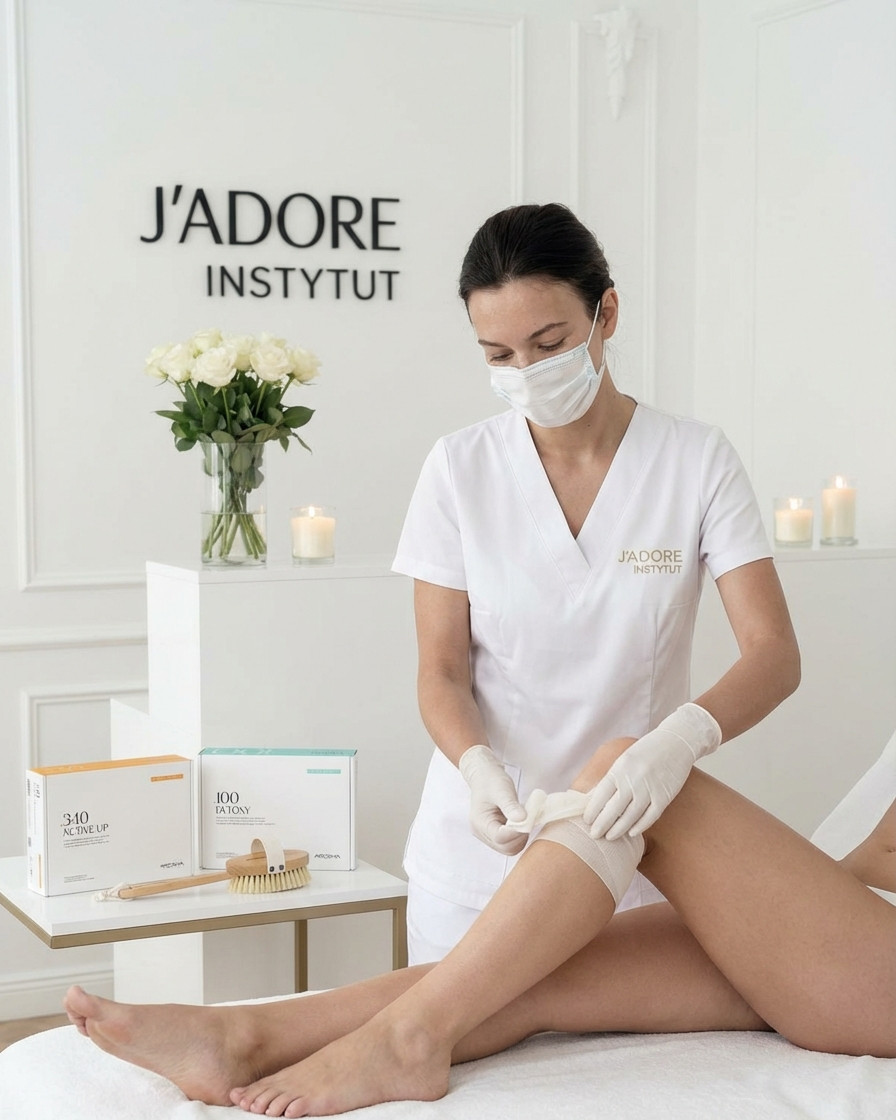
Applied in layers, the wraps exert even, continuous pressure on the tissue. The principle is similar to compression therapy. Tissue fluids are mechanically moved into lymphatic and venous vessels. This temporarily reduces swelling and creates a more defined body contour.
- 03
Temperature — opening blood vessels
Wraps are usually warming or applied with thermoactive film. Heat dilates small blood vessels and accelerates skin metabolism. It also temporarily increases the penetration of active ingredients into deeper layers of the epidermis and dermis.
- 04
Duration — supporting lymphatic flow
While you rest in the wraps, lymphatic flow becomes more efficient. The pressure supports the lymphatic system, which has no pump of its own like the heart. If you tend to retain water, you may feel noticeably lighter after treatment. You may also see reduced swelling.
- 05
After the treatment — the rehydration “window”
After the wraps are removed, the skin is warmed, well supplied with blood and more receptive. This is a good time to apply moisturising and firming ingredients. They absorb more effectively than under other conditions.
Together, these processes create an effect that is real and measurable. However, it occurs in a different layer from cellulite nodules. Wraps work with tissue water, circulation and surface skin tension. Cellulite lies deeper, in the architecture of connective tissue. Wrapping will not change this architecture.
Results you can expect — an honest guide
When considering body wrapping, it is worth using the right categories. Some results are genuinely offered by the treatment. Others should not be expected from it. Confusing these two categories is the main source of both disappointment and unfounded scepticism.
What body wrapping can offer
realistically, under the right conditions
- Temporary reduction in circumference (swelling drainage)
- A more defined contour and a feeling of lightness
- Improved skin firmness and a smoother skin surface
- Stimulated circulation and support for lymphatic drainage
- A relaxing effect and improved wellbeing
- Better absorption of cosmetics after the treatment
What body wrapping will not do
beyond the reach of wraps
- It will not change the structure of connective tissue beneath the skin
- It will not remove cellulite in a medical sense
- It will not burn fat tissue
- It will not replace lymphatic drainage in the treatment of lymphatic swelling
- The reduction in circumference is not permanent without regular series
When properly categorised, body wrapping has a sound place in salon offers. It is a treatment that genuinely improves appearance and wellbeing. It works in the layer it can reach, and it does so effectively. The issue begins only when it is sold as “cellulite removal”. That is a promise made in the wrong layer.
Cellulite requires different tools — a deeper layer
If cellulite lies deeper than wraps can reach, what really reaches it? The answer is more complex. Cellulite has multiple causes, and no single tool resolves it completely. The most effective approaches address it on several fronts at once. They improve circulation, break down fibrous connective tissue septa, strengthen the skin from within and reduce the volume of fat compartments.
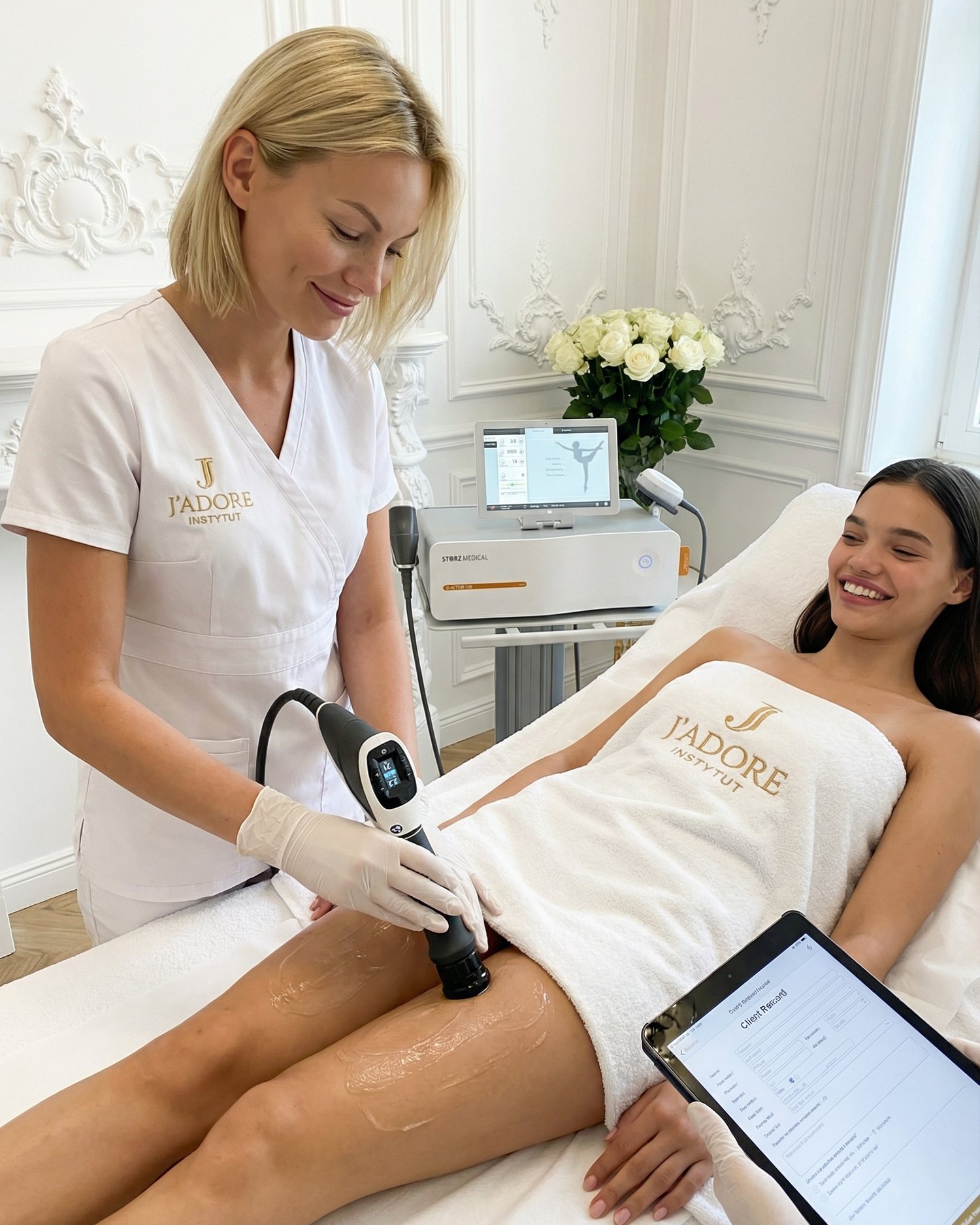
Physical treatments using shock waves or mechanical vacuum can reach layers that touch, cream or wraps cannot. Their action focuses on mechanically breaking down fibrous bands of connective tissue. These bands “anchor” the skin surface to deeper structures and create the characteristic dimples. This is a different level of work from body wrapping. This is why the two treatments can complement rather than exclude each other.
It is also worth remembering the role of lifestyle — no salon can replace what happens during the rest of the day. Physical activity that pumps blood through the capillaries, proper hydration and limiting factors that worsen fluid retention (sitting, tight clothing, alcohol, excess salt) are not an “alternative to treatments”, but their foundation. Treatments work best when lifestyle has prepared the ground for them.
How to combine it all — multi-layered programmes
The most rational approach to cellulite and body contouring is to think in layers — as with facial ageing. Each tool works at a different level, and these levels complement one another. Body wrapping is not inferior to deeper treatments. It simply works elsewhere. Where it works well, it works very well.
Shockwave therapy
It works directly on fibrotic connective tissue bands and breaks down fat nodules — reaching areas that bandages cannot. Combining it with body wrapping within one series allows work on different layers at the same time.
Lymphatic drainage
It enhances the mechanical drainage effect of the bandages. It is particularly valuable for swelling and heavy legs — manual drainage or pressotherapy provides a deeper and longer-lasting effect than compression alone.
Endermologie / vacuum massage
Mechanical stimulation of the skin-fat fold breaks down stagnation and stimulates fibroblasts. It complements body wrapping with a deeper action that is more targeted at the structure of cellulite.
Body biostimulators
When laxity and loss of skin firmness are also a concern alongside cellulite, biostimulators work from within. They stimulate collagen production and improve the density of the skin itself.