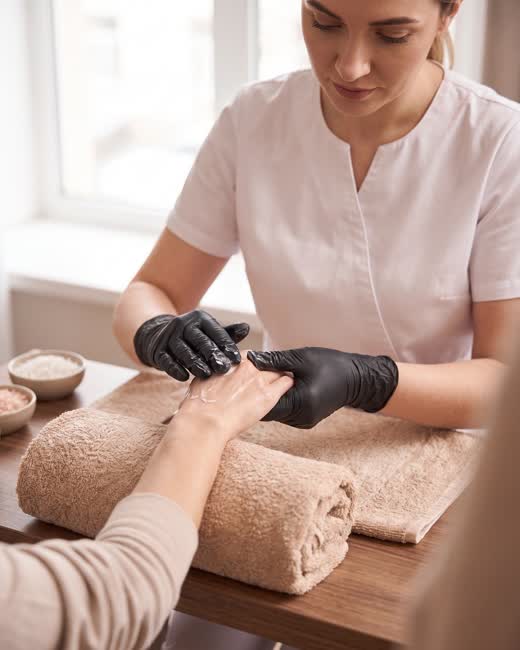
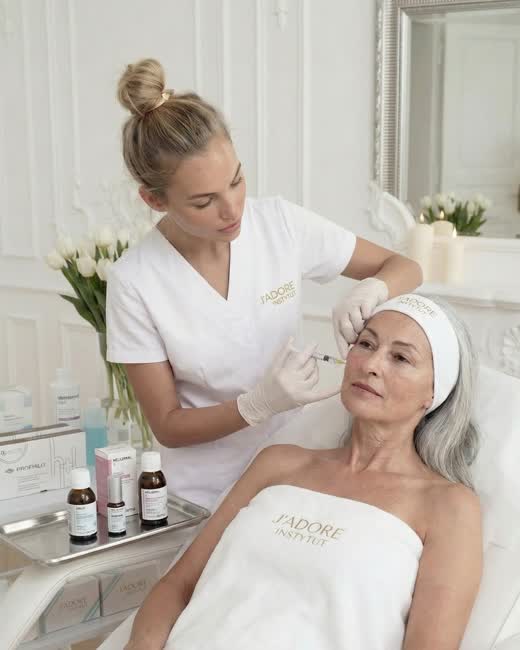
A treatment room at J'adore
MASSAGE & SPA (~30)
Heavy, swollen legs by the end of the day, a feeling of "trapped water", swelling after a long trip or flight, skin that has lost its "lightness" — these are signs your lymphatic system needs support. Manual lymphatic drainage is a very gentle, rhythmic massage performed by hand, using the Vodder technique — the best-documented method of manual drainage. Lightness of touch is key here: lymph flows just beneath the skin, so pressure is minimal, almost a stroke — this isn't a deep, kneading massage, but a calm, wave-like guiding of fluid in its natural direction of flow.
The result? Tissues feel relieved, swelling reduces, the body clears what has been building up more efficiently, and you feel a pleasant, calming lightness. It's one of the gentlest treatments we offer — you lie down, breathe, and the therapist's hands do the work. At J'adore Instytut it's performed by qualified massage therapists. Below you'll find everything worth knowing before your first visit.
usually as a series, tailored individually
How it works
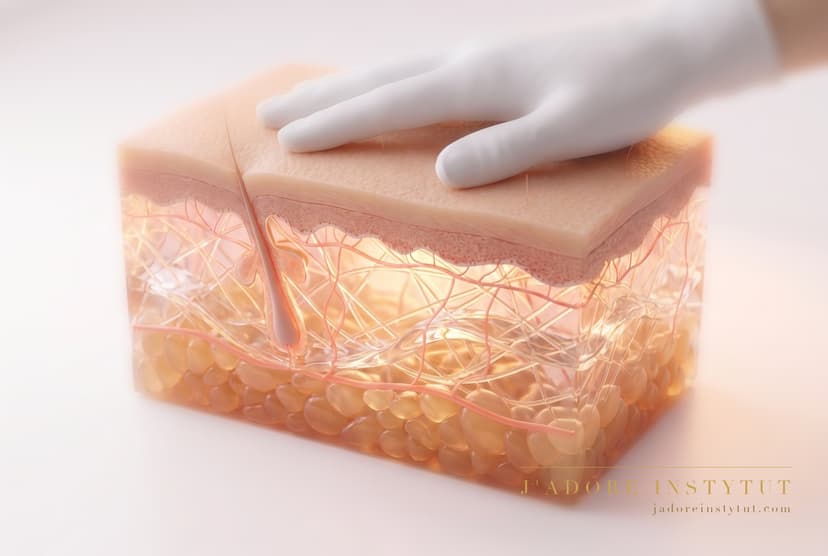
Your lymphatic system is your body's "drainage network" — it collects excess fluid, metabolic by-products and other build-up from tissues and carries them away. The problem is that lymph has no pump of its own (unlike the heart for blood) — it moves mainly through muscle activity, breathing and gentle massage. When you sit, stand or move too little for long periods, lymph flow slows and fluid builds up — hence swelling, heavy legs and that "trapped water" feeling.
Manual drainage acts as that missing pump — by hand. The therapist performs slow, rhythmic, circular, pumping movements, guided towards the nearest lymph nodes — exactly where lymph is meant to drain naturally. The key is lightness of pressure: lymphatic vessels sit just beneath the skin, so pressure that's too firm would close them off. That's why good drainage is almost a stroke, yet still highly effective. It's a rhythmic, wave-like massage that stimulates lymphatic circulation and helps tissues feel relieved.
Important and honest: drainage does not burn fat. The reduction in measurements you sometimes see straight away is mainly the result of tissue dehydration — the removal of built-up fluid. It's a genuine way to relieve tissues and support body shape and contour, but it doesn't replace diet or exercise.
Ideal for
Women's and men's needs
For women, manual drainage is most often about tackling swelling, water retention and water-related cellulite — especially in the legs, thighs and face. It's often a go-to ritual for lighter legs after a day in heels, and a favourite way to "de-puff" the face. This is classic lymphatic drainage for women.
What we work with
Lymphatic drainage for men is primarily about post-exercise recovery and lighter legs when working on your feet. Running, the gym, long hours standing — manual drainage helps to "reset" the muscles, reduce the feeling of heaviness and take the load off your circulation. It is recovery in its gentlest, most pleasant form.
What we work with
Did you know? Lymph is the only "circulation" in your body with no pump of its own — it's moved mainly by muscle activity, breathing and… gentle touch. That's why legs swell after a day without movement, and feel lighter after a walk. Manual drainage does for lymph exactly what a walk does — except you lie back and relax, while the therapist's hands do the work.
Safety
Manual drainage is gentle and pleasant, but it's still a treatment that stimulates lymph flow and circulation — which means it's not right for everyone, in every condition. Some contraindications aren't about comfort; they're about health and safety. That's why the conversation before your first session isn't a formality.
We ask about varicose veins, heart and kidney conditions, thrombosis, cancer, pregnancy, recent injuries and infections. This isn't idle curiosity — with certain conditions, drainage is contraindicated and we refer you to a doctor first.
Good drainage doesn't hurt and doesn't leave marks; we adjust intensity to your comfort and the goal of the session.
If you feel pain, numbness or discomfort — tell us straight away. Drainage should feel pleasant; any unpleasant sensation is a sign we need to adjust or stop.
Red flag: conditions where you see a doctor first, not the drainage table · Drainage moves fluid and stimulates circulation — for certain conditions, that's not neutral. Always consult a doctor before drainage if any of the following apply to you: thrombosis or thrombophlebitis, active cancer or ongoing oncological treatment, acute infection, fever or inflammation, heart failure or serious kidney disease, or swelling of unclear, sudden onset (especially if one-sided, painful, or accompanied by redness). In these situations, a doctor decides whether and when drainage is safe — a good salon won't perform the treatment on trust alone; it will ask for medical clearance.
Contraindications
Some contraindications are permanent and serious, others are temporary — in which case we simply postpone the treatment until the situation passes. Because drainage stimulates circulation and lymph flow, we take this list very seriously. For conditions marked as absolute, we refer you to a doctor first.
From the therapist's chair
The most commonly overlooked issue is "sudden swelling in one leg". Clients say: "my calf's swollen, I'll book a drainage session." That's exactly what you shouldn't do blind — sudden, one-sided, painful swelling can signal thrombosis, and in that case massage is dangerous. In that situation, I don't massage — I refer to a doctor. We only perform drainage once we're certain it's safe.
This isn't an exhaustive list — we go through your health conditions, medications, previous treatments and pregnancy individually before your first session. If in doubt, we always ask for medical consultation — your safety matters more than the treatment itself.

What to expect
The best thing about manual drainage is how little it asks of you, and how pleasant it is. You lie down comfortably, the therapist begins with very light, rhythmic movements — and you simply rest. Most people relax completely, and some just fall asleep. It's such a gentle massage that it can be surprising how such light pressure brings such real relief.
I often hear: "I had one session and the swelling came back the next day." That's normal — one drainage session won't change your circulation habits. Drainage works like a walk for the lymph: a single session relieves tissue in the moment, but real, lasting improvement comes from a regular series.
The effect on swelling builds gradually and lasts better the more you support it with movement, hydration and — if that's your goal — diet. Drainage itself is support, not a miracle shortcut.
Portfolio
A record of the work in our salons — the place where we publish treatment frames and, after photo sessions, results.
A record of results — in preparation. We publish photographs of our clients only with their consent.
Your routine after the treatment
This is one of the few treatments with practically no restrictions afterwards — no downtime, no visible marks, you go straight back to your day. A few simple rules, though, will make the results even better:
This is the most important thing: a glass of water before and after the treatment, and don't cut back on fluids in the evening. Drainage gets the lymph moving — your kidneys need water to finish the elimination process. Hydration genuinely improves the result.
Light movement after the treatment only helps — a walk "finishes off" the drainage's work, since muscle activity drives the lymph. You can go straight back to your daily activity.
Drainage is deeply calming — many people feel pleasantly drowsy. If you can, give yourself a quiet moment after the treatment; good sleep reinforces that feeling of relief.
Strong heat further dilates blood vessels and can heighten fatigue after an intensive drainage session. If you're planning a sauna, best to save it for another day.
Alcohol encourages water retention — working against the drainage. It's best to skip it that day and opt for a light, less salty meal, so you don't add to retention.
Drainage doesn't affect the epidermis and leaves no marks — makeup, work and daily activities are all fine. After facial drainage, wait a little before applying heavy makeup, to let your skin "rest".
Manual lymphatic drainage
"Drainage" covers several different treatments that do a similar thing — stimulate lymph flow — but using different tools and for different purposes. Here's how to tell them apart:
the therapist's precise hands
slower over large areas, more labour-intensive than a device
rhythmic pressure from cuffs
less precise on small areas (e.g. the face)
mechanical suction-and-roller massage
less "purely drainage" — this is mainly about contouring
Combine with
Manual drainage works well as a way to "finish off" other body treatments — it clears what other therapies have released within the tissue. The specialist decides on order and timing during your consultation, but the general logic stays the same:
The simplest way to decide: if you want the gentlest, most precise lymph work — say, on the face or after another treatment — and full relaxation under a therapist's hands → manual drainage. If you want to cover large areas of the legs or the whole body and simply lie back while a device does the work → device-based drainage (pressotherapy). If you're mainly tackling cellulite and laxity and want to contour your body → endermology. We often combine them in a series — one doesn't rule out the other.
Variants and rituals
We tailor manual drainage to what's bothering you — from pure leg work to gentle facial drainage and a version combined with pressotherapy. The therapist chooses the variant, pace and scope after a short conversation.
The best-documented method of manual drainage — slow, rhythmic, circular, pumping movements with very light pressure, guided towards the lymph nodes. A calm, wave-like rhythm gets the lymph moving without straining the tissue.
Dla kogoSwelling, water retention, leg relief, relaxation and calm.
The most popular variant — thorough, gentle work on the calves, thighs and ankles, exactly where fluid tends to build up.
Dla kogoHeavy, swollen legs, retention, post-travel swelling, post-workout recovery.
Very gentle drainage of the face and neck area — reduces eyelid puffiness, "de-puffs" the face and brings out a fresher contour. Ideal after a sleepless night or before an important event.
Dla kogoPuffy eyelids, a bloated face, a fresher, lighter look.
The therapist's hands do the precise work, while device-based cuff pressure finishes off the drainage over larger areas. A combination of precision and reach.
Dla kogoStronger relief for the legs and whole body, support for a contouring series.
Fact: What's the difference between the variants? Mainly the area treated (legs vs. whole body vs. face), and whether we add device-based pressure to the hands-on work (the version combined with pressotherapy). The mechanism itself stays the same: a slow, rhythmic, very light massage guiding the lymph in its natural direction. The therapist chooses the right option based on your goal, the condition of your legs/skin, and any contraindications.
Price list
Checking free hours…
From the magazine
Editorial pieces on how this treatment works in practice — what happens during the session, how to prepare, where the limits are and what the first days after look like.
See also
The result lastsrelief felt from the first session; the effect on swelling and contour builds over a seriesJ’adore Instytut
Please note. Manual lymphatic drainage is a wellness / relaxation service of a care-based nature; it is not a medical treatment, and it does not replace diagnosis or treatment (e.g. of lymphoedema or venous insufficiency), nor does it replace diet or physical activity. If you have chronic conditions, are pregnant, have swelling of unclear cause, or have any doubts, consult a doctor first — in particular, drainage requires prior medical approval in cases of thrombosis, active cancer, or swelling of unknown origin. The above text is for informational purposes. Details and the choice of variant are determined by the specialist during your visit.
Home care
Cosmetics matched to what your skin needs after a treatment — so the clinic effect lasts longer.
 body firming and celluliteDiego Dalla PalmaSCULPTOREA Thermoactive Anti-Cellulite Cream 250 mlView in the shop(opens in a new tab)
 body careSkeyndorCannabis Massage Cream – Spa SensesView in the shop(opens in a new tab)
 body firming and celluliteVagheggiFuoco — RE-shaping Thermal Cream 200 mlView in the shop(opens in a new tab)
 body careMesoesteticBodyshock Essential CreamView in the shop(opens in a new tab)
 body firming and cellulitePurles141 Lipolytic CreamView in the shop(opens in a new tab)
 body firming and celluliteDermoMedicaRetinoid Firming Body Lotion 200 mlView in the shop(opens in a new tab)
 body firming and celluliteSelvert ThermalRetinol Body Treatment. Stretch Mark and Even SkinView in the shop(opens in a new tab)
 body firming and celluliteDermalogicaBody Hydrating Cream 295 mlView in the shop(opens in a new tab)