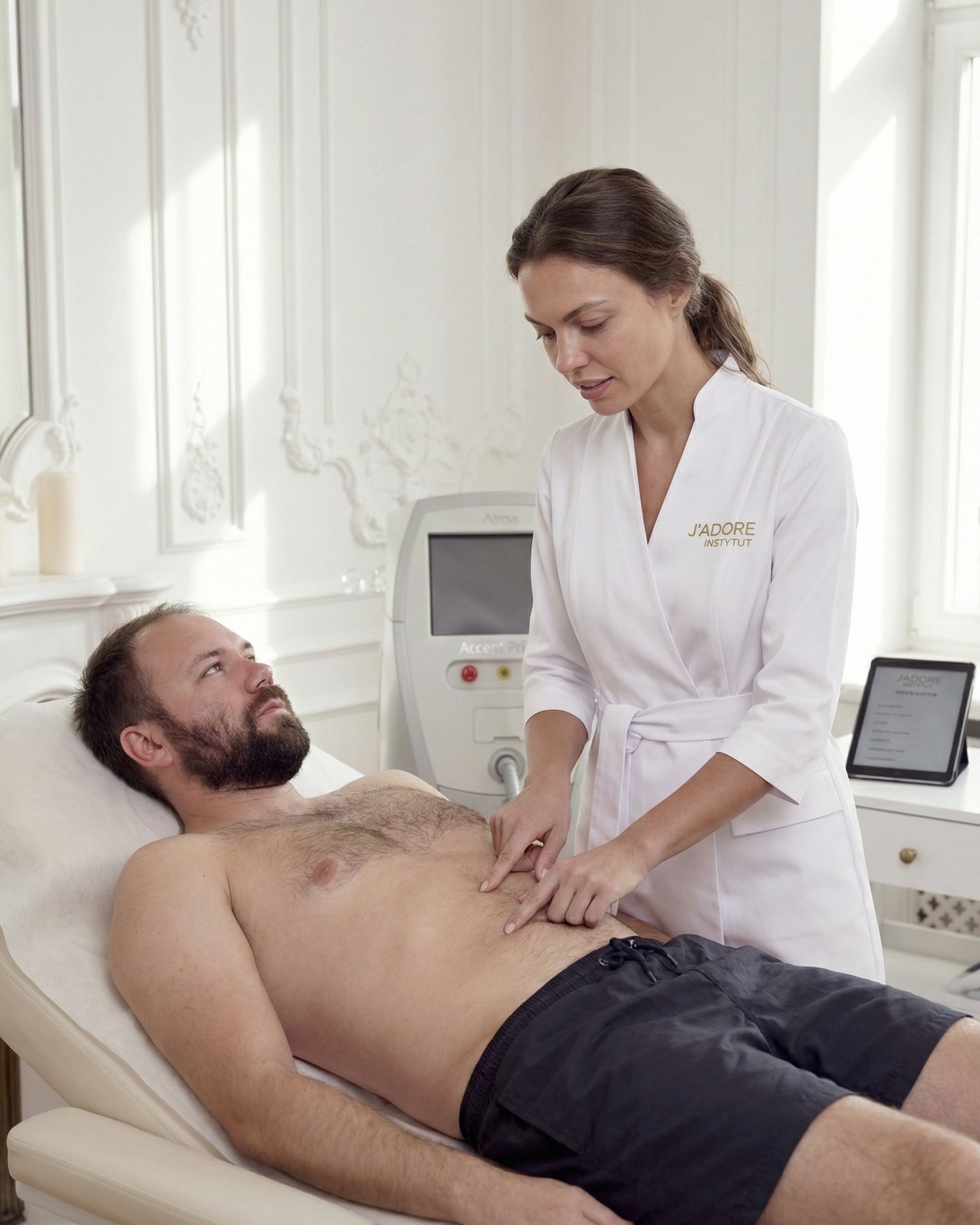

What acne scars are — and why they're difficult to treat
An acne scar isn't just a mark left by inflammation — it's a change in the structure of the dermis, the tissue that normally gives skin its firmness and smoothness. When acne inflammation damaged the dermis, collagen rebuilt itself incorrectly — hence the characteristic indentations, irregularities and thickened areas. No method erases a scar like a rubber eraser. What you can do is remodel, soften and smooth it, so it becomes far less visible.
- Atrophic (indented) — the most common after acne; three subtypes: boxcar (flat base, sharp edges), rolling (wavy, shallow) and ice pick (narrow, pin-deep)
- Hypertrophic scars and keloids — the skin produced too much collagen; less common after facial acne, more common on the body
- Post-inflammatory hyperpigmentation (PIH) — technically not a scar, but it often accompanies them; the good news is that it fades faster than structural tissue loss
Fractional microneedling RF vs fractional laser vs TCA peel — what each method does
Several methods on the market can genuinely improve the appearance of acne scars. They differ in mechanism, depth of action and recovery profile. Here's how they compare:
Fractional microneedling RF
collagen stimulation through heat in the deeper layers of the skin
- Microneedles create micro-channels, and radiofrequency delivers heat precisely to a specific depth
- Works on all skin phototypes — the risk of hyperpigmentation is much lower than with laser
- The epidermis remains largely intact — recovery time is shorter
- Particularly effective on rolling and boxcar scars
- Many people see clear improvement after just 2–3 sessions in the series
Fractional laser
controlled micro-thermal tissue damage
- Ablative fractional — removes micro-columns of the epidermis, strong remodelling; longer recovery
- Non-ablative fractional — similar effect with less surface damage
- Often produces very good results on medium-depth scars in lighter phototypes
- In many cases, the final result is comparable to fractional microneedling RF — achieved by a different route
TCA peel (including CROSS)
chemical penetration into the scar structure
- TCA CROSS technique (Cross Trichloroacetic Acid) — applying acid directly to an ice pick scar; often the only effective method for this type
- Full-face TCA peel — improves surface quality and evens out texture
- Available in different concentrations — matched to the depth of the scar
When fractional microneedling RF performs better — and when it doesn't
The question "does fractional microneedling RF work on scars?" has a simple answer: for many people, yes. But the question "will it work for me and on these scars?" is more complex. Here are a few situations where it tends to perform well — and a few where other options are worth considering:
It's worth knowing that the effect isn't immediate. Skin remodels collagen gradually — for many people, visible improvement appears within a few weeks of the treatment, and the full effect of the series is only assessed after a few months. That's not a flaw in the method — it's simply tissue biology.
- 01
Consultation & scar assessment
The specialist assesses scar types, depth, skin phototype and acne activity (active inflammation is an absolute contraindication). Only then does a plan take shape.
- 02
Series of fractional microneedling RF sessions
Usually several sessions spaced a few weeks apart — the gaps allow the skin to complete its collagen remodelling phase between sessions.
- 03
Recovery & protection
After each session, skin may be red and sensitive for a few days. One key element: daily SPF — without it, results are difficult to maintain.
- 04
Result assessment & possible follow-up
Once the series is complete, progress is assessed. Some people choose an additional peel or other complementary treatments, depending on what still needs improvement.
How to combine fractional microneedling RF with other methods
Acne scars are rarely uniform — different types often coexist on the same face. That's why the best results often come not from a single method, but from a carefully planned combination. A few proven pairings:
Fractional microneedling RF + TCA CROSS
RF evens out overall texture and improves rolling/boxcar scars, while TCA CROSS targets the deepest ice pick scars directly. The methods complement rather than conflict with each other — used in separate sessions.
Fractional microneedling RF + acid peel (series)
An acid peel (glycolic, mandelic or lactic, for example) used between RF sessions supports epidermal turnover and can speed up the fading of post-inflammatory hyperpigmentation.
Fractional microneedling RF + platelet-rich plasma (PRP)
Plasma applied directly after fractional microneedling RF can support regeneration and healing. Some protocols combine both treatments in the same session.
Fractional microneedling RF + mesotherapy
Needle mesotherapy or plasma mesotherapy boosts hydration and skin condition between RF sessions — particularly when skin is dehydrated or thin after long-term acne treatment.
An important rule when combining methods: sequence and spacing matter. The specialist decides what to combine and when, based on how your skin responds — it's not worth putting together a plan yourself from a list of available treatments.
What to realistically expect — and what not to
A good consultation is one after which you know exactly: what types of scars you have, what a given method can address, how many sessions you'll realistically need, and what happens if you skip SPF. If someone promises "scar removal" without making these distinctions, it's worth asking more questions.