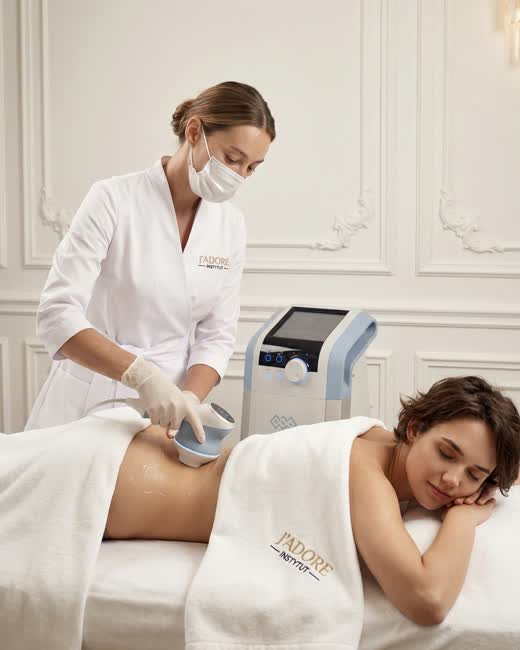
First, one thing: both lasers do the same thing, just differently
Let us start with what they have in common, as this explains half the confusion. Both are fractional lasers. This means they do not treat the skin with a uniform beam. Instead, they divide energy into a grid of thousands of microscopic points. Healthy, untouched tissue remains between them. It acts as a reservoir of cells and speeds up healing. Both lasers prompt the skin to repair itself. The device does not “smooth” the scar itself. Your body rebuilds the structure and produces new collagen in response to the stimulus.
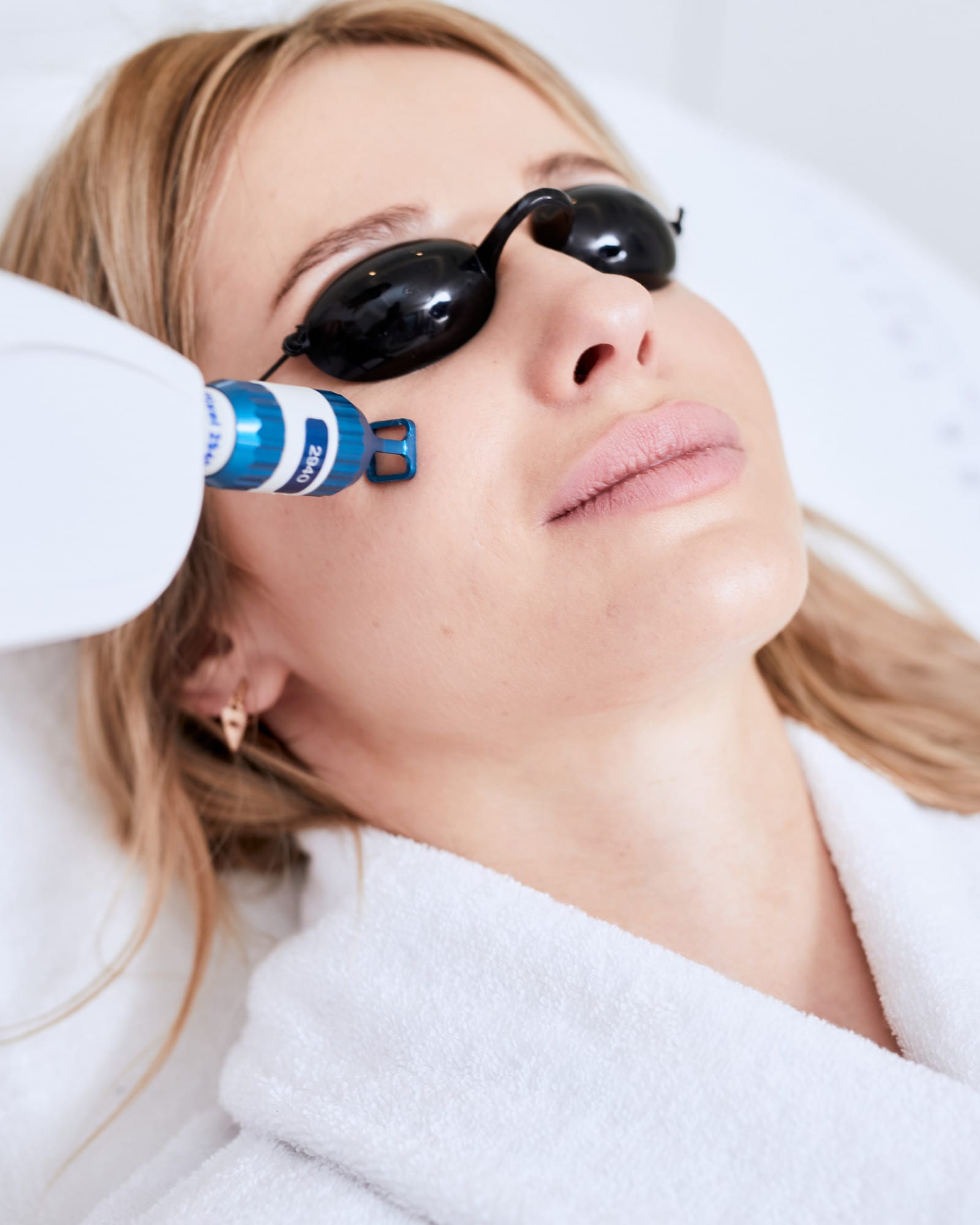
The whole difference lies in one word. Ablative means that the laser disrupts the surface. It precisely vaporises microscopic columns of tissue, creating temporarily “open” skin that needs to heal. A non-ablative laser works beneath the epidermis. It heats the dermis and creates thermal columns within it, but does not remove the outer layer. The epidermis remains intact, so there is no open wound — only temporary redness.
This leads to a simple conclusion worth keeping in mind throughout: a stronger stimulus = a stronger effect on scars, but also longer healing. The rest is about matching that balance to your skin and your calendar.
Ablative or non-ablative — an honest comparison
The easiest way to see the difference is side by side. Below are three columns: two fractional lasers and — for clarity — a related mechanical method that is often mistakenly placed in the same category. Each works on a similar principle, collagen remodelling, but with different intensity and a different time commitment.
Non-ablative laser
remodelling beneath the epidermis, without a wound
- shallow and medium-depth scars, texture, enlarged pores
- short downtime — usually a few days of mild redness
- epidermis remains intact — a quick return to daily life and work
Ablative laser (Er:YAG / CO2)
the most intensive texture remodelling
- deep and resistant scars (e.g. “ice-pick” scars), advanced resurfacing
- stronger results, usually fewer sessions
- genuine structural rebuilding where gentler methods cannot reach
Needle mesotherapy / microneedling
mechanical collagen stimulation
- gentle texture improvement, hydration, added active ingredients
- short recovery, a low threshold to start
- a good complement or a way to start “from scratch”
Note that the key to the decision lies in the “what it does NOT do” column. A non-ablative laser falls short where scars are truly deep — and this is its only real limitation. An ablative laser is less suitable when you do not have a week for recovery, or if you have a darker skin tone and a recent tan. Neither is a “worse” laser — it may simply be unsuitable for the situation.
A home test — what your choice depends on
Before anyone suggests a specific device, you can carry out a simple self-assessment in front of the mirror. It does not replace a consultation, but it helps steer the conversation in the right direction. You will arrive with specific observations, rather than simply saying, “I would like to do something about these scars”.
- Stand sideways to a window in natural light. Acne scars are most visible in light coming from the side. It reveals shadows and indentations that you will not see in flat bathroom lighting.
- Assess the depth. If you mainly see uneven, “rough” texture and shallow indentations — consider a non-ablative laser. It offers a strong effect for this type of scarring with minimal downtime.
- If you see deep, clearly defined indentations — especially narrow, puncture-like ones — a more intensive, ablative laser may be suitable. Gentler methods can help, but more slowly and over a longer series.
- Check your calendar, not just your skin. Do you have a week ahead when you can look as though you are “recovering” — with redness and peeling? If so, an ablative laser is a realistic option. If you cannot step away from work and meetings, a non-ablative laser is more convenient.
- Think about the sun. Are you planning a sunny holiday, or have you just returned with a tan? This is a reason to postpone treatment and often to choose a gentler approach. Tanned skin and an intensive laser increase the risk of discolouration.
It is also worth saying one thing honestly: no laser removes scars “100%”. A good treatment can significantly reduce their depth and even out texture. The difference can be very noticeable. But the goal is improvement, not a magical erasure. Those who approach treatment with this mindset are almost always satisfied. Those expecting a miracle in one day may feel disappointed, even when everything has gone perfectly.
What to expect — two different scenarios
As the main difference between these lasers is what happens after treatment, it is worth knowing both courses in advance. The choice is often easier when you know exactly what you are signing up for.
- 01
non-ablative — the first days
mild redness and a feeling of warmth; skin is sensitive but presentable — easy to conceal
- 02
non-ablative — the following weeks
gradual improvement in skin tone and smoother texture; results build with each session
- 03
ablative — the first days
redness, swelling, slight peeling and micro-crusting; skin “looks worse before it looks better”
- 04
ablative — after recovery
a smoother surface, more even skin tone; return to your usual routine after healing
- 05
both — after completing the series and over the following months
New collagen matures and scars become shallower. We assess the final result only after completing the full series.
When to combine them — and with what
The most interesting answer to the question “ablative or non-ablative?” is sometimes: both, but spaced over time. For acne scars, the best results rarely come from one treatment in isolation. More often, they come from a well-planned programme where laser treatment forms the foundation and other methods support healing and skin quality. A specialist decides on the order and intervals, but the principle remains the same:
Ablative for deeper scars + non-ablative for maintenance
More intensive remodelling where needed, with gentle texture refreshment between series and afterwards.
Laser + needle mesotherapy / microneedling
After healing, it nourishes and densifies regenerating skin. A good option for skin that needs support.
Laser + PRP
PRP administered around the treatment supports healing and enhances collagen production, especially with a more intensive ablative approach.
Laser + exosomes
Regenerative support for the skin after laser treatment, when faster “calming” and improved condition are important.
Barrier care (panthenol, ceramides) + SPF 50+
This is not an extra, but part of the protocol. It has a real effect on the result and reduces discomfort.
That is why a good salon does not sell “a laser”, but creates a plan. First, it identifies the type and depth of scars, assesses your skin tone and lifestyle, and only then selects the technology — often a sequence of technologies. If someone offers “one miracle treatment for all scars” as soon as you walk in, it is a good time to ask which specific scar type it is intended to treat.
Before you decide — three things worth addressing
Whichever laser you choose, several factors have a greater effect on safety and results than the device itself. It is worth asking about them in every salon.
- Who performs the treatment and assesses suitability. This treatment affects the skin. It should be carried out by a doctor or experienced cosmetologist who assesses your skin tone and scar type, then selects the technology and parameters. This is not simply “passing a handpiece over the skin using one standard setting”.
- Skin phototype and tanning. With darker skin tones, the risk of post-inflammatory discolouration increases. A specialist will then more often use gentler settings and a more cautious approach. A fresh tan is a reason to postpone treatment, not to “somehow make it work”.
- Cold sores. This is often underestimated: fractional lasers, especially ablative ones, can reactivate the cold sore virus — including outside the treatment area. If you experience recurrent cold sores, a specialist will usually recommend antiviral protection. An active outbreak means rescheduling the appointment.
And one more point that applies to both lasers: sun protection after the treatment is part of the result, not a cosmetic extra. Even the most beautiful resurfacing can end in discolouration if the skin is exposed to the sun “just for a moment” without SPF 50+ soon after the series. This area is regenerating. For several weeks, treat it with the same care as freshly healed skin.