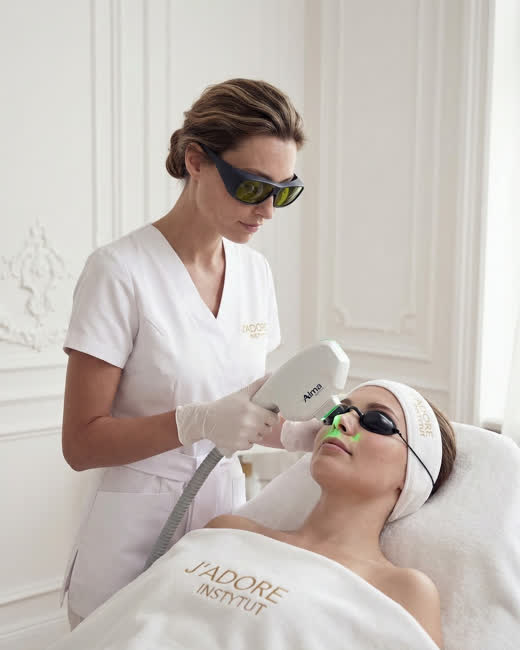
Where these myths come from
The history of ablative laser myths is short and fairly simple. For years — especially when lasers in this class were less precise — downtime really could be uncomfortable. Photos from that period still circulate online today and are treated as current. But fractionation changed the rules of the game: instead of removing the entire skin surface, modern ablative lasers work in a pattern of micro-columns — treating part of the skin while leaving untouched zones nearby that speed up healing. The result depends on parameters chosen for your skin and treatment goal, but the healing mechanism itself is now considerably gentler than the legends suggest.
Seven myths about downtime — one by one
Myth 1: "The skin literally peels off — like after a burn." This phrase comes up so often it's worth unpacking. Peeling after ablative laser is a fact — but it doesn't look like peeling after sunburn. With a fractional treatment, the skin loses its outer layers gradually, in small fragments that can easily be covered with mineral powder after just a few days. Intensity depends on the depth of treatment, but "sheets of skin falling off the face" is an image straight out of the 1990s, not a description of modern fractionation.
Myth 2: "A week shut away at home is the minimum." Time before you can return to work — without makeup, wearing a protective mask or a light mineral powder — is typically three to five days after a deeper treatment and one to two days after a gentler version. There's no single standard, because parameters are matched to your skin and goal — but "minimum a week" is a myth generalised from the most intensive, full-surface protocols. If you hear "a week" applied to every ablative laser treatment, that's not accurate information. Ask specifically about the depth of the treatment that applies to you.
Myth 3: "Your face swells so much you can't leave the house." Swelling is real — especially on the first and second day — but for most people it stays within a range you can simply observe, without alarm. The skin feels tight, pinkish and warm. Morning facial swelling is typical for the first few days and eases within hours of getting up. Cold compresses, sleeping with your head slightly raised and avoiding physical exertion shorten this stage noticeably. The dramatic swelling that circulates online as "proof" of heavy downtime is usually linked to very intensive treatments or to not following aftercare instructions.
Myth 4: "You can't go outside for a month." After ablative laser, the skin is more sensitive to UV radiation for a while and needs careful protection — but that doesn't mean sitting in the dark for a month. The reality is different: SPF50+ every morning, avoiding long sun exposure without covering your head, and avoiding sunbeds. With proper protection, you can go about your normal routine, go to work and drive. The restrictions scale with the season — a treatment done in autumn or winter has the advantage of naturally lower sun exposure.
Myth 5: "After the treatment, skin looks worse than before — forever." At the peak of peeling, skin can look patchy, rusty or grey. That's a transitional phase, not the final result — and it usually lasts a few days. This is exactly why it's worth not judging the treatment in the first week, and sticking to the aftercare protocol right through to the end instead of giving up halfway. Once healing is complete, skin can look more even, brighter and smoother than before the treatment — but the results unfold over several weeks, not all at once.
Myth 6: "Aftercare is so complicated you could easily get it wrong and cause harm." The list of ingredients to avoid after ablative laser isn't long or hard to remember: for a while, you avoid acids, retinol, alcohol and strong active ingredients. What you use instead are regenerating, soothing products that protect the skin barrier — the kind that should feature in any skincare routine anyway. Skin isn't as fragile as porcelain; it's in a phase of intensive regeneration, which means it needs simple, supportive care, not a complicated laboratory protocol.
Myth 7: "One treatment lasts forever." For many people, results from ablative laser last a long time — sometimes several years. But skin keeps ageing, and new issues (hyperpigmentation, texture changes) appear over time. That's why many protocols involve a series, or a repeat session after a set period. The treatment isn't a "one-off fix forever" — it's an investment with a long, but not permanent, effect. Managing expectations is part of a good consultation.
What healing looks like, day by day
- 01
Day of treatment — evening
Redness, warmth in the skin, a feeling similar to a strong sunburn. Mild swelling. Skin may look shiny from the regenerating products applied. The golden rule: don't touch or scrub anything.
- 02
Days 1–2 — peak swelling
Morning swelling, especially under the eyes. Skin feels warm and tight to the touch. At this stage, cold compresses bring clear relief. Going out is possible, but most people prefer to stay in.
- 03
Days 2–4 — peeling
Skin starts to peel where the treatment went deeper — gently, in small fragments. This is a natural, expected stage. Don't pull or peel it off by hand. Moisturising several times a day is the priority.
- 04
Days 4–7 — new skin
Peeling gradually fades. Underneath, fresh, pinkish skin is visible — sensitive and prone to dryness. You can slowly return to your normal skincare, still avoiding active acids and retinol. Mineral powder can cover the pinkness.
- 05
Weeks 2–4 — evening out
Skin stabilises and gradually loses its pink tone. SPF50+ protection is essential during this time. Results start to become visible, though the full outcome emerges over several weeks to a few months.
- 06
Months 2–3 — final result
Skin has fully healed. Collagen continues to build for several months after the treatment. This is the point at which it's worth assessing the result and planning any next steps with your doctor or specialist.
Ablative vs fractional non-ablative laser — the key differences
One of the most common misunderstandings is that "ablative laser" and "fractional laser" sound like different treatments, when in reality they're two separate axes of description. A laser can be both fractional and ablative — meaning it works in a pattern of micro-columns, removing the outer layers of skin only at specific points, not across the whole surface. This is exactly what shortens healing time while keeping the effect deep.
Fractional ablative laser
Deep regeneration, improved texture and hyperpigmentation
- Removes the outer layers of skin in a pattern of micro-columns
- Visible peeling and redness for several days
- Deeper, more pronounced effect — often after just one treatment
- Recovery time: usually 5–7 days before returning to life without makeup
Fractional non-ablative laser
Gradual improvement with minimal downtime
- Works beneath the skin, leaving the surface untouched
- Minimal or no visible symptoms after treatment
- Results build up across a series of treatments
- Back to daily life the next day
What really determines how you experience downtime
Experiences after ablative laser vary between people more than with almost any other treatment — and it's not a question of "weak" or "strong" skin. Three factors matter most.
- Depth and density of the treatment — parameters chosen by your doctor or specialist, not by you. The deeper and denser the protocol, the more intensive the healing. Settings for pale, thin skin with hyperpigmentation will differ from those for thick, oily skin with acne marks.
- Aftercare — moisturising several times a day, avoiding touching the skin, following ingredient guidelines. Skin that's well hydrated and protected heals faster and is less likely to leave marks behind.
- Your plan for this period — it's not about hiding at home. It's about not scheduling anything during this time that requires you to look flawless. Plan the treatment in advance, taking your personal and work calendar into account.
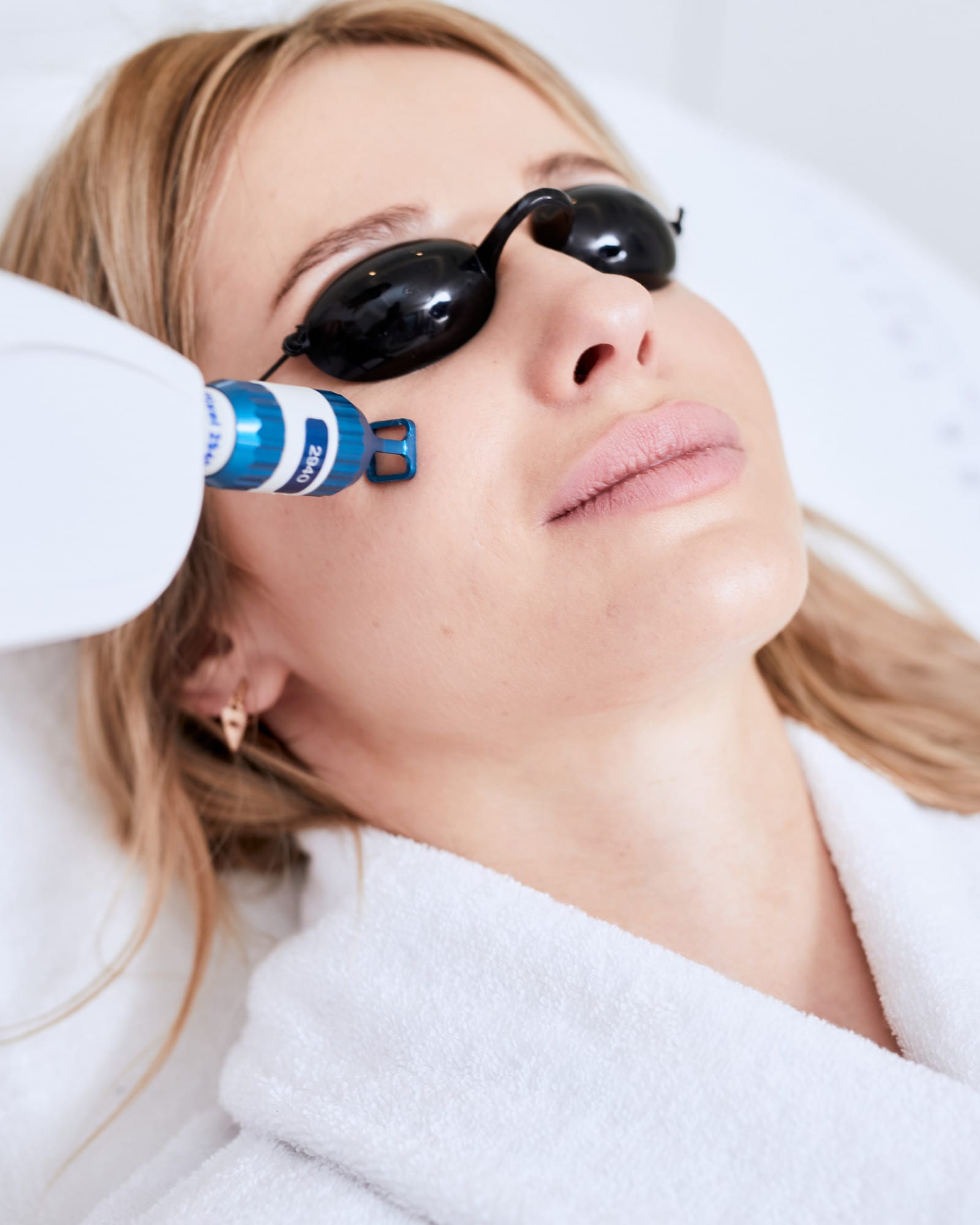
Which concerns respond best to ablative laser
Ablative laser isn't the answer to every skin concern — but for a handful of them, it's hard to match the result with any other method. Acne scars, deeper post-inflammatory hyperpigmentation (PIH), loss of elasticity and pronounced surface wrinkles are areas where ablative fractionation often delivers results that neither acids nor non-ablative lasers can achieve. The key is that the treatment causes controlled damage — and it's this that triggers the body's repair cascade, new collagen production and the remodelling of skin structure.
- Acne scars — shallower, atrophic (indented) scars can respond noticeably after just one or two treatments; deeper ones need a series
- Post-inflammatory hyperpigmentation (PIH) — especially the kind that doesn't respond well to acids and peels
- Wrinkles and surface lines — particularly around the mouth and eyes
- Loss of skin firmness and quality — an improvement in density and texture you can feel to the touch
- Surgical scars and injury marks — depending on the type and age of the scar
Before you decide
One of the most common comments after the treatment is: "I imagined it would be worse." Not because the treatment is trivial — but because the picture online is built on extreme cases, not the typical course. The decision to have ablative laser should be based on a thorough consultation, during which you assess — together with your specialist or doctor — your goal, your skin's condition, your plan for recovery time, and what you can realistically expect from your protocol.
It's worth coming to the consultation with a specific question: "Which protocol is right for my concern, and how much recovery time do I really need?" The answer won't be the same for everyone — and that's exactly what sets apart a salon that takes you seriously from a one-line "laser on offer" ad.