How IPL and laser reach hyperpigmentation — the logic, not the physics
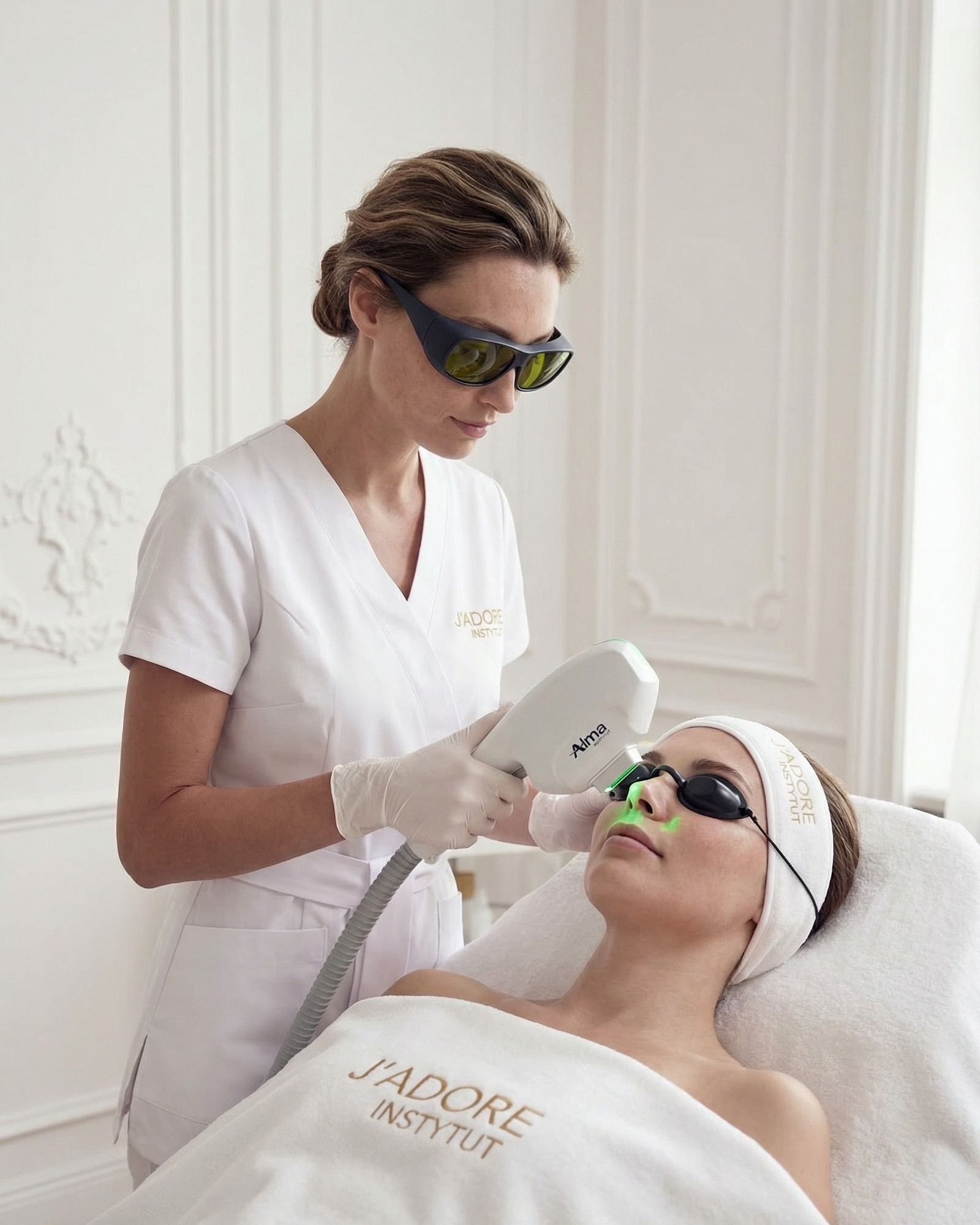
Both devices use light absorbed by pigment — melanin draws it in like a magnet. The difference lies in how precisely and how deeply they reach. IPL emits a broad range of wavelengths and works more superficially, covering a fairly wide area at once. Laser focuses energy on a narrow wavelength and can reach deeper, targeting more precisely. That doesn't make laser "stronger" — it makes it more specialised. For some types of hyperpigmentation, that precision is essential. For others, it isn't needed at all.
IPL
broad spectrum, works superficially on pigment
- sun-induced hyperpigmentation (shallow "sun spots")
- uneven skin tone after tanning
- mild post-sun hyperpigmentation on the body
- fair or light beige skin with visible spots
- can treat large areas in a single session
Laser (pigment / fractional)
precise, deep elimination of pigment
- melasma and hormonal hyperpigmentation (deeper-seated)
- post-inflammatory hyperpigmentation (from acne, injury)
- irregular spots with well-defined borders
- suitable for a wide range of skin phototypes with the right settings
- can work layer by layer, with greater control
Where the problem actually comes from — types of hyperpigmentation worth knowing
Before choosing a method, it helps to know what type of hyperpigmentation you're dealing with. Not every spot forms for the same reason — and the underlying cause often decides which device can help, and which could make things worse.
- Sun-induced hyperpigmentation (lentigines solares) — flat, brown spots that appear after years of sun exposure, most often on the face, décolletage and hands. Usually superficial — they respond well to IPL.
- Melasma — symmetrical, greyish-brown patches, often hormonal (pregnancy, contraception, menopause). Deeper-seated, unpredictable and prone to recurrence. A pigment laser with the right protocol can give better results than IPL — but it requires patience.
- Post-inflammatory hyperpigmentation (PIH) — marks left by acne, burns or injury. Skin type and the depth of the mark determine the choice of method; laser treatment is often combined with skincare.
- Uneven tone after tanning — diffuse darkening without clear borders. IPL often works very well here, evening out the tone across the whole area.
Skin phototype — one of the most important factors in choosing a method
What works well on fair skin can be risky on darker skin. Skin phototype (the Fitzpatrick scale, I to VI) shows how much melanin the skin contains — the more it has, the harder it is for a light-based device to "target" only the melanin in the hyperpigmentation and skip the surrounding healthy skin. That's why there's no single protocol for everyone.
This is one of the reasons a pre-treatment consultation isn't a formality — it's the moment your specialist assesses exactly this variable. Without it, a safe result is hard to guarantee.
What treating hyperpigmentation usually involves — the stages
With both IPL and pigment lasers, a realistic result usually takes several sessions, not one. The skin needs time to process the broken-down pigment and renew the epidermis. Here's what a typical plan looks like:
- 01
Consultation & diagnostics
We assess the type of hyperpigmentation, your skin phototype, sun exposure history and current skincare routine. Often with a Wood's lamp or dermatoscope. This is when the method is decided.
- 02
Skin preparation
Usually a few weeks before the treatment — avoiding the sun, daily SPF 50+ protection, and often a brightening product (containing, for example, retinol, vitamin C or niacinamide). This step isn't optional.
- 03
Series of sessions
Depending on the method and how deep the marks sit — anywhere from a few to over a dozen sessions, spaced several weeks apart. Results build up gradually; after each session, the hyperpigmentation may look "darker" before it starts to fade — that's a normal stage.
- 04
Aftercare & maintenance
Sun protection throughout the course of treatment and after it ends. Without it, results won't last — new melanin forms faster than it can be removed.
IPL versus laser — when each one actually makes sense
Instead of looking for the "better" device, it helps to ask a different question: what type of hyperpigmentation do I have, and at what stage do I want to act? Here's a practical rule that's easy to remember:
- You have fair skin, shallow sun spots, and no history of melasma → IPL is often enough, and it works faster.
- You have hormonal hyperpigmentation, deeper-seated marks or symmetrical patterns on the face → before turning to IPL, ask whether a pigment laser with the right protocol might work better.
- You have darker skin (phototype IV or higher) → a device-selection consultation is essential — not every IPL and not every laser is safe here.
- You have marks left by acne or injury → post-inflammatory hyperpigmentation is a category of its own; a light-based method is often combined with active skincare.
- You want to even out your overall skin tone after summer → IPL over large areas can give very satisfying results, faster than a targeted laser.
When it's worth combining IPL or laser with other methods
No light-based treatment works in isolation. The most lasting results come to people who treat the course as a plan, not a one-off event — choosing complementary treatments suited to their specific problem.
Chemical peel
Works on a different principle than light — it can complement a light-based course, especially for superficial hyperpigmentation or uneven tone. Often used for preparation or maintenance.
Mesotherapy with vitamin C and glutathione
Delivering brightening ingredients and antioxidants directly into the skin can strengthen and extend the results of a light-based treatment. A good choice as a follow-on to an IPL or laser series.
Regular home care with SPF
It isn't a "treatment", but without it no laser or IPL treatment will hold its results for more than a few months. Daily sun protection — even under a cloudy sky — is the foundation of any hyperpigmentation protocol.
Treatments for skin texture (for example, microneedling)
For post-inflammatory hyperpigmentation from acne, working on tone and texture together gives a fuller result than addressing only one issue.
A good clinic won't offer you "one treatment for hyperpigmentation". It will offer a plan — with a defined order, intervals between sessions, and skincare in between. If that's missing, it's worth asking why.