Two weeks in advance: set your goal and disclose your medical history
Note whether your goal is to work on the appearance of cellulite, tissue firmness, or to support regeneration for another indication. The same applicator does not mean the same protocol. Inform us about vascular diseases, coagulation disorders, thrombosis, cancer, pregnancy, implants in the area, active inflammation, and medications affecting blood clotting. Do not discontinue these on your own.
If an area hurts for an unknown reason, you may need diagnostics first. An aesthetic treatment should not mask a symptom that has not been evaluated.
Two days in advance: do not create bruises or irritation
Stop intensive brushing, cupping, aggressive self-massage, and any cosmetic product that makes your skin sting. Do not test warming preparations. A fresh bruise, abrasion, hair removal that has broken the epidermis, or sunburn may be a reason to postpone work on a given area.
- Note any particularly tender spots.
- Take a photo in neutral light without tensing your muscles.
- Do not plan a second intensive treatment for the same area without prior consultation.
- Report any infections and new medications before your arrival.
On the day of your visit: your skin must be clean and your information complete
Do not apply greasy lotion, fake tan, or any strong warming product to the area. Eat and hydrate normally; special "detoxes" do not improve the wave's performance. Wear clothing that easily exposes the area and will not compress it after the treatment.
During your first session, speak up about pain and unusual radiating sensations instead of treating them as proof of effectiveness. Parameters are selected based on the tissue and your tolerance. The goal is not to endure maximum intensity.
How it works: mechanics without magic
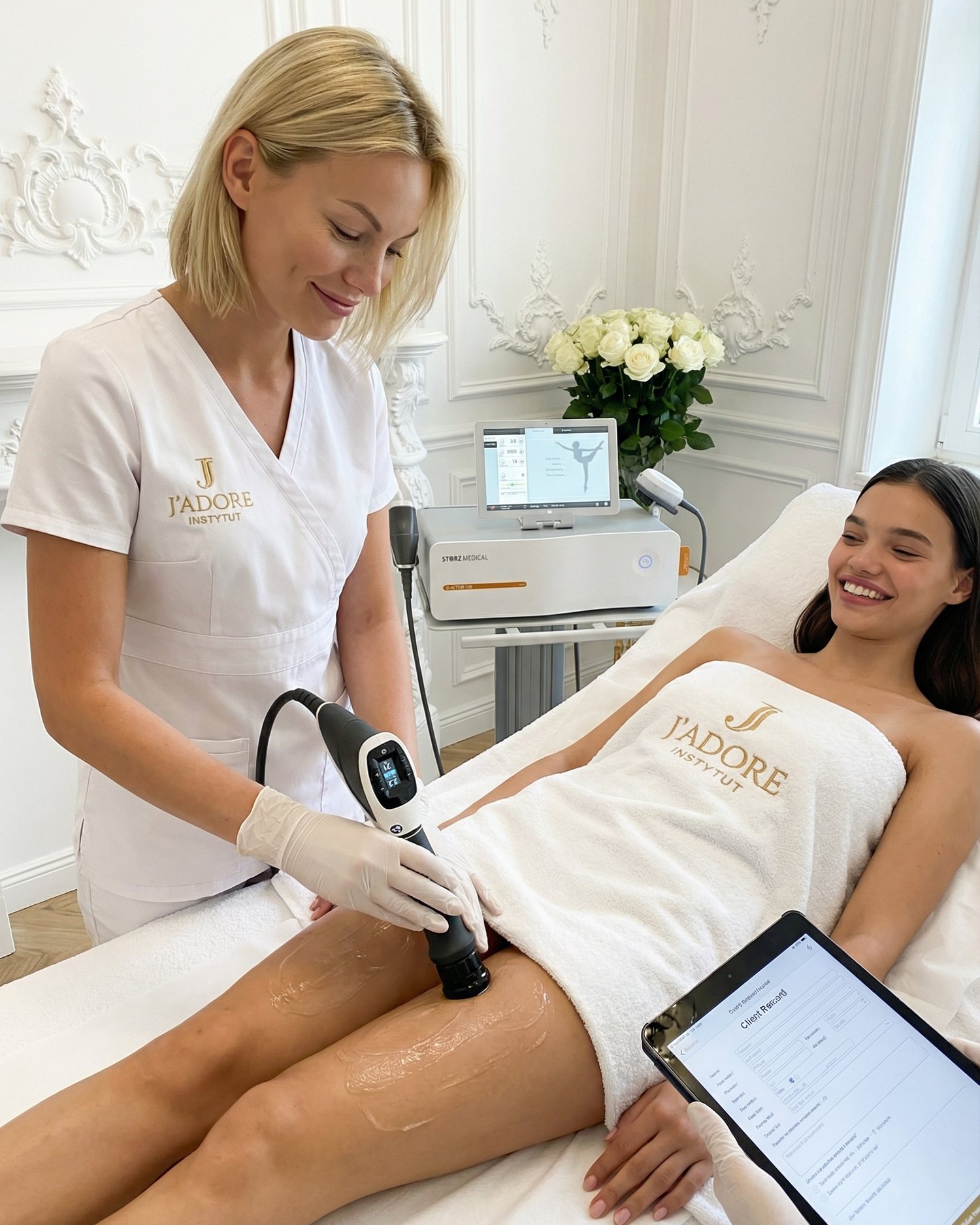
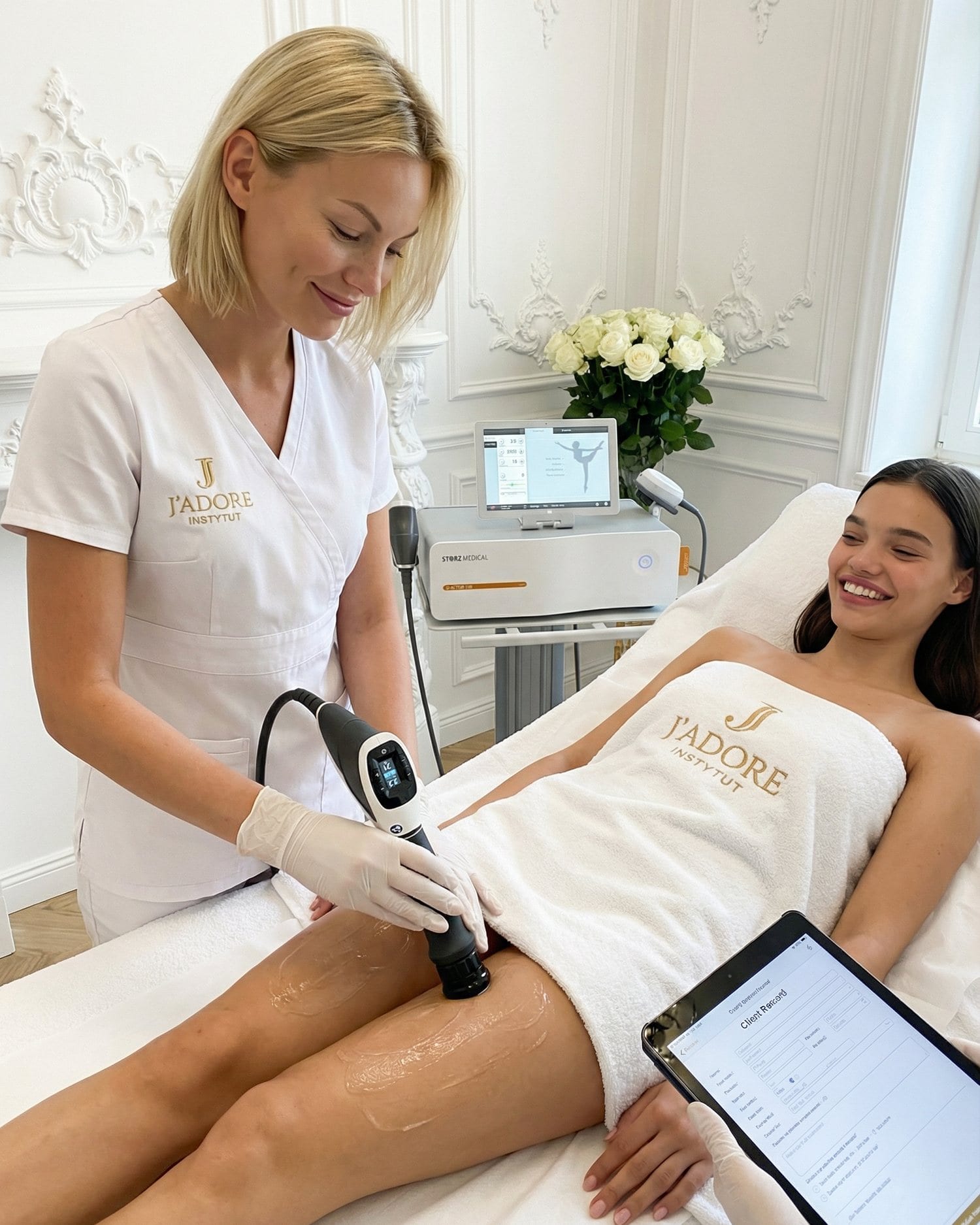
The applicator is placed against the skin and sends acoustic waves — pressure pulses — deep into the tissue. You feel vibrations and rhythmic impacts, which can be uncomfortable near bones but are manageable. No needles, no lasers, no incisions. A session for one zone is short, after which you can leave immediately and return to your normal day.
Three things happen in the tissue simultaneously:
- Mechanical destabilisation of adipocytes — acoustic pressure destroys fat cell walls in a controlled manner; the contents are gradually metabolised.
- Stimulation of collagen and elastin — fibroblasts in the dermis respond to the mechanical impulse with increased synthesis of structural proteins; the result is seen as improved skin firmness.
- Improvement of microcirculation — the wave increases perfusion in the treated tissue, which accelerates regeneration and reduces post-treatment swelling.
Two paths: silhouette reduction vs sports regeneration
In our clinics, the acoustic wave has two distinct applications for people who differ in their goals and treatment areas — it is important which one you discuss with the specialist before the treatment.
Reduction — love handles and midriff
for whom: silhouette
- breaks down stubborn fat cells in local zones
- strengthens skin firmness in the treated area
- a series of sessions at weekly intervals
- best combined with regular training and diet control
Regeneration — muscles and overstrain
for whom: sports and activity
- accelerates the healing of overstrained soft tissues
- reduces tension in contracted muscle groups
- helps with enthesopathy, tendon pain, and "stiff" hamstrings
- used locally, not on the entire silhouette zone
Many active people combine both approaches in one series: love handles and midriff are treated as a silhouette zone, while simultaneously tight quadriceps or contracted hamstrings are treated as regeneration. This can be planned during one visit with the specialist.
A series, not a one-off hit
The acoustic wave works cumulatively. One session provides an impulse, a series provides the result. How many sessions? This depends on tissue thickness, your body's individual response, and your goal — during the consultation, the specialist assesses this specifically for you, not from a table. The plan usually involves several visits at regular intervals.
- 01
Consultation
Tissue assessment, discussion of the goal (reduction / regeneration / combination), and exclusion of contraindications. No pressure to make a decision immediately.
- 02
First session
Application of the wave in the planned zone. A feeling of vibration and rhythmic impacts — manageable, not a pleasure, but tolerable. You leave and carry on with your day.
- 03
Subsequent sessions
Intervals between visits give the tissue time to respond. The body gradually metabolises the broken-down fat and remodels collagen.
- 04
Assessment after the series
Full result visible several to a dozen weeks after finishing the series. With an active lifestyle, results last for a long time.
When the acoustic wave is NOT for you
The treatment is safe for the vast majority of healthy people, but there are situations where the specialist will say "no" or suggest a different plan:
- Coagulation disorders or the use of anticoagulant medications
- A pacemaker or other active electronic implants.
- Active cancer or recent remission — an oncology consultation is required.
- Active inflammation, skin infection or open lesions in the planned area.
- Severe osteoporosis (when applying over bony areas).
What exactly is cellulite — where does the problem come from?
Cellulite is not just an aesthetic issue; it is a structural change in the subcutaneous tissue. Fat cells enlarge and put pressure on the network of connective tissue fibres. This creates characteristic "dimples" and "lumps" on the skin. This is accompanied by impaired circulation, lymphatic stasis and weakened collagen production. As a result, the skin loses elasticity and takes on an uneven, orange-peel texture.
This is why an effective approach to cellulite must work on several levels simultaneously: on fat, circulation, connective tissue fibres and the quality of the skin itself. No single method does everything at once. However, each of the three below handles a different piece of this puzzle exceptionally well.
Which problem — which method?
Instead of asking "what is best for cellulite", it is worth asking what exactly you care about. Answering a few questions usually narrows down the field of choice immediately:
- Slack skin, lacking tension, with a fine mesh of lines → the priority is collagen stimulation and improving skin quality → Emtone or a series of endermology with an emphasis on fibroblasts.
- Feeling of heaviness, swelling, legs that "gain weight" by the end of the day → the priority is drainage and circulation → endermology or a combination of endermology and the wave.
- Deep, hard cellulite with visible nodules and hardening → the priority is breaking down structural changes → shockwave therapy, often as a preparatory stage before Emtone or endermology.
- Moderate cellulite, you want a comprehensive improvement in appearance → Emtone or a combination of Emtone + endermology.
It is also worth remembering that cellulite has a history. It is often the result of connective tissue and vascular changes that have been building up for years. No method will reverse them in a single session, but a consistent series can bring a clear, lasting improvement for many people.
How to evaluate a plan before making a decision.
Regarding "preparation", write down your goal, your starting condition and the threshold at which a different method is needed. Ask for the name of the device or product, the person performing it, contraindications, the expected reaction and the check-up time. Translate general words into observable facts: what is supposed to change, when, and what this procedure will not change.
In the "Storz ESWT: preparation relies on a good interview, not on 'breaking down' tissues at home" plan, the ability to stop or change direction is important. A package, a trend and a positive review do not replace qualifications. If you cannot explain the goal in your own words after the conversation, return for the missing data before starting, not after the first unwanted reaction.
After the "Storz ESWT: preparation relies on a good interview, not on 'breaking down' tissues at home" treatment, compare your condition under similar conditions. Also record comfort, pain, swelling and the time it takes to return to your daily routine. A photo shows the surface, but it does not describe function or well-being. A good assessment combines both types of information.
Control point 1: when to change the plan.
Regarding "preparation", do not judge success solely by the intensity of the first reaction. Before the treatment, establish what signal means improvement, what means no response, and what is a reason to contact us. Written criteria protect you from adding promises after the fact and from repeating a procedure just because the next appointment was already scheduled.
In the "Storz ESWT: preparation relies on a good interview, not on 'breaking down' tissues at home" plan, if the goal remains unclear after stage 1, return to the diagnosis of the problem. Sometimes a different technique, a longer interval, simpler skincare or a medical consultation is needed. A good method does not lose credibility when it has limits; it gains it when the specialist can name those limits before starting.
Control point 2: when to change the plan.
Regarding "preparation", do not judge success solely by the intensity of the first reaction. Before the treatment, establish what signal means improvement, what means no response, and what is a reason to contact us. Written criteria protect you from adding promises after the fact and from repeating a procedure just because the next appointment was already scheduled.
In the "Storz ESWT: preparation relies on a good interview, not on 'breaking down' tissues at home" plan, if the goal remains unclear after stage 2, return to the diagnosis of the problem. Sometimes a different technique, a longer interval, simpler skincare or a medical consultation is needed. A good method does not lose credibility when it has limits; it gains it when the specialist can name those limits before starting.
Control point 3: when to change the plan.
Regarding "preparation", do not judge success solely by the intensity of the first reaction. Before the treatment, establish what signal means improvement, what means no response, and what is a reason to contact us. Written criteria protect you from adding promises after the fact and from repeating a procedure just because the next appointment was already scheduled.
In the "Storz ESWT: preparation relies on a good interview, not on 'breaking down' tissues at home" plan, if the goal remains unclear after stage 3, return to the diagnosis of the problem. Sometimes a different technique, a longer interval, simpler skincare or a medical consultation is needed. A good method does not lose credibility when it has limits; it gains it when the specialist can name those limits before starting.
Control point 4: when to change the plan.
Regarding "preparation", do not judge success solely by the intensity of the first reaction. Before the treatment, establish what signal means improvement, what means no response, and what is a reason to contact us. Written criteria protect you from adding promises after the fact and from repeating a procedure just because the next appointment was already scheduled.
In the "Storz ESWT: preparation relies on a good interview, not on 'breaking down' tissues at home" plan, if the goal remains unclear after stage 4, return to the diagnosis of the problem. Sometimes a different technique, a longer interval, simpler skincare or a medical consultation is needed. A good method does not lose credibility when it has limits; it gains it when the specialist can name those limits before starting.
Control point 5: when to change the plan.
Regarding "preparation", do not judge success solely by the intensity of the first reaction. Before the treatment, establish what signal means improvement, what means no response, and what is a reason to contact us. Written criteria protect you from adding promises after the fact and from repeating a procedure just because the next appointment was already scheduled.
In the "Storz ESWT: preparation relies on a good interview, not on 'breaking down' tissues at home" plan, if the goal remains unclear after stage 5, return to the diagnosis of the problem. Sometimes a different technique, a longer interval, simpler skincare or a medical consultation is needed. A good method does not lose credibility when it has limits; it gains it when the specialist can name those limits before starting.