A review only makes sense when the goal and area are specified
Shockwave can be used for various indications. Therefore, a review about "love handles" does not automatically answer questions about thigh cellulite. Look for information on the baseline state, the number of sessions in the plan, combined methods, and the timing of the assessment. Immediate redness is not a result of remodelling.
The most valuable entries also describe changes to the plan: lowering parameters, rescheduling a session due to bruising, or opting out when the problem did not fit the method.
Only compare photos taken under the same conditions
- The same light and distance.
- The same leg position and muscle tension.
- No smoothing oil only in the "after" photo.
- A description of the time elapsed since the last session.
- Information about diet, training, and other procedures.
Changing the angle of light can almost eliminate shadows created by irregularities. A gallery without shared conditions is aesthetic material, not documentation of the effect.
Check qualifications and the approach to pain yourself
Ask for the full name of the device, the applicator, the goal of the protocol, and the criteria for selecting intensity. A specialist should take a history regarding clotting, blood vessels, medications, pregnancy, implants, and skin condition. A red flag is the promise of one setting for every area.
Pain should be a message, not a character test. If reviews mention ignored discomfort, bruising presented as necessary proof, or a lack of contact after an unusual reaction, treat this more seriously than praise for the decor.
What is cellulite actually — where does the problem come from
Cellulite is not just an aesthetic issue — it is a structural change in the subcutaneous tissue. Fat cells enlarge and put pressure on the network of connective tissue fibres, creating characteristic "dimples" and "lumps" on the skin. This is accompanied by impaired circulation, lymphatic stasis, and weakened collagen production — which causes the skin to lose elasticity and take on an uneven, orange-peel texture.
This is why an effective approach to cellulite must work on several levels simultaneously: on fat, on circulation, on connective tissue fibres, and on the quality of the skin itself. No single method does everything at once — but each of the three below handles a different part of this puzzle exceptionally well.
Three methods — three different approaches
Before we compare them directly, it is worth understanding what each of them is in its essence:
- Emtone combines two energies simultaneously: heat and mechanical vibrations. It works at the level of the skin and subcutaneous tissue — it stimulates the production of collagen and elastin, improves microcirculation, and can influence the structure of fat cells.
- Endermology (LPG) is a mechanical method — a special head pulls the tissue in a controlled manner, stimulating lymphatic and blood circulation, relaxing hardened connective tissue septa, and stimulating fibroblasts to regenerate.
- Shockwave generates rapid pressure pulses that penetrate the tissue, breaking down the collagen fibres that form "cords" in cellulite and stimulating local repair processes.
Emtone
comprehensive action on the skin and subcutaneous tissue
- can improve skin quality and firmness
- combines collagen stimulation with action on adipose tissue
- a comfortable treatment without the specialist's hands touching the body
- often used on the thighs, abdomen, and buttocks
Endermology (LPG)
drainage, circulation, and tissue relaxation
- improves microcirculation and lymph drainage
- can relax hardened connective tissue septa
- effective in reducing swelling and the feeling of heavy legs
- works on large parts of the body — thighs, abdomen, back, arms
Shockwave
deep stimulation and breaking down of structural changes
- can break down hardened fat-connective tissue septa
- stimulates local regenerative processes
- used locally for deep, hard cellulite
- can improve skin elasticity in the treated areas
When is it worth combining methods?
The best results for advanced cellulite are often achieved by sequentially or parallelly combining methods — each works on a different aspect of the problem and they reinforce each other. A specialist creates the plan after assessing the tissue, but typical combinations are:
Shockwave + Emtone
Shockwave breaks down hardened structures and prepares the tissue, while Emtone stimulates collagen and drives regeneration — a combination particularly effective for deep, hard cellulite.
Endermology + Emtone
Endermology removes toxins and improves drainage, while Emtone models and densifies the skin — a good combination for cellulite with swelling and loss of firmness.
Shockwave + endermology
Shockwave breaks down structural changes, while endermology supports drainage and tissue regeneration — a proven combination for hard cellulite with lymphatic stasis.
A series of a single method with maintenance
For less advanced cellulite, one method in a regular series (e.g. 6–10 sessions) can provide lasting improvement — provided it is maintained with home care and physical activity.
What can you realistically expect?
- Results may be visible during the series, but they are often most pronounced a few weeks after its completion.
- Results are more lasting when accompanied by regular physical activity and proper hydration.
- Cellulite can return — especially with hormonal changes, prolonged sitting or a lack of movement. A maintenance session every few weeks often extends the results.
- For those with very lax skin or advanced changes, results may be more modest. Your specialist should tell you this directly during the consultation.
Red vs. white — what the colour really means
Stretch marks form when the skin stretches faster than it can produce enough collagen and elastin fibres. The result is a tear in the connective tissue network. This is where the difference begins between what appears red (pink, purple) and what becomes white (silvery, pearly).
Red stretch marks
tissue in the active, vascular phase
- Fresh — from a few months to approximately two years
- The red-pink or purple colour comes from dilated blood vessels
- The tissue is biologically active — cells are still remodelling
- For many, it is sensitive to the touch or slightly itchy
- The best time for intervention — the highest chance of a result
White stretch marks
tissue in the scarring, fibrous phase
- Older — the tissue has finished remodelling and has entered a stable state
- The white or silvery colour is a sign of pigment and vessel loss
- Collagen fibres are arranged irregularly; elastin is practically absent
- The skin in this area is often thinner and has less nerve supply
- They require methods that "wake up" the dormant tissue
Shockwave — when and why
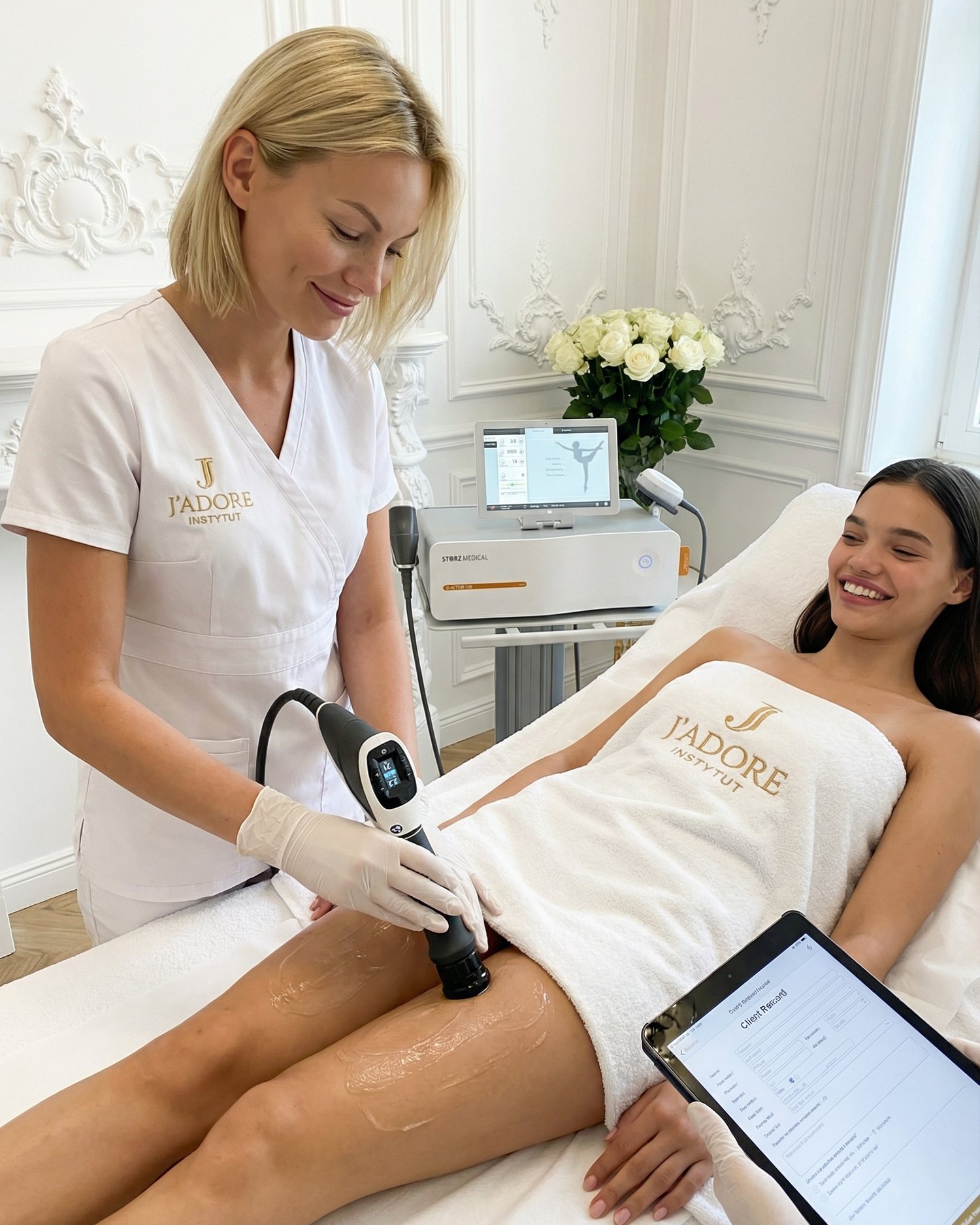
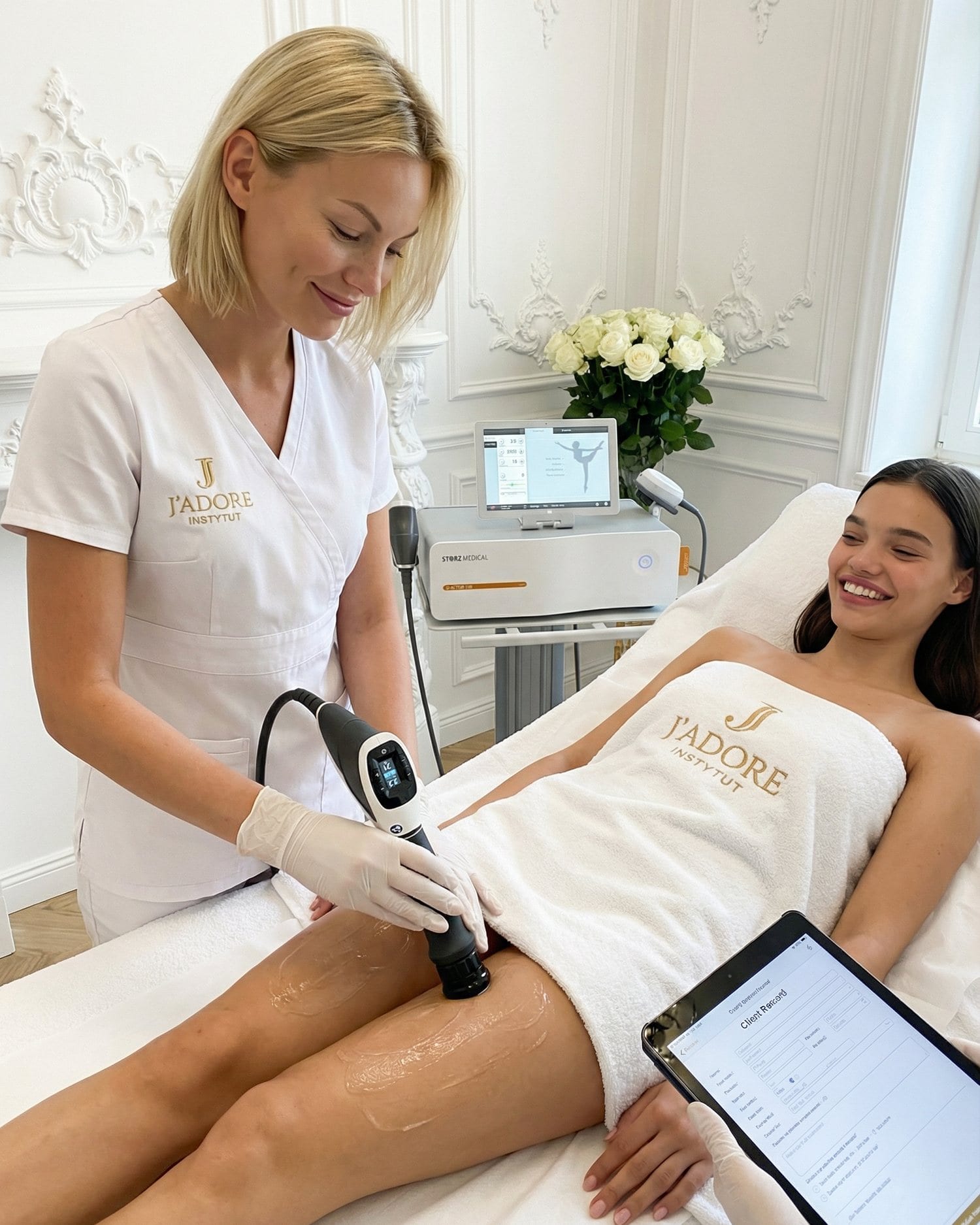
Shockwave is a mechanical method. It sends pressure pulses into the tissue, which literally "break it down" and force it to remodel. The result is the stimulation of fibroblasts (collagen-producing cells), increased blood flow and the loosening of fibrosis.
- White, established stretch marks — especially on the abdomen, thighs and buttocks
- Extensive areas — shockwave works perfectly on larger fields, e.g. after pregnancy
- Skin with accompanying cellulite — dual action on tissue structure
- People who cannot use light energy — e.g. those prone to discolouration
Comparison: which method, when
Shockwave
mechanical tissue stimulation
- Particularly effective for white, established stretch marks
- Safe for all skin phototypes
- Improves texture and stimulates your own collagen
- Can work on larger areas simultaneously
- Often combined with deep tissue massage
Laser
selective light energy
- Particularly effective for red and pink stretch marks
- Precise work on colour and texture is possible
- Faster reduction of redness and improves contrast with the surroundings
- Stimulates collagen remodelling through controlled micro-injury
- High satisfaction during the active phase of stretch marks
How to evaluate a plan before making a decision
When discussing "reviews", note the goal, the starting condition and the threshold at which a different method is needed. Ask for the name of the device or product, the person performing it, contraindications, the expected reaction and the check-up point. Translate general words into observable facts: what is supposed to change, when, and what this procedure will not change.
In the "Storz ESWT in Warsaw: a good review describes the protocol, not just the pain" plan, the ability to stop or change direction is important. A package, a trend and a positive review do not replace a qualification. If you cannot explain the goal in your own words after the conversation, return for the missing data before starting, not after the first unwanted reaction.
After the "Storz ESWT in Warsaw: a good review describes the protocol, not just the pain" treatment, compare your condition under similar conditions and also record comfort, pain, swelling and the time to return to your daily routine. A photo shows the surface but does not describe function or well-being. A good assessment combines both types of information.
Check-up point 1: when to change the plan
Regarding "reviews", do not judge success solely by the intensity of the first reaction. Establish before the treatment which signal means improvement, which means no response, and which is a reason to contact us. Written criteria protect against adding promises after the fact and against repeating a procedure just because the next date was already scheduled.
In the "Storz ESWT in Warsaw: a good review describes the protocol, not just the pain" plan, if the goal remains unclear after stage 1, return to the diagnosis of the problem. Sometimes a different technique, a longer interval, simpler skincare or a medical consultation is needed. A good method does not lose credibility when it has limits; it gains it when the specialist can name those limits before starting.
Control point 2: when to change the plan
Regarding feedback, do not judge success solely by the intensity of the initial reaction. Before the treatment, establish which signals indicate improvement, which suggest no response, and which require contact. Documented criteria protect against adding promises after the fact. They also prevent repeating a procedure simply because the next appointment was already scheduled.
In the "Storz ESWT in Warsaw: a good review describes the protocol, not just the pain" plan, if the goal remains unclear after stage 2, return to the problem diagnosis. Sometimes you need a different technique, a longer interval, simpler skincare, or a medical consultation. A good method does not lose credibility when it has limits. It gains credibility when the specialist can define those limits before starting.
Control point 3: when to change the plan
Regarding feedback, do not judge success solely by the intensity of the initial reaction. Before the treatment, establish which signals indicate improvement, which suggest no response, and which require contact. Documented criteria protect against adding promises after the fact. They also prevent repeating a procedure simply because the next appointment was already scheduled.
In the "Storz ESWT in Warsaw: a good review describes the protocol, not just the pain" plan, if the goal remains unclear after stage 3, return to the problem diagnosis. Sometimes you need a different technique, a longer interval, simpler skincare, or a medical consultation. A good method does not lose credibility when it has limits. It gains credibility when the specialist can define those limits before starting.