Discomfort should decrease as the tissue adapts.
In a tense area, you may feel pressure, pulling, warmth, or tenderness. Your breathing remains free, and the sensation quickly subsides after the pressure is reduced. If the pain is sharp, burning, electric, radiates, or causes dizziness, tell us immediately. The specialist will change the technique or finish working in that area.
The pain scale does not predict the result. Stronger pressure may trigger a reflex contraction and cause the body to defend the area instead of releasing it.
Before the treatment, disclose any jaw, tooth, sinus, or previous injury issues.
- Pain or clicking of the temporomandibular joint.
- Bruxism and the use of a splint.
- Recent dental treatment.
- Migraines, neuralgia, and numbness.
- Surgeries, threads, injections, and facial injuries.
- Active skin inflammation or infection.
This information does not always exclude treatment, but it changes the area, pace, and the need for consultation with a doctor, dentist, or physiotherapist. Zoga should not be used to guess a diagnosis.
Expect lightness after the treatment, not severe aggravation.
Temporary tenderness similar to the feeling after a massage and greater awareness of tense areas are possible. Increasing pain, visible swelling, numbness, vision disturbances, or persistent dizziness require contact and proper assessment.
The best signal is not facial redness, but easier jaw movement, calmer breathing, and less need to clench. If the result lasts only a short time, you need to look at your habits, stress, working position, and potential medical causes.
Why the face hardens — and why people do not feel it.
You have a model in your head: stress accumulates in the neck and shoulders. That is true, but not the whole truth. Facial muscles are constantly active — all day long you clench your jaw at meetings, furrow your brow over your monitor, and tense your jaw muscles when something annoys you. You have been doing this for years. A muscle that works permanently without relaxing shortens and hardens — just like the calf of a runner who never stretches. The external effect: the face looks heavier, fatigue is "etched" into your features, and your expression is severe even when you do not want it to be.
People rarely signal that something hurts in their face — because jaw pain "has always been there" or "it is probably just stress". Often that is the case. But stress has its record in the body — and the face is one of the first places where it is visible from the outside before you feel it yourself.
What exactly is yoga face — without beating around the bush.
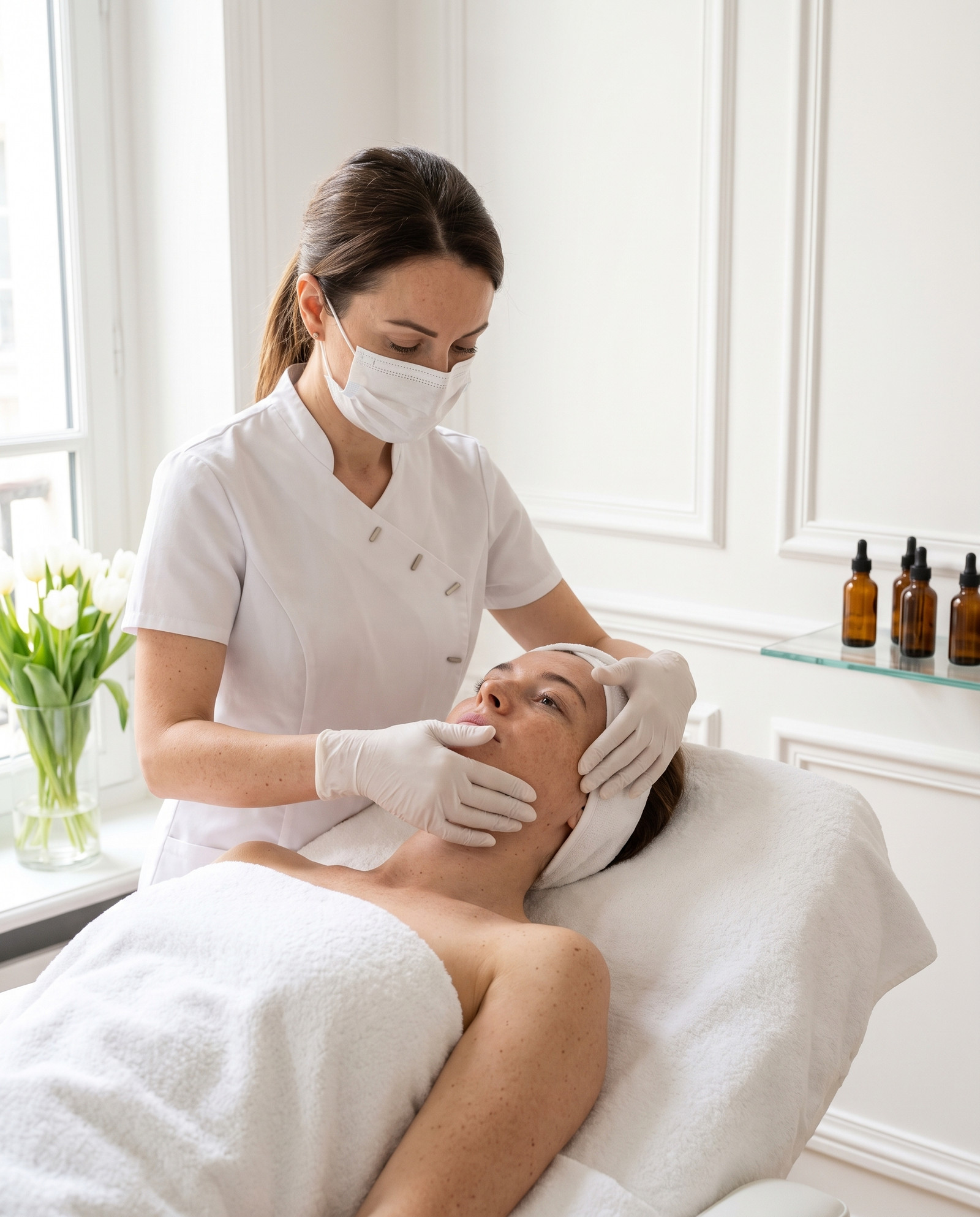
The name may sound strange, but a specific manual technique stands behind it. Yoga face is a combination of muscular massage, fascial techniques, and work with tension points on the face, neck, and nape. There are no exercises to do at home or meditation here. This is a salon treatment: the specialist works with their hands — and thumbs — along specific muscle lines.
Yoga face
manual work with the muscle
- relaxes specific tension points
- works on the entire face–neck–nape axis
- effect often visible immediately after the treatment
- zero downtime, zero medical intervention
Classic facial massage
superficial relaxation
- works mainly on the skin and subcutaneous tissue
- gliding, lymphatic, relaxation techniques
- good as a supplement to skincare
- effect of relaxation and radiance
The difference is simple: yoga face reaches deeper. Instead of gliding movements over the skin — pressure on the fascia, releasing trigger points, working with muscle attachments. It resembles facial physiotherapy more than a classic relaxation massage. For men with real jaw or neck tension — this is what makes the difference.
A tense jaw and what lies behind it.
Clenching teeth and jaw tension is a topic that appears exceptionally often — because it is directly related to stress and the way people "hold" it. With chronic tension, the masseter muscle hardens, which:
- is visible in profile — the massive, square jawline becomes more pronounced, and the face appears heavier.
- is felt in the morning — jaw stiffness, pain when opening the mouth wide, tension headaches.
- transfers higher up — a tense masseter "pulls" the temple and temporalis muscles, which affects the expression of the entire face.
Yoga face is not a treatment for bruxism — if you have a strong bite or grind your teeth at night, that is the role of a dentist and possibly an aesthetic doctor. But manual relaxation of the masseter, temples, and jawline often brings relief to the tension itself and clearly changes the appearance of the lower part of the face. Many people say after the treatment that for the first time in months, they do not feel that "tightness" in their head.
A tired face — where it comes from and what the treatment does.
A "tired face" is largely the result of chronic muscle contraction and impaired microcirculation in the tissue. When muscles are constantly tense, blood and lymph flow is limited. The skin loses its radiance, the tissue becomes dull, and features "pull" downwards. By relaxing deep muscles and stimulating circulation, yoga face restores tissue mobility — the result is a face that looks more rested and lively, not "done".
This is an important difference: the goal is not to "improve beauty". The goal is to restore the natural state of tissue that has lost its resilience and mobility through years of tension. That is why the effects of yoga face in men are often more striking than in women — because the tension is deeper and, in short: there is more to unlock.
What the treatment looks like — what happens in the salon.
- 01
Initial consultation
The specialist asks about specific tensions, ailments, and the place where stress is accumulated. Not "how do you want to look", but "what hurts or bothers you".
- 02
Palpatory diagnosis
Manual work — we assess tension in the masseter, temporal, forehead, neck and nape muscles. We locate trigger points and areas of restricted fascial mobility.
- 03
Working with deep muscles
We release the masseter, temporalis and neck muscles. We apply point pressure to attachments and work along the muscle lines — you will feel resistance followed by a clear release.
- 04
Fascial techniques
Slow, focused work on the connective tissue of the face and neck. The goal is to restore gliding between tissue layers and improve microcirculation.
- 05
Finalisation and results
Your face feels relaxed and well-perfused, with a calmer expression. Most people feel a distinct difference in their jaw and neck immediately after the treatment — the heaviness and tightness subside.

Who it is for — and when to start
You do not need to have an "appearance problem" for yoga face to make sense. It is a treatment for men who:
- wake up with tension or stiffness in the jaw or head
- have chronic tension headaches or neck pain
- look "heavier" in photos than in the mirror — a tired, "drawn" face
- feel that stress accumulates in their head, not just in their shoulders
- want to improve their skin condition and facial blood flow without medical intervention
- need a physical reset after a long project or an intense quarter, not just a holiday
Yoga face works better in a series than as a single session — tension built up over years does not disappear after one treatment. Many people see a visible change after the first session, but lasting results require regularity. A good analogy: just as regular stretching after a workout works better than a one-off physiotherapy course after an injury, yoga face in a series provides a different effect than a single visit.
Results — what you can and cannot expect
Yoga face is not a lifting procedure. It does not change facial contours, it does not work like Botox, and it does not eliminate wrinkles. What it can do — and does for many people — is:
- relief from jaw and temple tension — noticeable after the first treatment
- a more rested-looking face — less "drawn", with a calmer expression
- better jaw and neck mobility — less stiffness in the morning
- improved blood flow — skin looks more vibrant, less grey
- reduction of tension headaches for many people who use it regularly
The most common comment from people after a series: "I finally stopped feeling that heaviness in my head." It sounds imprecise — but if you know exactly what that feeling is, you understand why it is important to them.
What none of them can do — and why it matters
Both yoga face and kobido are skincare treatments, not medical ones. They work on muscles, circulation and lymph — and they do it very well. However, they will not replace methods that work on other "layers" of a problem: hyaluronic acid for volume loss, biostimulators for thinning skin or peels for epidermal quality.
This is good news: facial massages often work most beautifully together with other treatments — as part of comprehensive care, not as a solitary rescue.
How to assess a plan before making a decision
When discussing "pain and sensations", write down your goal, your baseline state and the threshold at which a different method is needed. Ask for the name of the device or product, the person performing it, contraindications, the expected reaction and the follow-up point. Translate general words into observable facts: what is supposed to change, when, and what this procedure will not change.
In the "Zoga Face Integration: intensity is meant to release tension, not add to it" plan, the ability to stop or change direction is important. A package, a trend or a positive review does not replace qualifications. If you cannot explain the goal in your own words after the discussion, return for the missing data before starting, not after the first unwanted reaction.
After the "Zoga Face Integration: intensity is meant to release tension, not add to it" treatment, compare your state under similar conditions and also record your comfort, pain, swelling and the time it takes to return to your daily routine. A photo shows the surface, but it does not describe function or well-being. A good assessment combines both types of information.
Control point 1: when to change the plan
Regarding "pain and sensations", do not judge success solely by the intensity of the first reaction. Establish before the treatment which signal means improvement, which means no response, and which is a reason to get in touch. Written criteria protect you from adding promises after the fact and from repeating a procedure just because the next appointment was already scheduled.
In the "Zoga Face Integration: intensity is meant to release tension, not add to it" plan, if the goal remains unclear after stage 1, return to the diagnosis of the problem. Sometimes a different technique, a longer interval, simpler skincare or a medical consultation is needed. A good method does not lose credibility when it has limits; it gains it when the specialist can name those limits before starting.
Control point 2: when to change the plan
Regarding "pain and sensations", do not judge success solely by the intensity of the first reaction. Establish before the treatment which signal means improvement, which means no response, and which is a reason to get in touch. Written criteria protect you from adding promises after the fact and from repeating a procedure just because the next appointment was already scheduled.
In the "Zoga Face Integration: intensity is meant to release tension, not add to it" plan, if the goal remains unclear after stage 2, return to the diagnosis of the problem. Sometimes a different technique, a longer interval, simpler skincare or a medical consultation is needed. A good method does not lose credibility when it has limits; it gains it when the specialist can name those limits before starting.