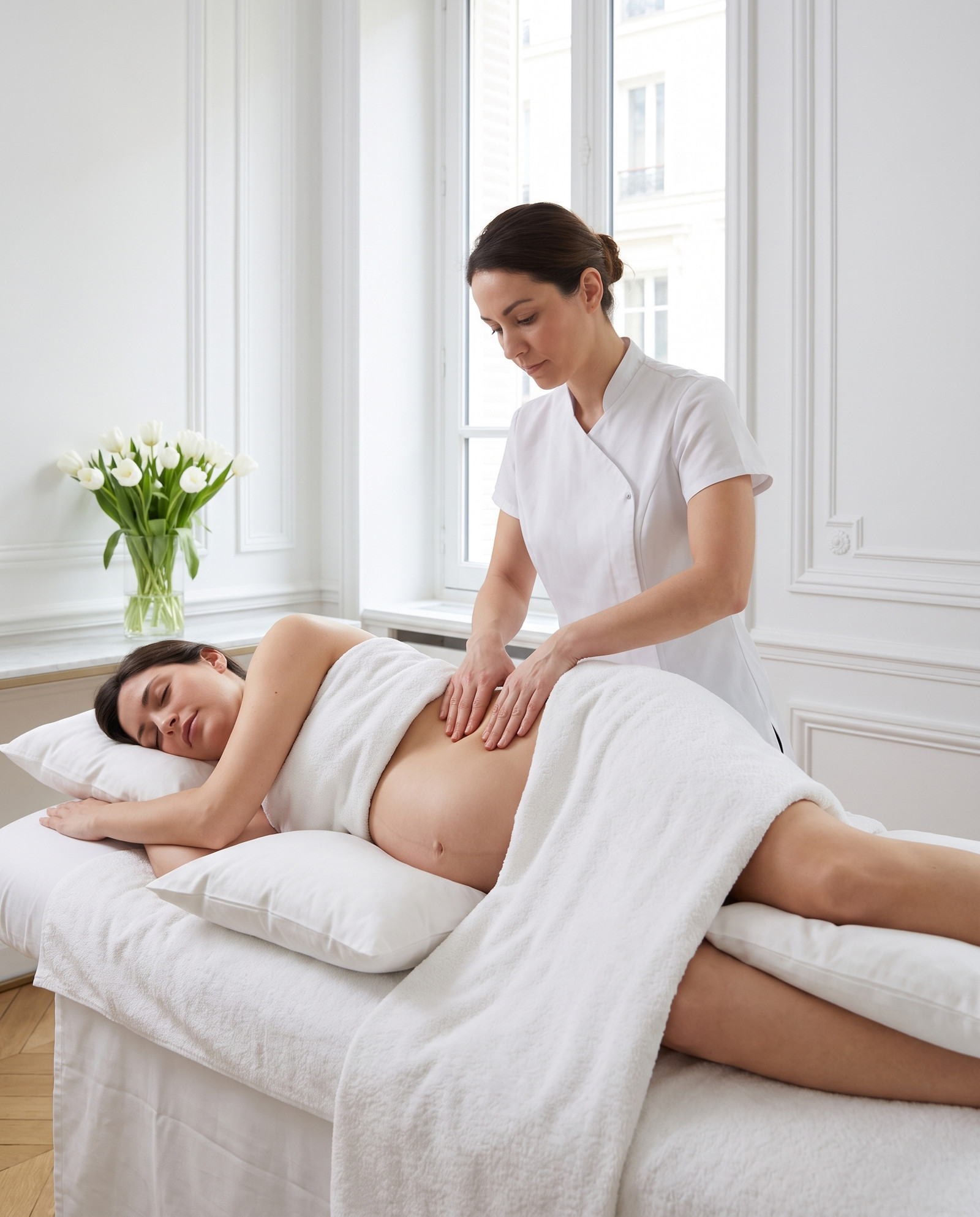
First you feel support, because good positioning precedes good pressure
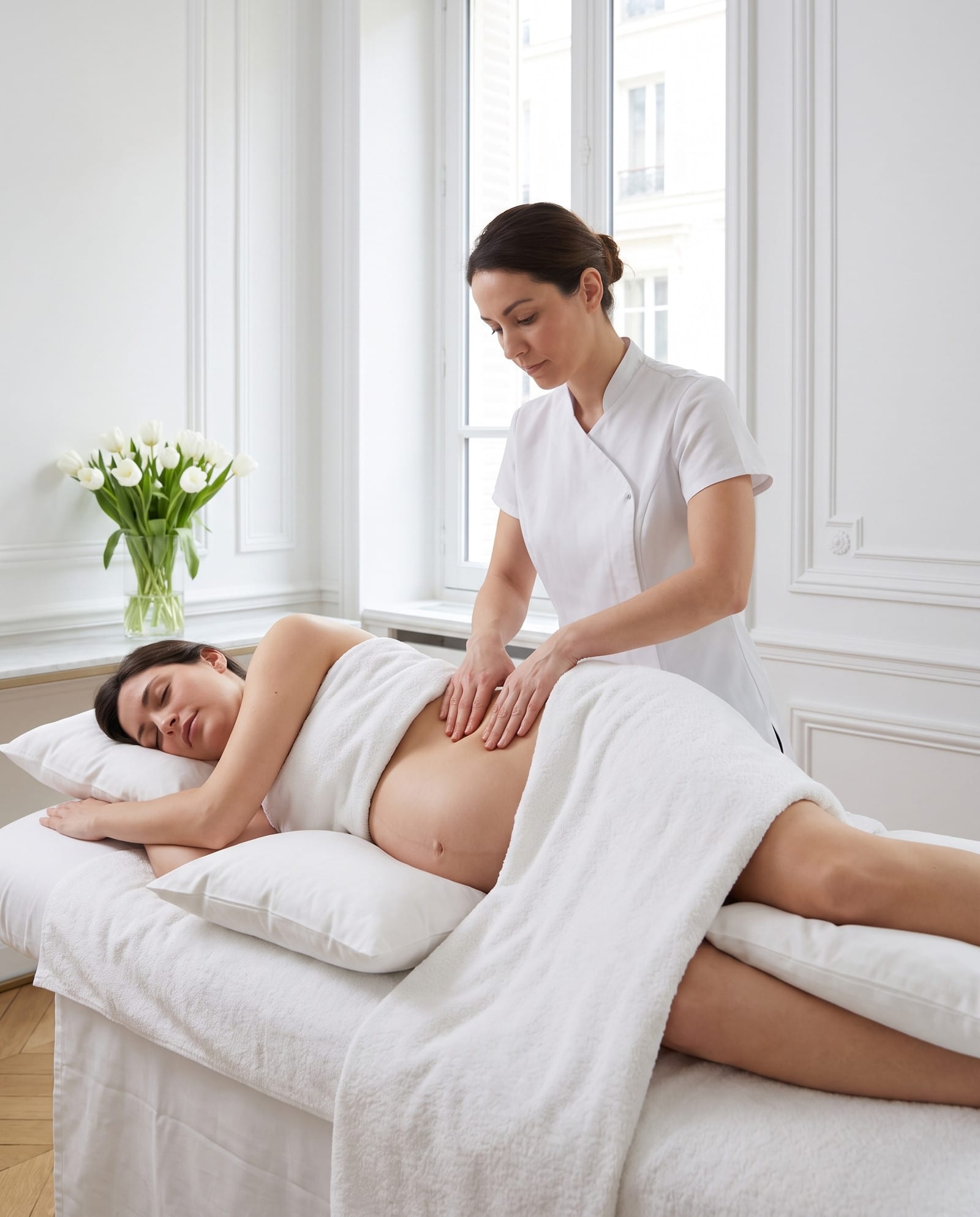
The session usually takes place on your side, with pillows stabilising your legs, abdomen and upper body. Your position should allow you to breathe freely and relax your muscles without the fear of rolling over with every movement of the therapist's hands. You may feel the weight of your body on your hip or shoulder, but not increasing numbness, tingling or joint pain. If the support is pressing on you, say so immediately. Adjusting a pillow is part of the treatment, not a disruption to the ritual.
As your pregnancy progresses, a position that worked a month ago may stop being comfortable. Do not try to fit your body into a fixed setup. The setup must be adapted to you. Your therapist should check your comfort before starting and again after you change sides. If you experience breathlessness, dizziness, nausea, sudden weakness or a feeling of fainting, the massage must be stopped and your position changed safely. Do not wait for your "body to get used to it".
The first touch should calibrate the pressure, not impose it immediately
Your sensitivity threshold can change from day to day. Fatigue, swelling, sleep quality, the stage of pregnancy and your general well-being affect your tolerance to touch. Therefore, a declaration from a previous visit is not valid indefinitely. Tell us how you feel today. A good therapist does not treat a request for a lighter technique as an obstacle, nor do they compare you to clients who prefer a stronger massage. Strength is not a measure of professionalism.
Pleasant pain is not necessary, and sharp pain means stop
Exercise particular caution with new pain for which the cause has not been explained. Do not ask for a "massage" of a unilaterally swollen and painful calf, acute abdominal pain or sudden back pain accompanied by other symptoms. These are situations for medical assessment, not for intensifying pressure. A cosmetologist performing a massage should not diagnose or assure you that every pain is solely muscle tension.
The warmth of hands and products should be neutral, not stifling or stinging
During the massage, you may feel the warmth of hands, covers and the glide product. It should remain pleasant. In pregnancy, it is easier to feel overheated, so ask for a lighter blanket, ventilation or a break if you feel breathless. Hot compresses and intense heating are not a requirement for prenatal massage. The mere fact that a salon calls something relaxing does not mean you have to endure a temperature that does not suit your well-being.
The abdomen should not be an area of deep work
Prenatal massage does not involve direct, strong pressure on the abdomen. Support may gently touch the skin, and changing sides requires natural movement of the torso, but there should be no feeling of compression. If anything presses on your abdomen or causes tension, say "stop". Your therapist should change your position without trying to convince you that the position is safe just because they use it for others.
Contractions, abdominal pain, bleeding, fluid leakage or other worrying obstetric symptoms are not a normal part of a massage. The treatment must be stopped and the contact instructions received from your pregnancy care team must be followed. Do not wait for the end of the session and do not try to determine the cause at the table. Massage may coincide with a symptom, but the salon is not the place to assess the safety of a pregnancy in such a situation.
Legs may feel relief, but swelling is not an invitation for strong pressure
For mild, bilateral heaviness in the legs, a gentle touch can be pleasant. This does not mean treating the swelling or giving permission for aggressive kneading. Pressure should be cautious, and your therapist must be aware of any varicose veins, history of thrombosis, circulatory disorders and current medical recommendations. If the skin is painful, very tight or one leg looks different from the other, an assessment of the cause is needed first.
Unilateral calf swelling with pain, redness or warmth, especially when combined with breathlessness or chest pain, requires urgent medical help. Do not try to check if a stronger massage will "get the circulation moving". This is an important boundary of sensations: heaviness that you know and have discussed is different from a new, sudden change. Your therapist should stop the procedure rather than mask an alarming symptom with relaxation.
Numbness in the arm or hip usually asks for a change of position
Lying on your side can eventually strain your shoulder, wrist, hip or ear. The first tingling is a signal to shift the support, change the angle or take a short break. Do not wait until the limb goes completely numb. Comfort is not about staying still for the entire session. You can move your foot, adjust your arm, sit up or change sides earlier. Good technique has room for these adjustments.
If numbness does not subside after changing position, intensifies or is accompanied by weakness, stop the massage and report the problem. Not every paraesthesia results solely from a pillow. A persistent symptom requires proper assessment. Conversely, short tingling that quickly disappears after relieving pressure is worth noting before your next visit so that different support can be used from the start to avoid repeating the same discomfort.
Breathing is a simple gauge of intensity
During a well-tailored massage, you should be able to breathe freely and answer in full sentences. If you hold your breath before every movement, clench your hands or count the seconds until the pressure ends, ask for a change. You do not need to use specialist terms. "Too strong here", "I need the pillow higher", "I'm feeling breathless" are full and sufficient messages. Your therapist should accept them without debating your pain threshold.
Sudden breathlessness, chest pain, fainting, strong palpitations or a feeling that something is clearly not in line with your norm means the session must be stopped. Do not try to "breathe through the pain" to finish the purchased time. Comfortable, deeper breathing may appear during relaxation, but massage does not treat respiratory disorders or the causes of heart palpitations. During pregnancy, the threshold for seeking help should remain in line with your doctor's recommendations.
Changing sides can be the most demanding moment of the session
Moving from one side to the other should be done without haste. First, the therapist moves the pillows, gives you space, and then sets up the support again. You may need to sit for a moment. Getting up in one sudden movement is not necessary. If you feel dizzy, stop in a safe position and wait for it to pass. Independence does not mean you have to cope without help.
After changing sides, comfort is checked anew. The other side of your body may have different sensitivity, swelling or tension. Do not assume that the pressure that was good before automatically fits now. Report if your lower arm is crushed, your hip hurts or the pillow does not support your abdomen comfortably. These adjustments do not shorten the value of the treatment; they allow it to be performed without unnecessary struggle with your position.
After a massage, mild tenderness should decrease, not build a history of effectiveness
After firmer work, muscles may be more noticeable, but the discomfort should be mild and gradually subside. A lack of tenderness does not mean the massage was too gentle. Extensive bruising, increasing pain, restricted movement or persistent numbness are not the expected "effect of deep work". In such cases, contact the salon, describe the area and the time the symptom appeared, and if the situation is serious — seek appropriate medical help.
Do not judge the entire session just a minute after getting off the table. Check how you feel after a few hours and the next day. If the lightness fades quickly, it does not automatically mean a mistake; daily burdens return. If, however, pain appears only later and increases, pass this information on before your next booking. Do not try to fix it with another massage without an explanation.
In Warsaw, choose a location where you can calmly discuss your position
J'adore operates at ul. Żelazna 59 and ul. Mińska 29A/46. Żelazna is open from Monday to Saturday from 8:00 to 21:00 and on Sunday from 11:00 to 19:00; Mińska from Monday to Saturday from 9:00 to 21:00. You can check the current description and availability on the prenatal massage in Warsaw page. When booking, state what stage of pregnancy you are in, what recommendations you have and whether lying on your side is currently difficult for you.
Prenatal massage is usually performed after the first trimester, after obtaining the consent of your pregnancy care provider. Consent alone does not remove the need for ongoing qualification. Bleeding, contractions, fever, suspected thrombosis, uncontrolled hypertension or other worrying symptoms may mean rescheduling the visit. Do not stop taking medication and do not hide symptoms just so the appointment can take place. Safety is more important than the continuity of the plan.
Before starting, establish a simple language of signals
- "Lighter" means an immediate reduction in pressure, without negotiation.
- "Pillow" means stopping and resetting the support.
- "Warm" means uncovering, ventilating or changing the product.
- "Stop" ends the movement and allows you to assess your well-being before making further decisions.
You do not need a code if communication is good, but such an agreement helps when you are lying on your side and do not want to explain things at length. Your therapist should also ask about your comfort instead of expecting you to report everything yourself. Silence does not always mean consent; it may stem from uncertainty about whether you are allowed to interrupt. A clear conversation before the first touch reduces this problem.
Before the massage, your skin suggests which places not to touch and how to guide the hands
Before applying the product, the cosmetologist examines the skin of your legs, back and areas accessible in the chosen position. They pay attention to visible, bulging veins, bruises, abrasions, fresh scars, sores and clearly reddened areas. Stretch marks in themselves do not exclude gentle contact, but the skin over them may be tight and more sensitive. If burning or discomfort appears when the hand is moved slightly, this is not an area for intense rubbing.
A well-felt massage leaves the body calmer, not defeated
During the session, you may feel firm, fluid pressure, the warmth of hands, skin movement and the gradual release of tension. You may also not feel a spectacular change. Both reactions are within the real range. However, there should be no sharp pain, abdominal pressure, increasing numbness, breathlessness or the need to grit your teeth. Proper intensity allows you to breathe and communicate at all times.
The most important question is not: "how much did I endure?", but: "was my body well supported, and were my signals heard?". Prenatal massage does not need pain to make sense. It needs current qualification, careful positioning and a person who knows how to change the plan. If something stops being comfortable, speak up immediately. This does not interrupt a good treatment. It is exactly what shows if it is being conducted well.